
 Worksheets
Free enterprise government and free enterprise
Total questions: 40
Worksheet time: 21mins
This is another name for capitalism
Free Contract
Free Enterprise
Infrastructure
Legal Equality
What is the name of the force that encourages people and organizations to improve their material well-being from economic activities?
Market Failure
Profit Motive
Positive Externality
Free Rider
What occurs when people who do not take part within an economic transaction benefit from it?
Negative Externality
A Modified Free Enterprise Comes into Play
Market Failure
Wellfare is revoked
What is a subsidy?
A government payment that helps cover the cost of an economic activity
A payment in which the government transfers income from taxpayers to recipients who do not provide anything in return
A product that is provided by a federal, state, and/or a local government and consumed by the public
A government program designed to protect people from economic hardships
What is an example of a negative externality?
Fewer Oil Rigs
Industrial Pollution
Less Toxic Waste
Smaller buildings
A system to protect people experiencing unfavorable economic conditions
innovation
standard of living
safety net
profit
Which is NOT an example of a public good?
police, fire, and ambulance services
an amusement park like Disney Land
public parks, sidewalks, roads
schools and libraries
The ability to decide for yourself which legal agreements you will enter into is called
a. profit motive
b. open opportunity
c. legal equality
d. free contract
Government programs designed to protect people from economic hardships
a. infrastructure
b. externality
c. safety net
d. public goods
e. subsidy
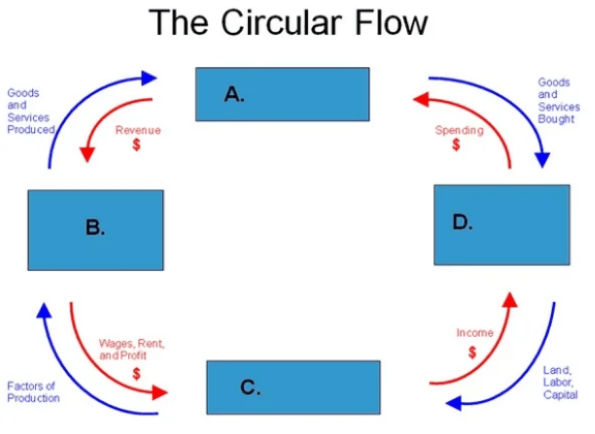
Point B represents
Product Market
Factor Market
Individuals
Businesses
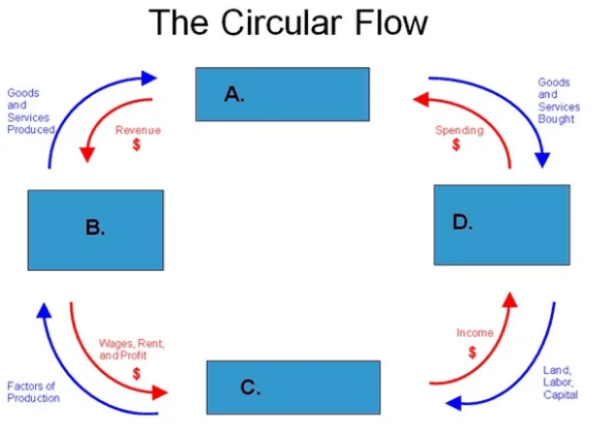
What does point A represent on the Circular flow diagram?
Households
Businesses
Factor Market
Product Market
A person stocks shelves at a grocery store and receives a wage. They have completed an exchange in which part of the circular flow model?
Individuals
Businesss
Factor Market
Product Market
Someone buys a car in exchange for a large amount of money. They have completed an exchange in which part of the circuclar flow model?
Product Market
Factor Market
Firms
Individuals
Money exchanged between businesses and individuals for labor.
wages
revenue
spending
profit
Health care left to the free-market (left to privately owned businesses to provide)
Capitalism
Socialism
Communism
United States is most like what type of economic system?
Capitalism
Socialism
Communism
The United States is best described as an example of a(n)...
pure capitalist economy
mixed-market economy
socialist economy
communist economy
What makes a Free Enterprise system Capitalist in nature
Anyone is free to start a business or enterprise
Everyone makes the same amount of money
Everyone must own a business
There is extreme government intervention
What is the ability of everyone to take part in the market by free choice?
Legal Equality
Free Contract
Profit Motive
Open Opportunity
What is another name for "a situation in which everyone has the same economic rights under the law"?
Positive Externality
Negative Externality
Legal Equality
Open Opportunity
What occurs when people who do not take part within an economic transaction benefit from it?
Negative Externality
A Modified Free Enterprise Comes into Play
Market Failure
Wellfare is revoked
What is infrastructure?
Consists of all the goods and services that are necessary for the functioning of society
Consists of all the government funding of goods and services for the poorer consumers
Consists of all the taxes that are used to pay for public transfer payments
Consists of all the goods and services that are extra within the functioning of society
What is the side effect of products and/or services that affect someone other than the producer or buyer?
Profit
Infrastructure
Subsidy
Externality
What is a subsidy?
A government payment that helps cover the cost of an economic activity
A payment in which the government transfers income from taxpayers to recipients who do not provide anything in return
A product that is provided by a federal, state, and/or a local government and consumed by the public
A government program designed to protect people from economic hardships
What is an example of a free rider?
A grandmother giving money to her graduating grandchild
Someone watching a fireworks display
Somebody splitting a hotel bill down the middle with another person
A child purchasing a powerup on Subway Surfers
Why do producers enter a Free Enterprise Economy?
To make products
To seek profit
To provide income to lower class consumers
To create services for people
What is a person who benefits from economic transactions they are not a part of?
Economist
Entrepreneur
Externality
Free Rider
People & Business can buy & sell their property as well as ban others from using it
Economic Freedom
Private Property
Competition
Self-Interest
Airbus receives ____ from government
subsidy
transfer payments
The role of the government is to impose ______ penalty on violators to prevent negative externalities.
taxes
penalties

government is ___ in product and resource markets
producer
consumer

Government receives from individuals and business
taxes
revenue
Government purchases mostly ___ in the resource market.
labor
land
capital
Money received from relatives
transfer payment
public transfer payment
Properties of public good
no one can be excluded
usage by one person does not decrease its value for others
funded by taxpayers
provided by private business
Person who bought a ticket to watch fireworks is a free rider
yes
no
Infrastructure includes
trains
buses
hospitals
sea ports
Governmental payments to poor to improve their wellbeing
welfare
donation

