
Font size
 Worksheets
EOC Standard 4
Total questions: 41
Worksheet time: 23mins
What was the main purpose of the first labor unions?
allow business owners to share information with each other
eliminate anarchists from the workplace
get better conditions and better pay for workers
provide labor when workers went out on strike
Which best explains the reason for the failure of the Populist Party?
Southern farmers supported political issues and candidates found in other parties.
The economic prosperity amongst farmers in the late 1800s made the party unnecessary.
The Democratic Party adopted several of the Populist Party's reforms
William McKinley's campaigning techniques appealed to Midwest farmers.
Who would most likely support William Jennings Bryan in the election of 1896?
a government official in Georgia
a farmer in Kansas who supported bimetalism
a merchant in New York
an industrial worker in Pennsylvania
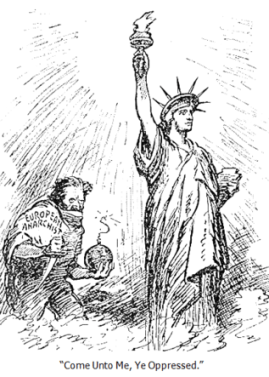
What kind of fears are reflected in the political cartoon?
communist fears of the free market
fears of international terrorism
fears of presidential scandals
nativist fears of immigrants
What is another word for "trust" as it is used in the phrase "anti-trust" laws?
demand
freedom
market
monopoly
The idea that business should be free from government regulation best represents which system?
Social Darwinism
capitalism
laissez-faire
socialism
Why do some historians label John D Rockefeller and other big businessmen of the Gilded Age as "Robber Barons"?
They mimicked the lifestyles of medieval lords.
Many owned large estates in the western part of the country.
Some stole large sums of money from the federal treasury.
They were ruthless competitors who cheated and exploited workers.
How did the ideas of Social Darwinism impact the economic culture of the United States in the late 1800s and early 1900s?
It justified the growth of large businesses at the expense of smaller businesses.
It promoted the use of government programs to improve the situation for poor citizens.
It led to the formation of labor unions as a way to improve working conditions.
It led to support for a private school system to give wealthy children the best education.
Why were many Americans opposed to labor unions in the late 1800s?
They believed unions were controlled by violent extremists.
They felt working conditions did not need to be improved.
They believed the government should implement wage controls.
They supported socialism as a way to equalize people.
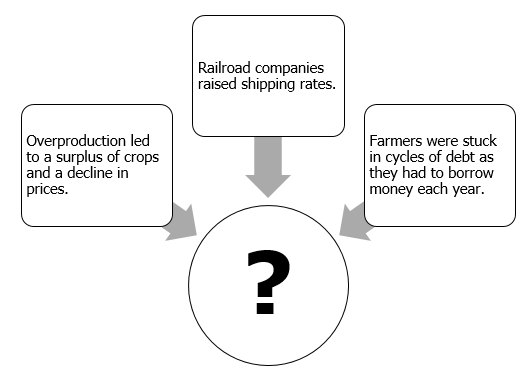
Which statement completes this chart?
Muckrakers published exposés that brought attention to the plight of farmers.
The federal government switched to the silver standard to help farmers.
The Grange Movement advocated that the government raise tariffs to help farmers.
The Populist Party was formed to address the issues that affected farmers.
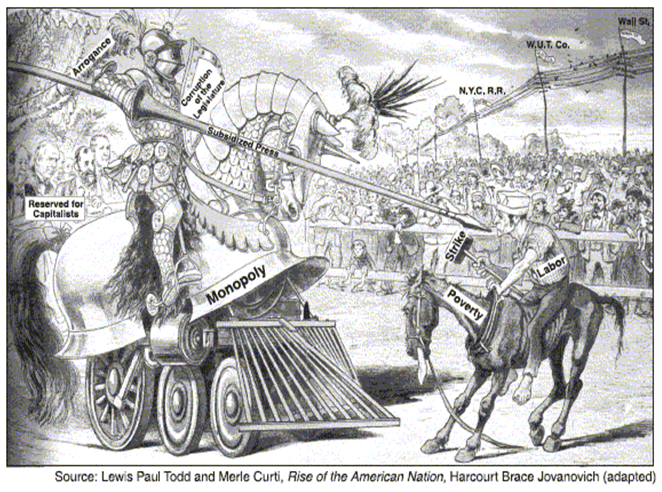
What conclusion can be drawn from this cartoon?
Labor unions are unlikely to win against big businesses.
Labor unions are often corrupt and arrogant.
Large corporations are not prepared to fight against labor unions.
Large corporations use tools like the strike to destroy labor unions.

Which individual would support this slogan?
a labor union member
a factory owner
a city official
an industrialist
_________________ dominated the steel industry during the late 1800s.
Andrew Carnegie
John D Rockefeller
JP Morgan
Donald Trump

The technique used by Andrew Carnegie to dominate the steel industry.
Bessemer Process
Grange Process
Trust
Gospel of Wealth
A major objective of the Sherman Anti Trust Act was to
Create more competition in the United States between businesses
Limit the power of the government
Allow for larger corporations to dominate the market
Eliminate competition within the oil and steel industry
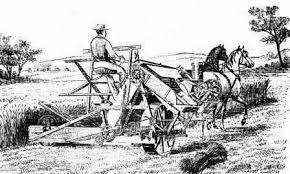
In the mid 1800s the mechanical reaper allowed farmers to become more efficient in their farming but also
allowed for overproduction
made them become better mechanics
increased the demand for gasoline
created less of a demand for horses
The Progressive Era was an attempt by activist to (choose all that are correct)
Improve conditions in urban areas
Clean up and expose Political Machines and their corruption
Support William "the boss" Tweed in his political en devours
Help farmers gain equal representation in politics
Progressives attempted to expose
The corruption in cities
The inequalities of minorities
Imperialist for not being democratic
Those that were supporting Communist in the U.S.
One objective of the Hull House was to
Stop the spread of communism within urban areas
Help immigrants assimilate and become educated in the United States
Help get William Tweed re-elected
Train nurses during WWI
Immigrants during the late 1800s were attracted to cities because
Cities had jobs
Cities had the best tenement housing conditions
Cities were the safest place to live
Immigrants could only live in cities due to labor laws
Why did many immigrants support political machines?
They helped them move out of the cities and find real estate in the country
They helped immigrants return to their native land
They provided them with jobs, shelter and opportunities
They spoke their native language
Which of the following are impacts of industrialization in the late 1800's?
Tenement Housing
Poor working conditions
Influx of immigrants into cities
Movement toward an agrarian society
Ethnic neighborhoods provided all of the following
Common food from their homeland
Ability to use their native language
Ability to practice their native customs in their neighborhood
Safety from Nativists
One objective of man of the Muckrakers in the early 1900s was to
Expose those involved in the Red Scare
Gain political support from Tammany
Support the activities of Tweed
Expose corruption within the Political Machines
Muckrakers attempted to bring to light
The horrible working conditions of immigrants
Corruption in Politics
Issues on the farms
Corruption within Ellis Island
3 Industries that benefited from the expansion of the Railroads
Oil, Steel and mining
Oil, Steel and Lumber
Gold, Service and Advertising
Tourism, Cotton and Steel
Unions provided all of the following to workers
Better pay
Better working conditions
Shorter Hours
Strength in numbers
Reason for Unions to dislike "SCABS"
weakened unions
took jobs away from union workers
SCABS were robber barrons
SCABS were from the farm
What is the main idea of the "Gospel of Wealth"?
The government should not burden the rich with heavy taxes.
Children should inherit a parent's wealth so that it stays within the family.
It is dangerous to pass along wealth to those not equipped to manage it.
All charitable donations should be given directly to the people who need it.
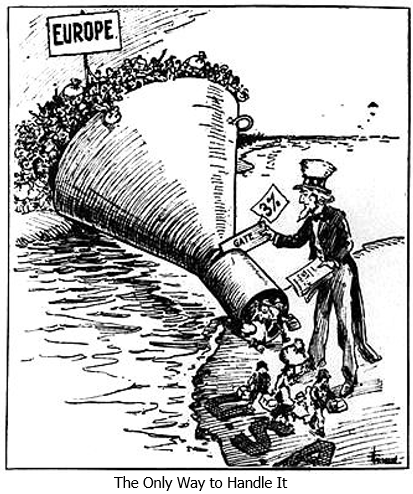
Why did the United States pursue the policy demonstrated in this cartoon?
to find a safer method of transport for people crossing the Atlantic Ocean
to improve relations with European countries
to limit the number of immigrants that entered the United States
to create an easier process for becoming an American citizen
to combat racial discrimination, racial violence, and segregation in the United
States?

