
 Worksheets
Science Unit 7 Reviewer
Total questions: 93
Worksheet time: 48mins
a star that is the center of our solar system; provides Earth energy
the Moon
the Sun
Mars
Saturn
to spin on an axis
orient
revolve
rotate
compass
to move in an orbit around another object in space
revolve
orbitation
rotate
orientation
what the side of Earth experiences when it is facing the sun; the time between sunrise and sunset on Earth
shadows
night
day
what the side of Earth experiences when it is not facing the sun; the time between sunset and sunrise on Earth
day
night
an imaginary line around which a mass, like a planet, rotates
equator
Prime Meridian
longitude
axis
a device that uses the position of shadows cast by the sun to tell the time of day
compass
sundial
shadow clock
pendulum
an area that observes a uniform standard time
time frame
end zone
time zone
When the sun is rising in New York, what is happening on the opposite side of the world?
The sun is also rising.
It's the middle of the day (noon).
The sun is setting.
The Sun circles Earth once every day.
true
false
When are shadows the longest?
morning
afternoon
evening
sunrise and sunset
There are some places on Earth that do not receive any daylight at certain times of the year.
true
false
In the morning, where do shadows always appear?
north
east
south
west
The Earth is tilted.
true
false
a star that is the center of our solar system; provides Earth energy
the Moon
the Sun
Mars
Saturn
to spin on an axis
orient
revolve
rotate
compass
to move in an orbit around another object in space
revolve
orbitation
rotate
orientation
Day and night on Earth occurs due to _____.
the rotation of the Earth
the tilt of the Earth's axis as it revolves around the Sun
the revolution of the moon around Earth
the rotation of our moon
Which diagram best explains why the sun appears to move across the sky each day?
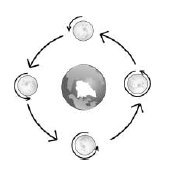


Gravity is a _____ that _____
2 objects towards one another.
thing
reaches
energy
pushes
force
pulls
weight
takes

Which of these has the strongest gravity?
Earth
Moon
Jupiter
Sun
Venus

What keeps the planets in orbit around the sun?
gravity
friction
magic
distance
an imaginary line around which an object spins
Axis
revolution
waning
phase
growing larger, as when the moon goes from the new moon phase
to the full moon phase
waxing
tides
lunar eclipse
revolution
the blocking of the sun's light by the moon from places on Earth
solar eclipse
waning
tilt
rotation
a slant
tilt
waxing
tides
rotation
the movement of one body in space around another body
revolution
lunar eclipse
axis
phase
the blocking of the sun's light by Earth from the moon
lunar eclipse
waning
tilt
revolution
a changing pattern of light on the moon as seen from Earth
phase
tides
revolution
solar eclipse
the daily rise and fall of the level of the ocean
tides
waning
rotation
axis
the spinning of an object on an axis
rotation
phase
lunar eclipse
axis
growing smaller, as when the moon goes from the full moon phase
to the new moon phase
waning
revolution
tides
solar eclipse
l. When the moon is __________, the lighted part of the moon
from Earth is growing.
waxing
waning
Like Earth, the moon rotates on an _________.
phase
axis
A year is the time it takes Earth to make one ____________
around the sun.
revolution
rotation
The new moon is a _________ in which the moon is between Earth
and the Sun.
phase
tilt
During a ______________, the full moon looks dark
for a short time.
lunar eclipse
solar eclipse
Every day, ocean _______ can be seen near the shore.
rotation
tides
After the full moon, the light on the moon begins _________.
waning
waxing
When the moon moves between Earth and the sun, it can cause
a __________________.
solar eclipse
lunar eclipse
How long does it take the moon to orbit the earth?
1 year/ 365 days
1 day/ 24 hours
29 days
1 hour

How do we see the moon?
The earth's light reflects on the moon
The sun's light reflects on the moon

When the moon gets larger it is ______________.
waxing
waning

When the moon is getting smaller it is ________________.
waxing
waning

When the moon cast a shadow on earth it is called _________________.
new moon
full moon
lunar eclipse
solar eclipse

When we can see the whole moon it is a ____________________.
full moon
new moon
solar eclipse
lunar eclipse

A hole in the ground on the moon is called a _________________.
crater
asteroid
rock
meteoroid
Meteoroids hitting the moon has caused the craters.
true
false
There is air and water on the moon
true
false
What is the object that orbits the earth in 29 days?
earth
moon
sun
How many planets are there in the solar system?
6
8
9
14
The ____ are the four planets closest to the Sun
outer planets
gas giants
inner planets
larger
The inner planets rotate _____ than the outer planets.
more slowly
more quickly
more frequent
less frequent
The outer planets are ____ than the inner planets,
smallest
larger
slower
rocky
The outer planets are also called ________.
terrestrial planets
larger planets
gas giants
farthest planets
The outer planets have thick atmospheres of ____ and ______.
oxygen and helium
carbon dioxide and helium
hydrogen and nitrogen
Hydrogen and helium
The four inner planets are:
Jupiter, Saturn, Uranus and Neptune
Mercury, Venus, Earth and Pluto
Mercury, Venus, Earth and Mars
Jupiter, Saturn, Neptune and Pluto
The four outer planets are:
Jupiter, Saturn, Uranus and Neptune
Mercury, Venus, Earth and Pluto
Mercury, Venus, Earth and Mars
Jupiter, Saturn, Neptune and Pluto
The ______ do not have solid surfaces and have a small, rocky core.
outer planets
terrestrial planets
inner planets
smallest
The outer planets are also called ________.
gas giants
terrestrial planets
inner p[lanets
smallest
The outer planets are made of _____.
rock and ice
rock and metals
gas
ice
What planet do we live on?
Mars
Venus
Earth
Saturn
What planet is closest to the sun?
Neptune
Mercury
Mars
Venus
What planet has thousands of beautiful, tiny rings made of chunks of ice and rock?
Jupiter
Saturn
Uranus
Neptune
Which is the hottest planet?
Mercury
Venus
Earth
Mars
Which is the smallest planet?
Neptune
Jupiter
Mercury
Mars
Which is the farthest planet from the sun?
Uranus
Saturn
Jupiter
Neptune
What planet is known as the red planet because of its red looking surface?
Earth
Uranus
Saturn
Mars
Which of the following lists the correct order of the planets from the sun?
Mercury, Venus, Mars, Earth, Jupiter, Saturn, Uranus, Neptune
Mercury, Venus, Earth, Mars, Jupiter, Saturn, Uranus, Neptune
Mercury, Venus, Earth, Mars, Saturn, Jupiter, Uranus, Pluto
Mars, Venus, Earth, Mercury, Jupiter, Saturn, Uranus, Neptune
What are the changing shapes of the Moon called?
Plants
Phases
Orbits
Spins
Objects in space made up of hot gases, like the sun, are called...
Planets
Moons
Rocks
Stars
Where does the light of the Moon come from?
The Earth
Its own gases
The Sun
Saturn

How many moons does Earth have?
1
2
3
4
What is the shape of planetary orbits?
Elliptical
Circular
Hexagonal
Cubic
What is the difference between revolution and rotation?
Rotation is going around another object and revolution is spinning in place.
These words mean the same thing.
Rotation is spinning on an axis and revolution and going around another object.
Rotation is when an object moves and revolution is when an object stops moving.
Earth's rotation is about how long?
22 hours
8 hours
16 hours
24 hours
Which of the following is responsible for the seasons on Earth?
Revolution and tilt of the axis
Rotation and tilt of the axis
Revolution only
Rotation only
Which is the largest planet in our solar system?
Earth
Jupiter
Mercury
Neptune
Between which two planets is the asteroid belt?
Earth and Mars
Jupiter and Saturn
Mercury and Venus
Mars and Jupiter
What is the force called that governs all planetary motion?
Gravity
Work
Revolution
Dark Side
Which group of planets are known as the outer planets?
Mercury, Venus, Earth, and Mars
Mars, Jupiter, Saturn, and Uranus
Jupiter, Saturn, Uranus, and Neptune
Earth, Mars, Jupiter, and Saturn
In which direction do planets revolve around the sun?
Clockwise
Counter-clockwise
What is the degree of Earth's tilt?
20.5 degrees
25 degrees
23.5 degrees
33 degrees
Which is found in the belt between Mars and Jupiter
Comets
Asteroids
Meteors
Stars
I am a rock entering a planet's atmosphere.
meteor
moon
asteroid
comet
The shape of comet's paths are ________________.
circular
elliptical
irregular

A meteor when it burns in the atmosphere is also known as a ____.
rock
shooting star
ball of ice

A meteoroid is found
in Space
entering earths atmosphere
impacting earths surface
Choose the best description for a meteoroid...
-burns up while entering earths atmosphere
-hits earth surface
-still in space

