
 Worksheets
Scientists and History of Atomic Structure
Total questions: 51
Worksheet time: 46mins
Subatomic particles with a negative charge
Electrons
Neutrons
Protons
Quarks

All matter is made of atoms
Rutherford
Bohr
Democritus
Dalton
Elements are made of tiny solid particles
Bohr
Democritus
Thomson
Aristole
Most mass in an atom is in the nucleus
Rutherford
Thomson
Bohr
Dalton
Positively charged atoms with electrons. "Plum pudding"
Democritus
Bohr
Thomson
Dalton
electrons travel in fixed orbits
Dalton
Bohr
Thomson
Rutherford
Small dense nucleus in atom that is surrounded by electrons
Heisenberg
Shrodinger
Thomson
Rutherford
Rutherford's "gold-foil" experiment using alpha particle scattering concluded that
the center of the atom is empty
atomic mass is spread over the whole atom
the center of the atom has a negative charge
most of the atom is empty
Found that atoms are tiny, hard, and uncuttable.
Schrodinger
Rutherford
Democritus
Thomson
Believed atoms were solid, indivisible spheres.
Dalton
Rutherford
Bohr
Democritus

What is the smallest particle of an ELEMENT, and it has also all the properties of it?
Molecules
Nucleus
Subatomic particle
Atoms
What is the small, DENSE REGION consisting of protons and neutrons at the CENTER of an atom?
Molecules
Nucleus
Subatomic particle
Atoms


What is the outside of an atom called?
nucleus
electron cloud
nuclei
core


1s22s22p63s23p64s23d10

1s22s22p63s2
Choose the correct shortcut configuration for iodine.
[Ar]4s24d104p5
[Kr]5s24d105p5
[Xe]5s25d105p5
none of the above
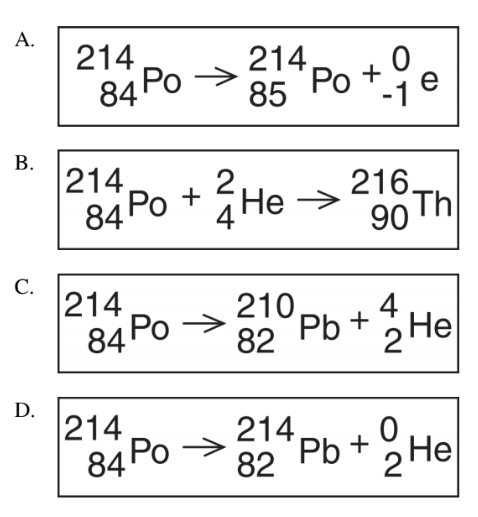
Which equation correctly represents the alpha decay of polonium-214?
A
B
C
D
The three main types of nuclear radiation are alpha, beta, and gamma. Which of the following lists these types of radiation from highest penetrating power to lowest penetrating power?
alpha, gamma, beta
beta, alpha, gamma
beta, gamma, alpha
gamma, beta, alpha

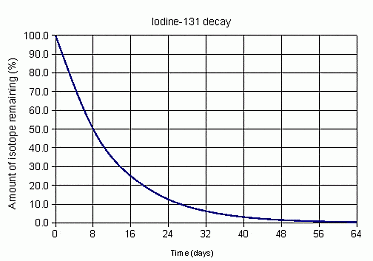

What is the only difference between two different isotopes of the same element?
Number of neutrons
Number of protons
Number of electrons
Size of atom

This type of element is dull, brittle solids and gases, insulators, poor conductors of heat and electricity, as well as having low melting points.
metals
metalloids
nonmetals
The elements in this family are soft, silvery, and very reactive with water.
Alkaline Earth Metals
Alkali Metals
Transition Metals
Lanthanides

How many VALENCE ELECTRONS does Chlorine have?
2
7
8
10
17

Name this ionic compound: Al2O3
Dialuminum oxide
Aluminum oxygen
Oxygen Aluminide
Aluminum oxide

Anions ____ electrons, becoming _____ charged.
Gain; positively (+)
Gain; negatively (-)
Lose; positively (+)
Lose; negatively (-)

Cations _______ electrons, becoming _______ charged.
Gain; positively (+)
Gain; negatively (-)
Lose; positively (+)
Lose; negatively (-)

Metals (like Na) typically _____ electrons in the formation of ionic bonds.
Gain
Lose
Keep the same

Using the model, write the chemical formula for an ionic compound that has Mg and Cl.
MgCl2
Mg2Cl2
Mg+2Cl-1
Mg2Cl2
What is the average mass of this element?

The hyphen notation of an atom of calcium with 20 protons, 20 electrons, and 22 neutrons is
calcium - 20
calcium - 40
calcium - 62
calcium - 42

