
 Worksheets
Unit 3 Exam 3 Review (Biology)
Total questions: 51
Worksheet time: 56mins
Organisms that make their own food
Producer
Consumer
Decomposer
Organisms that obtain energy by feeding on other organisms
Producer
Consumer
Decomposer
Organisms that break down wastes and dead organisms and return the raw materials to the environment
Producer
Consumer
Decomposer
Consumers that feed on the bodies of dead organisms
Carnivores
Omnivores
Herbivores
Scavengers
Consumers that eat both plants and animals
Omnivores
Carnivores
Herbivores
Scavengers
A food _______ is a series of events in which one organism eats another and obtains energy.
chain
web
pyramid
plate
As you work your way up the energy pyramid, what happens to the energy?
It increases
It decreases
It stays the same
Nothing

In the energy pyramid, what is the bottom level composed of?
Producers
First-Level Consumers
Second-Level Consumers
Third-Level Consumers
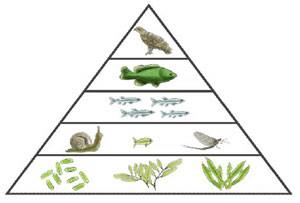
In the energy pyramid, what comes after the producers?
Producers
First-Level Consumers
Second-Level Consumers
Third-Level Consumers
How much energy is available to be passed on to the next level in a food web?
100%
10%
50%
75%
Glucose is broken down into pyruvic acid during which process
what are the outputs of glycolysis?
CO2
Pyruvic acid x 2
H2O
ATP
What role do NADH and FADH2 (produced during Glycolysis and Kreb's Cycle) play in cellular respiration
they are energy carriers (hydrogen)that use that energy to produce massive amounts of ATP
They are waste products and are pushed out of the cell
They are necessary for long-term energy storage
They don't play any role in cellular respiration
What happens in the electron transport chain?
NADH and FADH2 drop off hydrogens to form massive amounts of ATP
pyruvic acid is formed from breaking down glucose
CO2 is released and H2O and ATP
glucose is broken down and ATP is formed
Where do the reactions of photosynthesis take place in autotrophs?
Chloroplast
Mitochondria
Cell Walls
Cytoplasm
Where does the energy for plants to perform photosynthesis come from?
Breaking down ATP
sunlight
glucose metabolism
None of the Above
Photosynthesis is a biological process that occurs in autotrophs. Which of the following is produced as a result of photosynthesis?
Water and light
Glucose and chlorophyll
Glucose and oxygen
Carbon dioxide and water
What is the chemical equation for photosynthesis? Choose the BEST answer
C6H12O6 + O2 -> CO2 + H2O
CO2 + H2O --> C6H12O6 + O2
6 CO2 + 6 H2O --> C6H12O6 + 6 O2
C6H12O6 + 6 O2 -> 6 CO2 + 6 H2O
What is the pigment responsible for absorbing light energy in chloroplasts during photosynthesis?
None of the Above
Carotenoids
Xenophylls
Chlorophyll
Cellular Respiration involves the chemical breakdown of _____ to form ATP Energy
Fats
Fructose
Glucose
Proteins
Where do the reactions of Aerobic respiration take place? (Krebs Cycle & Electron Transport Chain)
Cytoplasm
Mitochondria
Chloroplasts
Cell Wall
oxygen and carbon dioxide
light and water
What does aerobic mean?
without ATP
without oxygen
with ATP
with oxygen
Where does anaerobic respiration occur in the cell?
cytoplasm
nucleus
mitochondria
chloroplast
What does anaerobic mean?
without oxygen
with oxygen
without ATP
with ATP
What does a plant take IN to start photosynthesis?
oxygen
carbon dioxide
glucose
lipids
What does a plant give OFF in photosynthesis?
water, sunlight
glucose, oxygen
oxygen, water
glucose, carbon dioxide
A light-dependent reaction requires sunlight AND:
glucose
water
ATP
oxygen

What cycle are fossil fuels part of ?
carbon
oxygen
nitrogen
phosphorus
What is the largest reservoir for nitrogen?
the ocean
rocks and minerals
the atmosphere
bacteria
The carbon in coal, oil, and natural gas came from
the combustion of fossil fuels
the remains of dead organisms
carbon-fixing bacteria in swamp soil
carbon dioxide dissolved in ocean water
Nitrogen fixation is the process in which certain bacteria convert nitrogen gas into
liquid nitrogen
nitrates
nitrites
ammonia
The water cycle is driven by
water
wind
the sun
Earth's rotation
A place where matter/nutrients are collected/stored.
A lake
A reservoir
A cloud
The atmosphere
When water is heated in the ocean by the sun and turns into water vapor
Condensation
Evaporation
Transpiration
Human activity can increase CO2 levels in the atmosphere through
Photosynthesis
Burning of fossil fuels
Planting more trees
Removing nitrogen from fertilizer.

Nitrogen in the atmosphere is unusable. What form is nitrogen in the atmosphere?
Nitrites
Ammonia
Nitrates
N2 gas
Denitrifying bacteria
Turn nitrogen gas into nitrates so that plants can synthesize amino acids.
Turn nitrates into nitrites so that nitrogen fixing bacteria can synthesize DNA.
Returns nitrogen into the atmosphere in the form of N2 gas.
Use phosphorus as fertilizer.
The Carbon Cycle has the greatest impact on ______________ on Earth
Living organisms
Climate change
Plants
The sun
Which of these nitrogen cycle processes converts atmospheric nitrogen to a soil form of nitrogen that is usable by plants?
nitrogen fixation
nitrification
denitrification
ammonification
assimilation
If the plant population decreased, the amount of carbon in the atmosphere would _________.
Stay the same
Increase
Decrease

