
Font size
 Worksheets
Control and Coordination - Unit 15
Total questions: 60
Worksheet time: 36mins
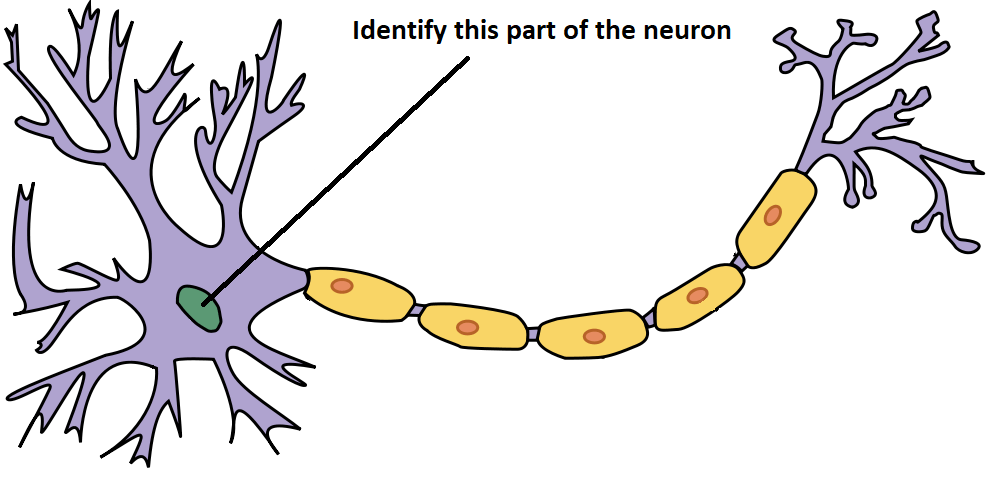
Identify the part pointed.
Nucleus
Cell Body
Axon
Node of Ranvier
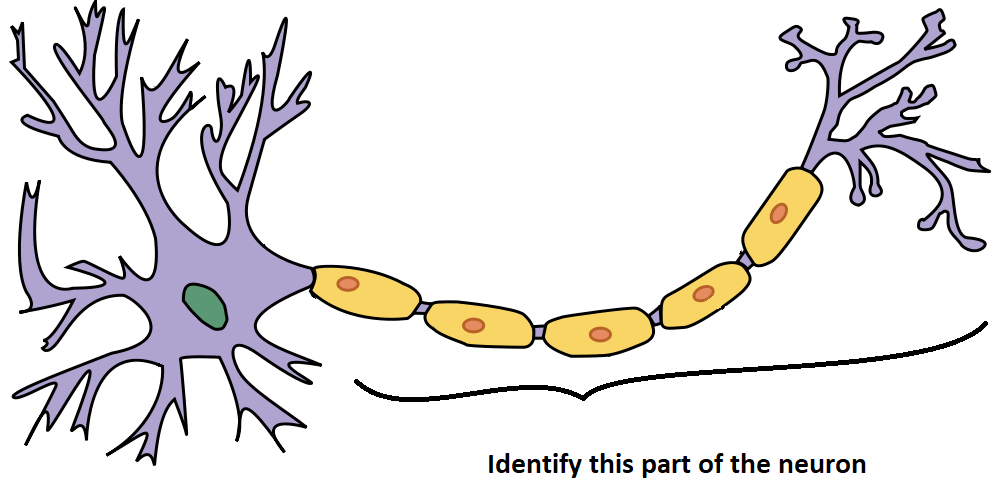
Nucleus
Cell Body
Axon
Node of Ranvier
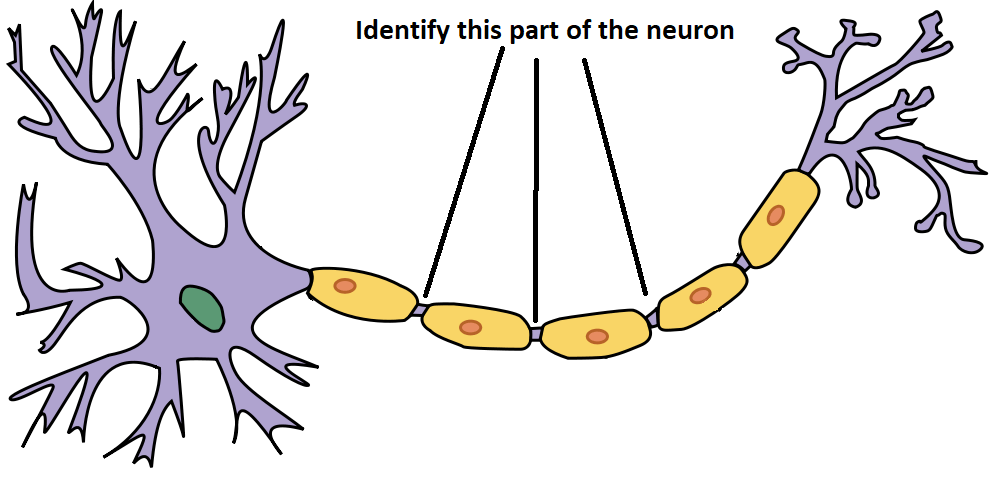
Nucleus
Cell Body
Axon
Node of Ranvier
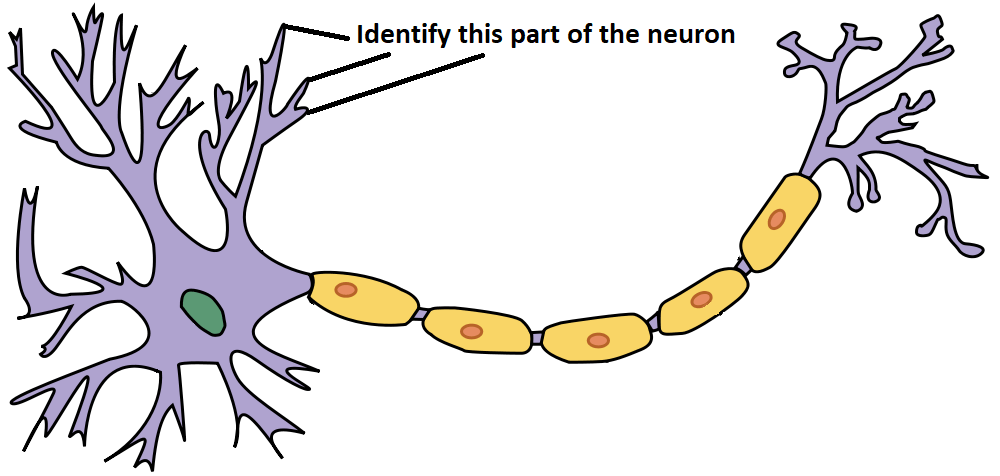
Dendrites
Axon Terminals
Myelin Sheath
Schwann Cells
What direction foes the electrical signal travel through the neuron?
From dendrites, down the Axon, and out Axon terminals
From Axon terminals, down the Axon, & out of the dendrites
Any direction up or down the cell
From the Axon, to the Dendrites, and out the Axon terminals
What is the generalised order during a nervous response?
Receptor → stimulus → neurones → effector → response
Response → receptor →neurones → effector → stimulus
Stimulus → receptor → neurones → effector → response
Stimulus → effector → neurones→ receptor → response
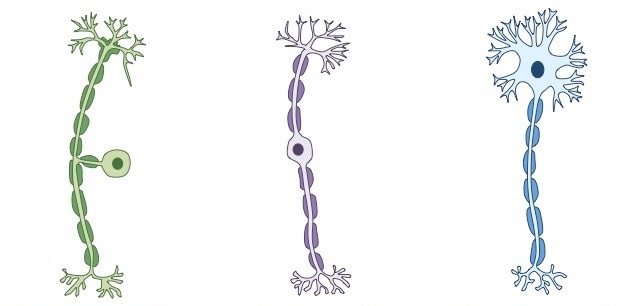
What type of neurone is shown on this picture as green?
Sensory
Relay
Motor
Synapse
When the axon is in resting potential, the inside has a negative charge.
True
False
A resting axon have ___ potential difference.
+70 mV
-70 mV
-50 mV
+30 mV
__________ is attached to the Z line?
myosin
actin
thick filament
troponin
What is the contractile unit formed from Z line to Z line?
Sarcomere
T Tubule
Sarcoplasmic reticulum
Fascicle
____________ attaches to actin to form the cross bridge.
Troponin
Tropomyosin
Myosin/ myosin head
Calcium
The H zone changes size during a muscle contraction.
True
False

The I band is labeled here as _______.
AD
AC
BC
AB
The A band is labeled here as _______.
AD
AC
BC
AB
The myosin is labeled here as _______.
BD
AC
BC
AB
The Z line is labeled here as _______.
BD
AC
AE
AB
A sarcomere is labeled here as _______.
BD
BC
AE
AB
What is released from the sarcoplasmic reticulum?
Inorganic phosphate
ADP
Calcium
ATP
The only energy source that can be used to directly power muscle contraction is
acetylcholine (Ach)
ATP
cross bridges
neuromuscular junction
Which two structures block the active site on an actin filament?
fascicle & actin
actin & perimysium
troponin & tropomyosin
actin & myosin
A muscle fiber cannot contract until _______________ rushes into the cell to remove the blocking molecules and make the active site available to be engaged.
Calcium
ATP
Myosin
Sarcomere
When a myosin head engages with the active site on the other filament, this is known as a(n)
Sarcomere
Z-line
cross-bridge (power stroke)
M line

This image shows a ________?
Sarcomere
Fascicle
Neuromuscular Juntion
Prime mover
The name for the very narrow gap between the two cells in a synapse:
synaptic cleft
electrical synapse
chemical synapse
ganglion
A chemical released by neurons into a synapse to send a signal to another cell:
synaptic vesicle
electrical synapse
neurotransmitter
action potential
The channels that are opened by an action potential reaching an axon terminal, sending the final trigger to release neurotransmitters:
ligand-gated sodium channels
ligand-gated potassium channels
voltage-gated calcium channels
voltage-gated potassium channels

What's in the picture?
synaptic vesicles
neurotransmitters
presynaptic neuron
postsynaptic neuron
synaptic cleft

What's in the picture?
synaptic vesicles
neurotransmitters
presynaptic neuron
postsynaptic neuron
synaptic cleft

What's in the picture?
synaptic vesicles
neurotransmitters
presynaptic neuron
postsynaptic neuron
synaptic cleft

What's in the picture?
synaptic vesicles
neurotransmitters
presynaptic neuron
postsynaptic neuron
synaptic cleft
Chemicals released into a cleft when an action potential reaches the terminal are called.....
ligand gated ion channels
synaptic vesicles
neurotransmitters - acetylcholine
voltage gated ion channels
Which side of the synapse contains neurotransmitters?
presynaptic
postsynaptic
both
Which is the correct order/sequence of the parts of a neuron in a neural impulse?

what might be a job of a motor neuron?
connecting to a muscle and helping you move
connecting within the brain to help you make a decision
sending a message toward your brain from a pain receptor in your skin
all of these

Myelin would be which color of structure?
the red one
the blue one
the green one
the purple one

This is made up of the brain and spinal cord
Central Nervous System (CNS)
Peripheral Nervous System (PNS)
Autonomic nervous system
Somatic nervous system

What is the function of Schwann cells?
Conduct impulses
Phagocytosis
Make up the myelin sheath
Slow conduction

All the parts of the nervous system except the brain and spinal cord.
Central Nervous System (CNS)
Peripheral nervous system (PNS)
Autonomic nervous system
Somatic nervous system
Depolarization occurs when
sodium channels open
potassium channels open
sodium channels close
potassium channels close

Depolarization is occuring at number
1
2
4
5
Which of the following uses ACTIVE transport?
sodium-potassium pump
sodium channel
potassium channel
diffusion


What number on the graph represents the refractory phase?
Why is -55 mV a significant number?
Which one of the following is involved in maintaining a resting membrane potential?
Na+/K+ ATPase pump moves 3Na+ in for every 2K+ out
Na+/K+ ATPase pump moves 3K+ in for every 2Na+ out
Na+/K+ ATPase pump moves 3Na+ out for every 2K+ in
Na+/K+ ATPase pump moves 3K+ out for every 2Na+ in
Non-myelinated axons have a way to prevent sodium channels from opening after an action potential has passed. What is this called?
Repolarization
Nerve impulse
Refractory period
Saltatory conduction
During depolarization, ________ ions move into the axon.
Sodium
Potassium
Calcium
Iron
During repolarization, _________ ions move out of the axon.
Sodium
Potassium
Calcium
Iron
Which of the following is correct about refractory period? [check all that applies]
it ensures that action potentials are discrete events, no overlapping
it happens when repolarisation starts and ends when resting potential is reestablished
it ensures that the impulse can only travel in one direction
all of the above
During depolarization, which channels are open?
Voltage - gated Na+
Voltage - gated K+
Na/K proton pumps
All of the above
During resting period, which of the following is true?
3 Na+ are pumped out
2 K+ are pumped in
both K+ and Na+ voltage gated channels are closed
all of the above
Steroid hormones are lipid soluble and can pass through the phospholipid bilayer.
True
False
In seed germination, gibberellin is produced by the embryo when water comes in the seed.
True
False
Muscle cells are multinucleated.
True
False

