
 Worksheets
Sex-linked Traits and Pedigrees
Total questions: 57
Worksheet time: 34mins
Name
Class
Date
1.
Which of the following is NOT a sex-linked trait?
a)
Color-blindness
b)
Muscular Dystrophy
c)
Huntington disease
d)
Hemophilia
2.
How many PAIRS of sex chromosomes do humans have?
a)
23
b)
46
c)
1
d)
2
3.
I have 2 X chromosomes. What am I?
a)
Male
b)
Female
4.
I have 1 X chromosome and 1 Y chromosome. What am I?
a)
Male
b)
Female
5.
If a gene is found only on the X chromosome and not the Y chromosome, it is said to be what?
a)
sex-linked trait
b)
polygenic trait
c)
codominant trait
d)
incomplete dominance trait
6.

What percentage of the offspring will have this recessive disease?
a)
0%
b)
25%
c)
50%
d)
75%
7.

What percentage of the female offspring will be a carrier for this recessive disease?
a)
0%
b)
50%
c)
100%
d)
25%
8.
Hemophilia is a recessive x-linked disorder.
Which genotype represents a female who is a carrier for hemophilia?
Which genotype represents a female who is a carrier for hemophilia?
a)
XHXh
b)
XhXh
c)
XHXH
d)
XhY
9.
Hemophilia is a recessive x-linked disorder.
Which genotype represents a male with hemophilia?
Which genotype represents a male with hemophilia?
a)
XHXh
b)
XhXh
c)
XHY
d)
XhY
10.
Colorblindness is a recessive x-linked disorder.
Which genotype represents a male with normal vision?
Which genotype represents a male with normal vision?
a)
XNXN
b)
XnXn
c)
XNY
d)
XnY
11.
Colorblindness is a recessive x-linked disorder.
Which genotype represents a female who is colorblind?
Which genotype represents a female who is colorblind?
a)
XNXn
b)
XnXn
c)
XNXN
d)
XnY
12.

Which of the following genotypes belongs in the red box in the Punnett square?
a)
XBXb
b)
XbXb
c)
XbY
d)
XBY
13.
If a woman is a carrier for a sex linked recessive trait of hemophilia and her husband has hemophilia, which of the following is true? Make a punnett square!
a)
All sons will have hemophilia
b)
all daughters will have hemophilia
c)
50% of daughters and 50% of sons have hemophilia
d)
100% of sons have hemophilia and 100% of daughters are carriers
14.

Which of the following genotypes belongs in the red box in the Punnett square?
a)
XBXb
b)
XbXb
c)
XBXB
d)
XbY
15.

In fruit flies, red eye color (R) is a sex-linked trait that is dominant over white eye color (r).
According to the Punnett square, what percentage of female offspring will have red eyes?
According to the Punnett square, what percentage of female offspring will have red eyes?
a)
0%
b)
25%
c)
50%
d)
100%
16.

In fruit flies, red eye color (R) is a sex-linked trait that is dominant over white eye color (r).
According to the Punnett square, what percentage of offspring will have white eyes?
According to the Punnett square, what percentage of offspring will have white eyes?
a)
0%
b)
25%
c)
50%
d)
100%
17.

Duchenne muscular dystrophy is a recessive x-linked disorder.
According to the Punnett square, what percentage of male offspring will have the disorder?
According to the Punnett square, what percentage of male offspring will have the disorder?
a)
0%
b)
25%
c)
50%
d)
100%
18.

Duchenne muscular dystrophy is a recessive x-linked disorder.
According to the Punnett square, what percentage of offspring will have the disorder?
According to the Punnett square, what percentage of offspring will have the disorder?
a)
0%
b)
25%
c)
50%
d)
100%
19.

Hemophilia is a recessive x-linked disorder. According to the Punnett square, what percentage of offspring will have the disorder?
a)
0%
b)
25%
c)
50%
d)
100%
20.

Hemophilia is a recessive x-linked disorder. According to the Punnett square, what percentage of offspring will have the disorder?
a)
0%
b)
25%
c)
50%
d)
100%
21.

Which individual in the first generation is a carrier?
a)
The male
b)
The female
c)
individual 1
d)
None of the above
22.

How many kids did the mother and father from the first generation have?
a)
2
b)
4
c)
5
d)
6
23.

How many boys did the mother and father from the first generation have?
a)
2
b)
4
c)
5
d)
6
24.

How many girls did the mother and father from the first generation have?
a)
2
b)
4
c)
5
d)
6
25.

In the second generation-how many people have the disease or display the physical trait?
a)
2
b)
4
c)
5
d)
6
26.

In the second generation-how many people are carriers of the trait?
a)
2
b)
3
c)
5
d)
6
27.

How many individuals are there in the 3rd generation?
a)
2
b)
3
c)
4
d)
6
28.

How many kids did individual one and two (from the second generation) have?
a)
2
b)
3
c)
4
d)
6
29.

How many people in this whole pedigree have the trait/disease?
a)
2
b)
3
c)
4
d)
6
30.

How many people in the pedigree are carriers for the disorder?
a)
6
b)
8
c)
2
d)
9
31.

Looking at this pedigree, how many family members have the disease?
a)
4
b)
7
c)
All
d)
None
32.

In the second generation-how many people have the disease or display the physical trait?
a)
2
b)
4
c)
5
d)
6
33.

How many kids did the mother and father from the first generation have?
a)
2
b)
4
c)
5
d)
6
34.

How many generations are shown in this pedigree?
a)
1
b)
2
c)
3
d)
4
35.

What do half colored symbols represent?
a)
The individual is a carrier.
b)
The individual expresses the trait.
c)
The individual has both recessive alleles.
d)
The individual has both dominant alleles.
36.
In a pedigree, what shape represents a male?
a)
circle
b)
square
c)
triangle
d)
diamond
37.

How many people in the pedigree are carriers for the disorder?
a)
6
b)
8
c)
2
d)
9
38.

Examine the pedigree. The allele for the presence of a widow’s peak is dominant. Therefore, we can tell from the chart that in the couple labeled 2:
a)
the male is heterozygous and the female is homozygous.
b)
the male is homozygous and the female is heterozygous.
c)
the male is homozygous and the female is homozygous.
d)
the male is heterozygous and the female is heterozygous.
39.

The genotype of the affected son and daughter at the bottom of this pedigree...
a)
could be homozygous dominant
b)
could be homozygous recessive
c)
could be heterozygous
d)
Can't tell
40.

a)
Not affected Female
b)
Not affected Male
c)
Affected Male
d)
Affected Female
41.

What do half colored symbols represent?
a)
The individual is a carrier.
b)
The individual expresses the trait.
c)
The individual has both recessive alleles.
d)
The individual has both dominant alleles.
42.

a)
Not Affected Male
b)
Not Affected Female
c)
Affected Male
d)
Affected Female
43.

a)
Not affected male
b)
Not affected female
c)
Affected male
d)
Affected female
44.

a)
Not affected male
b)
Not affected female
c)
Affected male
d)
Affected female
45.
What does a vertical line coming down from a square and circle that are connected by horizontal line indicate?
a)
They are cousins
b)
The children
c)
Aunts and Uncles
46.

How many generations are shown in this pedigree?
a)
1
b)
2
c)
3
d)
4
47.

Which members of the family above are afflicted with Huntington's Disease?
a)
I-1, II-2, II-3, II-7, and III-3
b)
I-1, I-2, II-3, II-7, and III-5
c)
I-1, I-3, II-8, and III-2
d)
I-2, II-1, II-4, II-5, II-6, II-8, III-1, III-2, III-4, and III-5
48.
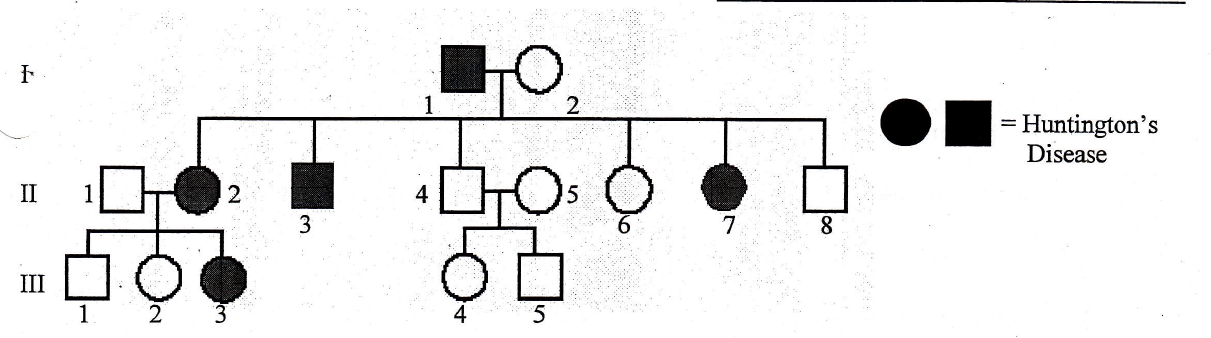
There are no carriers for Huntington's Disease- you either have it or you don't. Is Huntington's disease caused by a dominant or recessive trait?
a)
Dominant
b)
Recessive
49.

How many of II-1 and II-2's girls have Huntington's?
a)
1
b)
2
c)
3
d)
4
50.

Which gender can be carriers of colorblindness and not have it?
a)
Just males
b)
Just females
c)
Both genders
51.

What kind of trait is colorblindness if females can be carriers without having the disease?
a)
Autosomal trait
b)
Sex-linked trait
52.

Why do all the daughters in Generation II carry the colorblind gene?
a)
Because mom passed on the gene.
b)
Because dad passed on the X chromosome.
c)
Because their brother has it.
d)
Because their brother gave it to them.
53.

Name 2 IV generation colorblind males.
a)
IV-1 and IV-2
b)
IV-1 and IV-6
c)
IV-5 and IV-8
d)
IV-1 and IV-5
54.

Give the genotype for person III-3
a)
GG
b)
Gg
c)
gg
55.
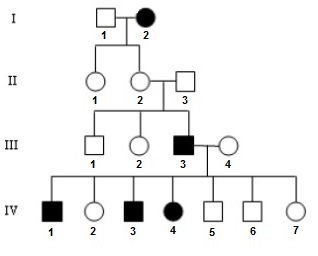
If hemophilia is a sex-linked recessive trait, what genotype would individual IV-2 have?
a)
XBXb
b)
XbXb
c)
XBY
d)
XbY
56.
If hemophilia is a sex-linked recessive trait, what genotype would individual III-3 have?
a)
XBXb
b)
XbXb
c)
XBY
d)
XbY
57.

What type of trait is shown in the pedigree? (look at the difference between males and females)
a)
Autosomal Recessive
b)
Sex-Linked Recessive
c)
Autosomal Dominant
d)
Sex-linked Dominant
100 %

