Wayground logo

Free Printable Worksheets

Font size

S
M
L
XL
Worksheets

Algebra 2 Test 7 Review: Piecewise Functions

Total questions: 108

Worksheet time: 3hrs 1mins

Name
Class
Date
1.
What is g(7) if:
a)
-17
b)
-13 
c)
13       
d)
17
2.
What is f(-2)?
a)
4
b)
1
c)
1
d)
DNE
3.

Find f(0)

a)

-3

b)

18

c)

4

d)

0

4.

Match the graph with the correct equation.

a)
b)
c)
d)
5.

Find h(5) using the equation.

a)

-25

b)

25

c)

3

d)

7

e)

undefined

6.
Evaluate the function when x = 6 
a)
f(6) = -5
b)
f(6) = 4
c)
f(6) = 2
d)
f(6) = 7
7.

What is g(-2) if:

a)

-7

b)

7

c)

1

d)

-1

8.
What is g(4) if:
a)
-17
b)
-13 
c)
13       
d)
-5
9.

Find the value of f(−8)f\left(-8\right) .

a)

2121  

b)

−8-8  

c)

00  

d)

99  

10.

Evaluate f(3)=

a)

-1

b)

-7

c)

4

d)

5

11.

Evaluate f(-3)=

a)

-1

b)

-7

c)

4

d)

5

12.

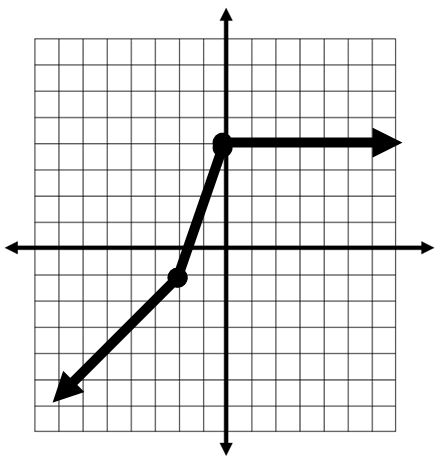
How many "pieces" are graphed in this function?

a)

1

b)

2

c)

3

d)

4

13.

A house painter charges $12 per hour for the first 40 hours he works, $18 for the ten hours after that, and $24 for all hours after that.


How much does he earn for a 70 hour week?

a)

$1020

b)

$1140

c)

$840

d)

He works for free!

14.

Graph

a)
b)
c)
d)
15.
What is the domain restriction of the blue piece of this function?
a)
x > 0
b)
x ≥ 0
c)
x > 2
d)
x ≥ 2
16.

What is the domain interval for the green piece of this function?

a)

-2 < x ≤ 1

b)

-1 < x ≤ 0.5

c)

x > -2

d)

x ≤ 1

17.
What is the value of f(0)?
a)
-2
b)
2
c)
4
d)
0
18.
Which piecewise function corresponds to this graph? (Take your time)
a)
f(x) = { x  if x < 4;   -x+1  if x ≥ 4
b)
f(x) = { x  if x ≤ 4;  -x+1  if x > 4
c)
f(x) = { -x+1  if x < 4;  x  if x ≥ 4
d)
f(x) = { -x+1  if x ≤ 4;  x if x > 4
19.

Which graph matches:

-x+4 if x<2

2x-6 if x>=2

a)

A

b)

B

c)

C

d)

D

20.

Using the pictured graph, what is the domain of the red line? 

a)

x<3

b)

-3≤x≤1

c)

x>1

d)

x≤-3

21.

Using the pictured graph, what is the equation of the blue line? 

a)

12x +3\frac{1}{2}x\ +3  

b)

xx  

c)

-1

d)

-x

22.
What are the domain restrictions for the middle piece of this function?
a)
x ≥ 1
b)
x ≥ 2
c)
2 ≤ x < 6
d)
1 ≤ x < 3
23.

Which piecewise function matches this graph?

a)
b)
c)
d)
24.
What is the RANGE of the function?
a)
(-∞, +∞)
b)
(-∞, 4]
c)
(-∞, 4)
d)
[0, 4]
25.

Identify the domain.

a)

x∈Rx\in R  

b)

−4≤x≤4-4\le x\le4  

c)

−4<x<4-4<x<4  

d)

−3≤x≤2-3\le x\le2  

26.

Identify the range.

a)

y∈Ry\in R  

b)

y≤2y\le2  

c)

−3≤y<2-3\le y<2  

d)

−3≤y≤2-3\le y\le2  

27.

Identify where the graph is increasing.

a)

none 

b)

−4<x<−1-4<x<-1   

c)

−4≤x≤−1-4\le x\le-1   

d)

−4≤x<3-4\le x<3   

28.

Identify where the graph is decreasing.

a)

none 

b)

−4<x<−1-4<x<-1   

c)

−1<x<3-1<x<3    

d)

x>3x>3    

29.

Identify where the graph is constant.

a)

none 

b)

−4<x<−1-4<x<-1   

c)

x>−1x>-1     

d)

−1<x<4-1<x<4     

30.

Identify the domain.

a)

x∈Rx\in R  

b)

x<−2  or  x>3x<-2\ \ or\ \ x>3    

c)

x<−2   or  −2≤x<3x<-2\ \ \ or\ \ -2\le x<3      

d)

x<1  or  2<x<5x<1\ \ or\ \ 2<x<5      

31.

Identify the range.

a)

y∈Ry\in R  

b)

y≤5y\le5     

c)

y<1  or  y≥−1y<1\ \ or\ \ y\ge-1       

d)

2<y≤5  or  y≥−12<y\le5\ \ or\ \ y\ge-1       

32.

Identify where the graph is increasing.

a)

x∈Rx\in R  

b)

x<−2  or  x>3x<-2\ \ or\ \ x>3     

c)

x<0  or  x>3x<0\ \ or\ \ x>3       

d)

x>3x>3        

33.

Identify where the graph is decreasing.

a)

x∈Rx\in R  

b)

x<−2x<-2     

c)

0<x<30<x<3        

d)

x>3x>3        

34.

Identify where the graph is constant.

a)

0<x<30<x<3   

b)

none     

c)

x∈Rx\in R         

d)

−2<x<0  or  x>3-2<x<0\ \ or\ \ x>3          

35.

Which best describes the domain of the graph?

a)

x∈Rx\in R   

b)

x<−1,x<-1,    1<x<3,1<x<3,  

or x≥3x\ge3  

c)

x≤−1  or  x≥1x\le-1\ \ or\ \ x\ge1   

d)

x<−1  or  x≥1x<-1\ \ or\ \ x\ge1   

36.

Which best describes the range of the graph?

a)

y∈Ry\in R   

b)

y<2,y<2,    2<y<6,2<y<6,  

or y≤2y\le2  

c)

y<6y<6   

d)

y<−1,y<-1,   

2≤y<6,2\le y<6,  

or y≥3y\ge3  

37.

What is the domain and range of the function?

a)

Domain: x∈Rx\in R  

Range:  y∈Ry\in R  

b)

 Domain: −5≤x≤5-5\le x\le5  

Range: y∈Ry\in R  

c)

Domain: x∈Rx\in R  

Range:  y≤4y\le4  

d)

Domain: x∈Rx\in R  

Range:   y<4y<4  

38.

Which below is TRUE?

a)

Domain: x∈Rx\in R Constant: −1<x<1-1<x<1  

b)

Range: y∈Ry\in R   

Constant: −1≤x≤1-1\le x\le1  

c)

Domain: x∈Rx\in R   Decreasing: x≤−1x\le-1

d)

Range: y∈Ry\in R  

  Increasing: x≤−1  or  x≥1x\le-1\ \ or\ \ x\ge1  

39.

At what approximate time did d=22 miles ?

a)

1.47 hours

b)

7.5 hours

c)

2 hours

d)

3 hours

40.

This graph shows the weight of a puppy over a 6-month period. Did the puppy's weight increase faster at the start or end of the six months?

a)

The puppy grew faster at the start of the six months.

b)

The puppy grew faster at the end of the six months.

c)

There's no way to tell from the graph.

d)

The puppy grew the same at the start and end of the six months.

41.
Which piecewise function corresponds to this graph? (Take your time)
a)
f(x) = { x  if x < 4;   -x+1  if x ≥ 4
b)
f(x) = { x  if x ≤ 4;  -x+1  if x > 4
c)
f(x) = { -x+1  if x < 4;  x  if x ≥ 4
d)
f(x) = { -x+1  if x ≤ 4;  x if x > 4
42.

Which piecewise function matches this graph?

a)
b)
c)
d)
43.

Is this a function? Explain.

a)

No. Does not pass the vertical line test.

b)

No. Does not pass the horizontal line test.

c)

Yes. Passes the vertical line test.

d)

Yes. Passes the horizontal line test.

44.
a)
$12.75
b)
$35
c)
$45
d)
$27.75
45.
a)
$12.75
b)
$35
c)
$43.40
d)
$27.75
46.
How much does it cost to make 300 photocopies?
a)
$24.00
b)
$20.00
c)
$40.00
d)
$300.00
47.

Does it cost to more to make 500 or 550 photocopies?

a)

500 photocopies cost more

b)

550 photocopies cost more

c)

It costs the same

d)

$35.00

48.
If a lawyer charges $120 an hour (or any fraction of an hour), how much is a bill for 3 hours and 20 minutes?
a)
$420
b)
$480
c)
$400
d)
$360
49.
If a lawyer charges $120 an hour (or any fraction of an hour), how much is a bill for 3 hours and 20 minutes? What is the equation for this problem?
a)
l(x) = 120x
b)
l(x) = 120[x-1]
c)
l(x) = 120[x]
d)
l(x) = 120[x+1]
50.

Match the graph with the correct equation.

a)
b)
c)
d)
51.
Pick the correct graph
a)
A
b)
B
c)
C
d)
D
52.
If a lawyer charges $120 an hour (or any fraction of an hour), how much is a bill for 3 hours and 20 minutes?
a)
$420
b)
$480
c)
$400
d)
$360
53.

During which interval is the bicyclist moving the fastest?

a)

0≤t≤20\le t\le2

b)

2≤t≤42\le t\le4

c)

4≤t≤74\le t\le7

d)

1≤t≤31\le t\le3

54.

What is the domain of the for the following piecewise function?

a)

(−∞, +∞)\left(-\infty,\ +\infty\right)

b)

[−6, +∞)\left[-6,\ +\infty\right)

c)

(−∞,−5)∪[−3, +∞)\left(-\infty,-5\right)\cup\left[-3,\ +\infty\right)

d)

[−5, 3)\left[-5,\ 3\right)

55.

What is the range for the following piecewise function?

a)

(−∞, −5]\left(-\infty,\ -5\right]

b)

[−3, +∞)\left[-3,\ +\infty\right)

c)

[−6, +∞)\left[-6,\ +\infty\right)

d)

(−∞, +∞)\left(-\infty,\ +\infty\right)

56.

What is the range of this piecewise function?

a)

[-3, 3]

b)

[-3] U [0] U [3]

c)

(-3, 3)

d)

(-3) U (0) U (3)

57.

What is the domain of this piecewise function?

a)

(-∞, ∞)

b)

[-3] U [0] U [3]

c)

[-5, 5]

d)

(-3) U (0) U (3)

58.

Which statement is FALSE?

a)

-4 is included in the domain, but 4 is not

b)

The interval of decrease is (-4, 0)

c)

The interval of increase is (-1, 2)

d)

The interval of increase is (0, 2)

59.

Where are the discontinuities of this function, if any exist?

a)

at x = -3 and x = 1

b)

at x = -3

c)

at x = 1

d)

there aren't any

60.

What is the DOMAIN?

a)

(-∞, +∞)

b)

(-∞, -1] U [3, +∞)

c)

[-1, +∞)

d)

(-∞, -1) U (-1, +∞)

61.

Which "piece" of the function would you use to evaluate the piecewise function for  f(−4).f\left(-4\right).  

a)

−2x+1-2x+1

b)

5x−45x-4

62.

Evaluate the piecewise function for  f(0)f\left(0\right)   . Type only the number in the answer.


(a)  

63.

Evaluate the piecewise function for f(−3)f\left(-3\right)  . Type only the number in the answer.


(a)  

64.

Evaluate the piecewise function for f(0)f\left(0\right)  . Type only the number in the answer.


(a)  

65.
What is the DOMAIN?
a)
(-∞, +∞)
b)
(-∞, 1)
c)
(-∞, 1]
d)
(-∞, 0) U (0, +∞)
66.
What is the RANGE?
a)
(-∞, +∞)
b)
(-∞, 1)
c)
(-∞, 1]
d)
(-∞, 0) U (0, +∞)
67.
What is the DOMAIN?
a)
(-∞, +∞)
b)
(-2, +∞)
c)
[-2, +∞)
d)
(-∞, 0) U (0, +∞)
68.
What is the RANGE?
a)
(-∞, +∞)
b)
(-2, +∞)
c)
[-2, +∞)
d)
(-∞, 0) U (0, +∞)
69.

What is the DOMAIN?

a)

(4, +∞)

b)

[4, 10)

c)

[-8, 10]

d)

[4, 10]

e)

(-8, 10)

70.

What is the RANGE?

a)

(4, +∞)

b)

[4, 10)

c)

[-8, 10]

d)

[4, 10]

e)

(-8, 10)

71.

What is the DOMAIN?

a)
(-∞, +∞)
b)

(3, +∞)

c)

[-7, +4)

d)

(-∞, 3]

e)

(-∞, 3)

72.

What is the RANGE?

a)
(-∞, +∞)
b)

(3, +∞)

c)

[-7, +4)

d)

(-∞, 3]

e)

(-∞, 3)

73.
What is the DOMAIN?
a)
(-∞, +∞)
b)

(-∞, 7]

c)

(-∞, 7)

d)

(-7, 7)

e)

(-4, 7)

74.

What is the RANGE?

a)
(-∞, +∞)
b)

(-∞, 7]

c)

(-∞, 7)

d)

(-7, 7)

e)

(-4, 7)

75.
What is the DOMAIN?
a)
(-∞, +∞)
b)

(-∞, 1)

c)

(-1, +∞)

d)

[-1, +∞)

e)

(-∞, 1]

76.

What is the RANGE?

a)
(-∞, +∞)
b)

(-∞, 1)

c)

(-1, +∞)

d)

[-1, +∞)

e)

(-∞, 1]

77.

Name the location of a jump discontinuity for the function f (x). Enter it in the form x = number.

(a)  

78.

Does the function have a jump discontinuity?

a)

Yes

b)

No

79.

How many jump discontinuities does the function have?

(a)  

80.

This piecewise function is:

a)

Continuous

b)

Discontinuous

c)

Neither continuous nor discontinuous

d)

Both continuous and discontinuous

81.

The function is:

a)

Continuous

b)

Discontinuous

c)

Neither continuous nor discontinuous

d)

Both continuous and discontinuous

82.

How much would you pay for 35 minutes of play at The Strike Zone?

a)

$35

b)

$27.75

c)

$45

d)

$12.75

83.

Describe the transformation(s) in the following function.

f(x)=45∣x+5∣+2f\left(x\right)=\frac{4}{5}\left|x+5\right|+2  

a)

Vertical stretch by a factor of 45\frac{4}{5}  ,

Shift left 5 units,

Shift down 2 units

b)

Vertical compression by a factor of 45\frac{4}{5}  ,

Shift right 5 units,

Shift up 2 units

c)

Vertical stretch by a factor of 45\frac{4}{5}  ,

Shift right 5 units,

Shift up 2 units

d)

Vertical compression by a factor of 45\frac{4}{5}  ,

Shift left 5 units,

Shift up 2 units

e)

Vertical compression by a factor of 45\frac{4}{5}  ,

Shift left 5 units,

Shift down 2 units

84.
Describe the transformation of y = f(x) for the new function
 y = f(x) + 5
a)
The graph of y = f(x) was shifted to the right 5 units. 
b)
The graph of y = f(x) was shifted to the left 5 units. 
c)
The graph of y = f(x) was shifted up 5 units. 
d)
The graph of y = f(x) was shifted down 5 units.
85.
Describe the transformation of y = f(x) for the new function
 y = f(x) - 5
a)
The graph of y = f(x) was shifted to the right 5 units. 
b)
The graph of y = f(x) was shifted to the left 5 units. 
c)
The graph of y = f(x) was shifted up 5 units. 
d)
The graph of y = f(x) was shifted down 5 units.
86.
Describe the transformation of y = f(x) for the new function
 y = 5f(x)
a)
The graph of y = f(x) compressed horizontally by a factor of 1/5
b)
The graph of y = f(x) was stretched horizontally by a factor of 5
c)
The graph of y = f(x) was compressed vertically by a factor of 1/5
d)
The graph of y = f(x) was stretched vertically by a factor of 5
87.
Describe the transformation of y = f(x) for the new function
 y = 1/5f(x)
a)
The graph of y = f(x) compressed horizontally by a factor of 1/5
b)
The graph of y = f(x) was stretched horizontally by a factor of 5
c)
The graph of y = f(x) was compressed vertically by a factor of 1/5
d)
The graph of y = f(x) was stretched vertically by a factor of 5
88.
Describe the transformation of y = f(x) for the new function
 y = - f(x)
a)
The graph of y = f(x) was flipped vertically across the x axis. 
b)
The graph of y = f(x) was flipped horizontally across the y axis.
c)
The graph of y = f(x) was shifted down.
d)
The graph of y = f(x) was shifted up
89.
Describe the transformation of y = f(x) for the new function
 y = f(- x)
a)
The graph of y = f(x) was flipped vertically across the x axis. 
b)
The graph of y = f(x) was flipped horizontally across the y axis.
c)
The graph of y = f(x) was shifted down.
d)
The graph of y = f(x) was shifted up
90.
Describe the transformation of y = g(x) for the function
y = 3g(x - 3) + 5
a)
Shifted up 5 units
Shifted right 3 units
Stretched vertically by a factor of 3
b)
Shifted up 5 units
Shifted left 3 units
Stretched vertically by a factor of 3
c)
Shifted down 5 units
Shifted left 3 units
Stretched vertically by a factor of 3
d)
Shifted down 5 units
Shifted left 3 units
Stretched vertically by a factor of 1/3
91.

Which of functions represents the graph?

a)
b)
c)
d)
e)

None of these

92.

Postage rates on envelopes are a great example of step functions. There is a fixed price for a certain range of weights and then another fixed price for another range of weights, etc. Below is the graph of one such price structure.


According to this graph, what would be the postage rate on a letter weighing 1.5 ounces?

a)

$0.50

b)

$0.70

c)

$1.00

d)

$1.10

e)

$0.90

93.

Is this a function?

(a)  

94.

Select all names for the function

a)

Round Down Function

b)

Round Up Function

c)

Floor Function

d)

Ceiling Function

e)

Greatest Integer Function

95.

Select all names for the function

a)

Floor Function

b)

Greatest Integer Function

c)

Ceiling Function

d)

Round Down Function

e)

Round Up Function

96.

Evaluate f(2.7)

a)

2

b)

3

c)

2.5

d)

2.7

97.
How much does it cost to rent the Karaoke machine for 3 days?
a)
$50
b)
$100
c)
$150
d)
$175
98.

Sketch the graph of the function.

a)

A

b)

B

c)

C

d)

D

99.
Sketch the graph of the function.
a)
A
b)
B
c)
C
d)
D
100.

Evaluate

f(2)f\left(2\right)  

a)

1

b)

0

c)

2

d)

3

101.

Evaluate f(1.9)f\left(1.9\right)  

a)

1

b)

2

c)

1.5

d)

3

102.

⌈623⌉\lceil6\frac{\text{2}}{\text{3}}\rceil =

a)

5

b)

6

c)

7

d)

6.66

e)

Does not exist

103.

⌈9.33⌉\lceil9.33\rceil =

a)

8

b)

9

c)

10

d)

9.5

e)

Does not exist

104.

⌈−1.6⌉\lceil-1.6\rceil =

a)

-1

b)

-2

c)

0

d)

1

e)

Does not exist

105.

⌈267⌉\lceil2\frac{\text{6}}{7}\rceil =

a)

2

b)

3

c)

0

d)

2.857

e)

Does not exist

106.

⌊π⌋\lfloor\pi\rfloor  

a)

3

b)

4

c)

Does not exist

d)

3.1

107.

⌊−3.22⌋\lfloor-3.22\rfloor  

a)

-4

b)

-3

c)

-2

d)

-3.5

e)

Does not exist

108.

⌊−413⌋\lfloor-4\frac{1}{3}\rfloor  

a)

-6

b)

-5

c)

-4

d)

-4.333

e)

Does not exist