
 Worksheets
MIDTERM EXAM CHEMISTRY LABORATORY
Total questions: 50
Worksheet time: 30mins
What do you call to the procedure for preparing a less concentrated
solution from a more concentrated one?
quantitative analysis
dilution
redox titration
gravametric analysis
What is the analytical technique done to study concentration of solution based on the
measurement of mass?
gravametric analysis
tirtration
electrolysis
qualitative analysis
What is the convenient technique use to carry out
quantitative studies of acid-base neutralization
reaction?
redox titration
equivalence point method
electrolysis
acid-base titration
A science class is doing a laboratory experiment with liquids.
What safety equipment will keep their hands safe from spills?
goggles
an apron
gloves
all of these
When dealing with unknown chemicals, why is it important to read the label on the container?
The label will tell you the possible dangers of using the chemical and the safety rules you should follow when handling the chemical.
The label will tell you the nutritional value in one serving of the chemical.
The label will tell you how to perform experiments that are not in your lab manual.
The label will tell you how the chemical tastes so that you can try some during the lab.
Why is it important to wear safety goggles when pouring an unknown liquid?
Safety goggles make you look like you're a real scientist.
Safety goggles protect your body from getting burned during an experiment.
Safety goggles make it easier to see what you are doing, which helps to avoid making mistakes during the experiment.
Safety goggles protect your eyes from liquids that could splash up and cause serious damage.
Once a laboratory experiment has been finished, it is important to
taste the product of the laboratory experiment.
leave the lab area immediately without cleaning.
play around with the laboratory equipment.
clean up the lab area and wash your hands.

what type of mixture can be separated using the arrangement shown?
salt dissolved in water
ink components
saw dust and iron fillings
sand mixed with water

in this type of arrangement the substance that remains in the filter paper in the funnel is called?
filtrate
mixture
residue
dirty

in this type of arrangement the substance that is obtained in the conical flask is called?
water
residue
filtrate
mixture

this arrangement can be used to separate
mixture of sand and water
mixture of salt and water
ink components
chalk and water

in this arrangement the substance obtained 9 is called
filtrate
distillation
distillate
fraction
Which of the following techniques can we use to separate homogeneous mixtures?
Crystallisation
Distillation
Evaporation
All of the above

Name the separation technique
Centrifuge
Crystallisation
Distillation
Evaporation

Name the separation technique
Distillation
Crystallisation
Evaporation
Condensation

Name the separation technique
Filtration
Evaporation
Distillation
Separation
True or false: Magnets can be used to separate iron filings from sand
True
False
In a salt water solution ...
Salt is the solute and water is the solvent
Salt is the solvent and water is the solute
True or false: Sieving can be used to separate a mixture with two solid components of different sizes
True
False
What is the basis for separating the components of a mixture through distillation?
freezing point of the substances
room temperature
decaying period
boiling point of the substances

The image shows a mixture of concrete nails and saw dusts. What technique is best to use to separate the nails from the saw dusts?
sieving
chromatography
decantation
magnetic separation

Water is the univeral ____.
solute
solvent
solution
solute + solvent =
solution
equation

Mixture of sugar and hot water.
Homogeneous
Heterogeneous

Homogeneous
Heterogeneous

Homogeneous
Heterogeneous
in this type of arrangement the substance that is obtained in the conical flask is called?
water
residue
filtrate
mixture

This method is a technique used in separating a less-dense substance from a denser one.
decantation
evaporation
distillation
filtration

This involves using a strainer or a big screen to separate the components of solid mixtures.
chromatography
distillation
sieving
physical manipulation

This method is used to separate metals from non metals.
use of magnet
physical manipulation
sieving
chromatography

This method is useful in a pharmaceutical industry in determining the amount of each chemical in each product.
distillation
chromatography
sieving
decantation

You are using a sieve and pouring a flour and sugar mixture through it. Both substances pass through. Why is this?
They are the same size.
They have different masses.
This separates them easily.
They are the same color.
Which BEST describes the meaning of mass of an object?
The amount of space an object or substance takes up
Mass divided by volume
The amount of matter in an object or substance
The weight of an object only in solid form and in zero gravity
Which of the following BEST describes volume?
How much space an object takes up
Where an object is in space
How much an object weighs
The mass of an object compared to its weight
What two properties do you need to find density?
Volume and weight
Mass and volume
Only volume
Only mass
The density of water is
13600 kg/m3
1000 kg/m3
7800 kg/m3
625 kg/m3

If all masses are 20g, which material has the GREATEST volume? (Volume = mass/density)
Oil
Kool-aid
Sprite
Vinegar
If I cut a block of gold in half, what happens to its density?
Density is cut in half.
Density stays the same.
Density doubles.
Density cannot be determined.

The mass of the jade is 13g, what is the density?
1.3 g/mL
0.81 g/mL
1.24 g/mL
0.77 g/mL

What is the same about the cubes?
Density
Weight
Mass
Volume

What is the volume of the cubes?
216 cm3
36 cm3
18 cm3
108 cm3

Can a single instrument measure density directly?
Yes, the graduated cylinder.
Yes, the scale.
Yes, a ruler.
No. You need mass and volume.

Which substances could be identical substances?
Substance 1 & 3
Substance 2 & 3
Substance 1 & 2
None of the substances are identical.
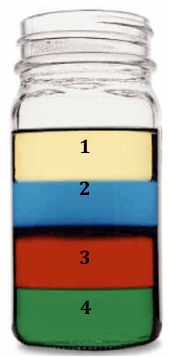
A piece of copper has a mass of 89g and a volume of 10.0 cm3. What would be the density of the copper?
0.89 g/cm3
89 g/cm3
8.9 g/cm3
890 g/cm3
What is the volume of 150.0 grams of lead if it has a density of 11.3 g/cm3?
13.3 g
13.3 cm3
.075 g
1695 cm3
A cube of aluminum has a volume of 9cm3 and weighs 81 g. What is its density?
9 g/ cm3
.11 g/cm3
729 g/cm3

