wayground logo

Free Printable Worksheets

Font size

S
M
L
XL
Worksheets

TEST WAVES

Total questions: 39

Worksheet time: 57mins

Name
Class
Date
1.

Which of the following can waves transfer energy through?

a)

solid

b)

liquid

c)

gas

d)

empty space

e)

all of the above

2.

What do all waves transfer?

a)

Matter

b)

Heat

c)

Electricity

d)

Energy

3.

Which of the following can waves transfer energy through?

a)

solid

b)

liquid

c)

gas

d)

empty space

e)

all of the above

4.

What are the two types of waves?

a)

longitudinal and transverse

b)

sound and light

5.

What is the number of complete waves passing a fixed point in a given amount of time?

a)

Amplitude

b)

Intensity

c)

Wavelength

d)

Frequency

6.

What is the frequency of this wave? You must count the number of complete waves.

a)

1 Hz

b)

5 Hz

c)

10 Hz

7.

What is the distance between the calm sea and the highest wave called?

a)

Wave

b)

Frequency

c)

Amplitude

d)

Magnitude

8.

What does #1 represent?

a)

Period

b)

Frequency

c)

Wavelength

d)

Amplitude

9.

What does #2 represent?

a)

Period

b)

Frequency

c)

Wavelength

d)

Amplitude

10.

What do all waves transfer?

(a)  

11.
The lowest part of the wave is?
a)
trough
b)
crest
c)
point of origin
d)
compression point
12.
A _____________________ is the distance between a point on one wave and the identical point of the next wave.
a)
amplitude
b)
wavelength
c)
frequency
d)
compression
13.
Which wave has a greater frequency?
a)
A
b)
B
14.

A wave that can only travel through matter is called:

a)

solid waves

b)

longitudinal waves

c)

transverse waves

d)

mechanical waves

15.

True or false: In Longitudinal (or Compression) waves particles move back and forth in a wave.

a)

true

b)

false

16.

True or false: In Transverse waves particles travel side to side in a wave.

a)

true

b)

false

17.
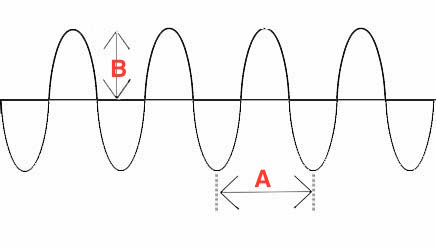
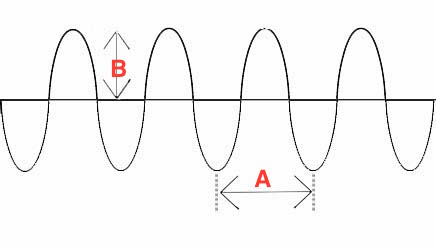
What property of this wave is represented by the letter "A"
a)
amplitude
b)
crest
c)
trough
d)
wavelength
18.
What property of the wave is represented by the letter "B"?
a)
amplitude
b)
crest
c)
trough
d)
wavelength
19.
What types of waves carry energy at a right angle or perpendicular to the direction of the energy flow?
a)
Longitudinal waves
b)
Transverse waves
c)
Sound waves
d)
P-waves
20.
What do waves carry from place to place?
a)
Energy, but not matter or particles
b)
Energy and matter or particles
c)
Matter or particles but not energy
d)
Neither energy nor matter or particles
21.
The most dense part of a longitudinal wave.
a)
Density
b)
Compression
c)
Rarefaction
d)
Amplitude
22.
What are the parts of a longitudinal wave?
a)
Compressions and rarefactions
b)
Crests and troughs
c)
Compressions and crests
d)
Rarefactions and troughs
23.
Which wave is pictured?
a)
Transverse
b)
Longitudinal
c)
Both
d)
Neither
24.
Sound is an example of which type of wave?
a)
Transverse
b)
Longitudinal
c)
Both
d)
Neither
25.
How would you describe the movement of a transverse wave?
a)
Up and down
b)
Back and forth
c)
In zigzags
d)
Linear
26.
Light is an example of which type of wave?
a)
Transverse
b)
Longitudinal
c)
Both
d)
Neither
27.
Which wave travels parallel in relation to a medium?
a)
Transverse
b)
Longitudinal
c)
Both
d)
Neither
28.
Sound needs a medium to travel through.  What is a medium?
a)
solid, liquid, gas
b)
open space
c)
waves
d)
nothing
29.
a)
Longitdinal Wave
b)
Transverse Wave
30.
The material through which a wave travel 
a)
trough
b)
medium
c)
crest
d)
vibration
31.
A disturbance that transfers energy from place to place
a)
Energy
b)
Wave
c)
Force
d)
Motion
32.
Energy can neither be created or destroyed
a)
Law of conservation of Mass
b)
Law of conservation of Energy
33.

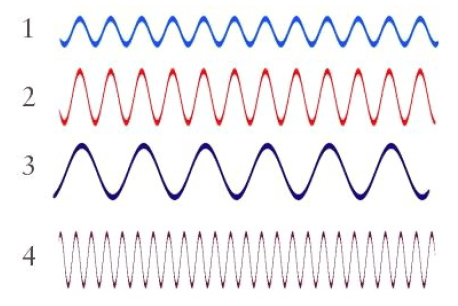
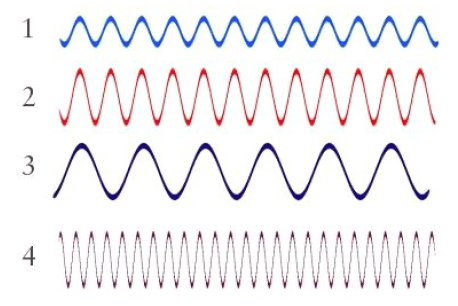
Which wave in the diagram has the greatest frequency?

a)

1

b)

2

c)

3

d)

4

34.

Which wave in the diagram has the greatest wavelength?

a)

1

b)

2

c)

3

d)

4

35.

What type of wave is this?

a)

Longitudinal

b)

Transverse

c)

Mechanical

d)

Electromagnetic

36.

What type of wave is this?

a)

Electromagnetic

b)

Mechanical

c)

Longitudinal

d)

Transverse

37.

What type of wave interaction is shown here?

a)

reflection

b)

diffraction

c)

interference

d)

refraction

38.

What type of wave interaction is shown here?

a)

diffraction

b)

reflection

c)

refraction

d)

interaction

39.
The repeated back-and-forth or up-and-down motion.
a)
diffraction
b)
vibration
c)
compression
d)
frequency