
 Worksheets
Unit 1 Geometry Review after Chapter 3
Total questions: 65
Worksheet time: 2hrs 57mins
What has two dimensions?
Line
Point
Plane
A ______ indicates a location or position.
Line
Point
Plane
LM
point LM
line LM
line segment LM
ray LM

Points that lie on the same line
Space
Collinear Points
Bisector
Coplanar Points

Points or lines that are not in the same plane.
Non-Coplanar
Coplanar
Collinear
Parallel

Lines that are not coplanar and do not intersect.
Collinear
Skew Lines
Non-Collinear
Ray

The point that divides the segment into two segments that have the same length.
Coplanar
Midpoint
Ray
Line

Two rays that have a common endpoint and form a line.
Opposite Rays
Plane
Parallel
Midpoint

A line, ray or segment that divides a segment into two congruent segments.
Ray
Midpoint
Bisector
Plane

Example 2: Find x if the length of PR is 45 units in length. [Refer to the figure]
3
44
5
6

Find the length indicated.
(a)

If m∠ABC = 103° find x.
(a)
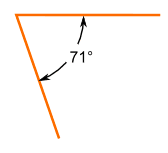

What is the length of PR?
11
8
5
3

Calculate m∠ABC.
45°
60°
105°
15°
Which of the following shapes are not polygons?
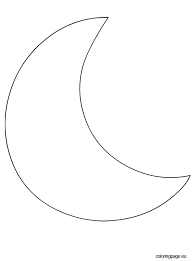
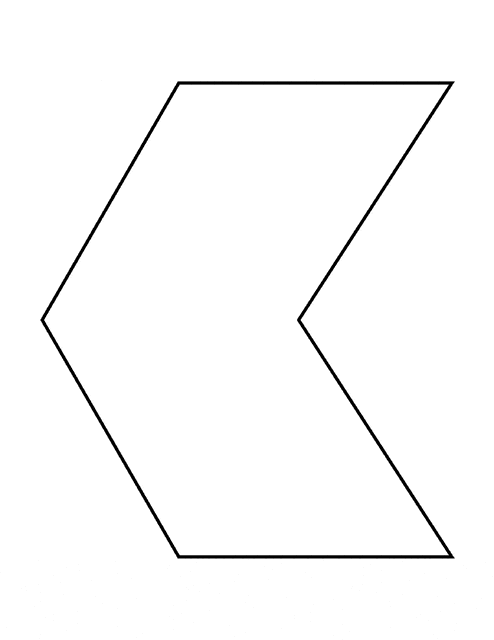
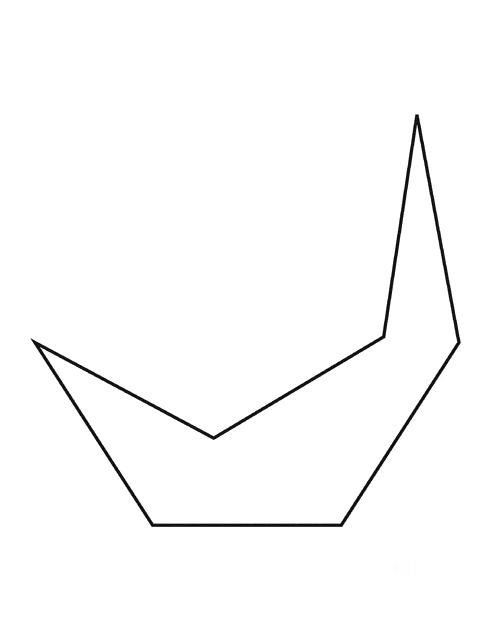
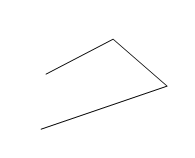
which shape is not a polygon


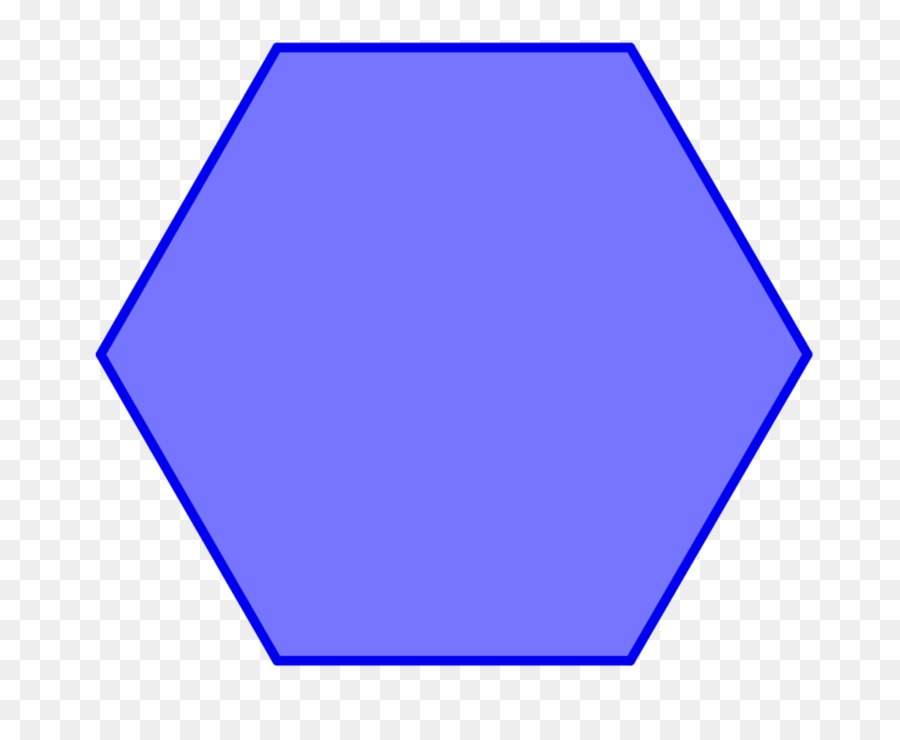

Convex polygon


Concave polygon


11cm
25cm
24cm
24cm2

The area of the parallelogram is (a) square centimeters

Find the area.
180
90
28
56
Do the segment lengths 9, 12, and 15 form a right triangle?
Yes
No

Find the length of the missing side
17
15
22
13

Find the length of the missing side
20
68
16
80
Consider the statement:
If Ed lives South of Canada, then he lives in Texas.
Which of the following is a COUNTEREXAMPLE to this false statement?
If Ed lives South of Canada, then he lives in Minnesota.
If Ed lives North of Canada, then he lives in Texas.
∼p→∼q
Inverse
q→p
Converse
p→q
Original Conditional
∼q→∼p
Contrapositive
Which of the following is a counterexample to the following conjecture? If x2 = 4 , then x = 2
x = 4
x = -2
x = 2
x = -4
If a whole number is even, then its square is divisible by 4.
The number I am thinking of is an even number.
Statement 1: If you exercise regularly, then you have a healthy body
Statement 2: If you have a healthy body, then you have more energy
Which law of logic is this?
If I clean the bathroom, then I don't have to do the dishes.
I cleaned the bathroom.
Therefore, I don't have to do the dishes.
Law of Detachment
Law of Syllogism
Law of Contrapositive
None

What is the relationship of the angles?
Corresponding angles
Consecutive interior angles
Alternate interior angles
alternate exterior angles

Which pair of angles are corresponding angles?
∠ 7 and ∠ 4
∠ 2 and ∠ 6
∠ 8 and ∠ 1
∠ 2 and ∠ 8
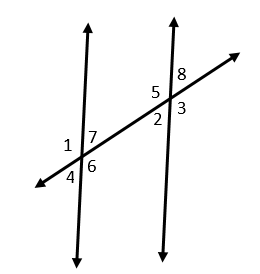
1) Given the two parallel lines cut by a transversal.
What is the vertical angle to angle 4?
Angle 2
Angle 6
Angle 8
Angle 7

What is the relationship between angles A and B?
corresponding
alternate interior
alternate exterior
supplementary
1) Given the two parallel lines cut by a transversal.
which angle is Alternate exterior to ∠4 ?
∠2
∠6
∠8
∠7

Same Side Interior Angles

What are supplementary angles?
Angles that add up to 180°
Angles that add up to 90°
Angles that are equal to each other
Angles that are opposite of each other when lines intersect
What are complementary angles?
Angles that add up to 180°
Angles that add up to 90°
Angles that are equal to each other
Angles that are opposite of each other when lines intersect.

127
52
127
52
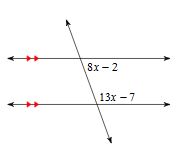

Find m ∠D.
∠D=116°
∠D=64°
∠D=180°
∠D=26°

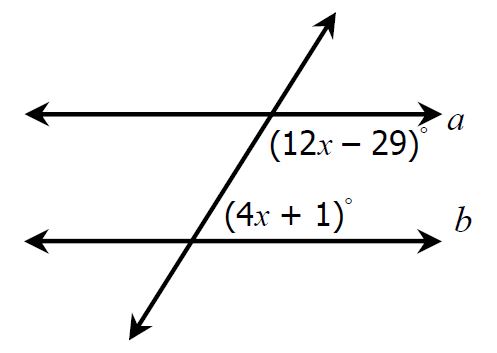
12X - 29 = 4X +1
12X - 29 + 4X +1=90
12X - 29 + 4X +1=180

Find the exact measures of the given angles.
(a)

Which could be used to prove the lines are parallel?
Converse of Alternate Interior Angles Theorem
Converse of Same-Side Interior Angles Theorem
Converse of Corresponding Angles Postulate
Cannot be proved parallel

Which could be used to prove the lines are parallel?
Converse of Vertical Angles
Converse of Alternate Interior Angles Theorem
Converse of Corresponding Angles Postulate
Cannot be proved parallel

No
Yes, Corresponding angles are congruent
Yes, Alternate Interior angles are congruent
Yes, Alternate Exterior angles are congruent

Write the equation of the line with slope -2 through the point (7, −1).
y = −2x + 15
y = −2x − 15
y = −2x + 13
y = −2x − 13
Write the equation of the line through the points (8, −7) and (−2, 8).
y = 3/2x + 11
y = −3/2x + 11
y = −3/2x + 5
y = 3/2x − 19
Write the equation of a line PARALLEL to y = 2x + 3 that passes through the point (3, 1).
y=2x −3
y=2x−5
y=2x + 1
y=−21x+25
Write the equation of a line PERPENDICULAR to y = -2x + 1 that passes through the point (2, 3).
y=−21x+21
y=21x+2
y=−2x+7
y=−2x+8
Which of the following is the correct midpoint formula given two endpoints (x1, y1) and (x2, y2)?
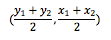
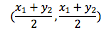
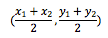

Find the midpoint of the line segment with the given endpoints (3,9) and (5,9)
(-1,0)
(4,9)
(6,7)
(7,9)

Find the distance between each pair of points. Round your answer to the nearest tenth, if necessary.
A
B
C
D
Which of the following formulas is the distance formula?
(2x1+x2, 2y1+y2)
(x2−x1)2+(y2−y1)2
a2+b2=c2
x2−x1y2−y1

