
 Worksheets
Introduction to Forces
Total questions: 50
Worksheet time: 1hrs 28mins
The sum of all forces acting on an object and direction is called the:
Contact Force
Balanced Force
Unbalanced Force
Net Force


Ted is trying to move a fridge through his house, he gets stuck on a carpet and even though he is pushing the fridge, it is not moving. What force is acting against him?
gravity
friction
applied force
normal force
A push or pull exerted on an object is called a(n):
Force
Net force
Momentum
Speed
Forces are a vector so they have both a direction and a:
Magnitude
Motion
Speed
Height
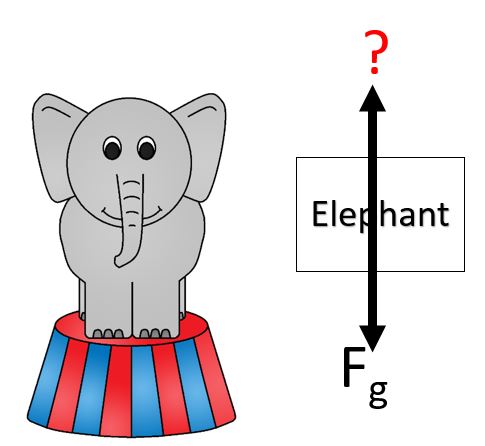
What is the name of the missing force?
gravity
normal force
applied force
frictional force
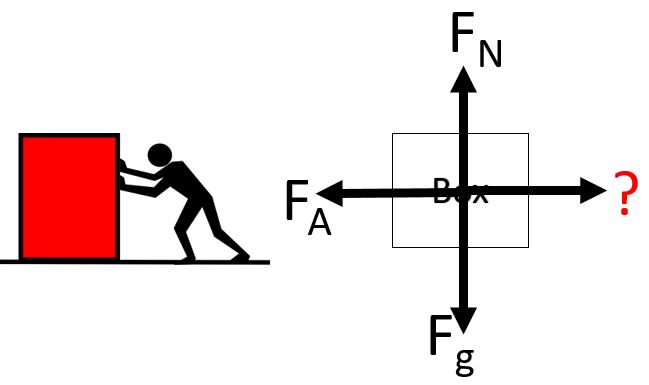
What is the name of the missing force?
frictional force
normal force
gravity
applied force

What is the name of the missing force?
applied force
gravity
friction
normal force
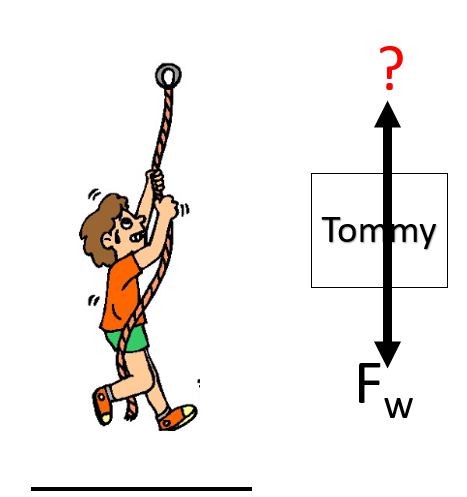
What is the name of the missing force?
tension force
gravitational force
normal force
applied force
A leftward force is applied to a crate to push it across the floor at a constant speed. Which is the correct force diagram?


A hockey puck glides to the right across the ice at a constant speed. What would the force diagram for this look like? [Assume no friction]


A downward-moving skydiver who has just opened the parachute is slowing down. Which force diagram shows this sitation?


The force that keeps objects on top of surfaces instead of letting them sink into the surface is known as:
normal
gravity
friction
applied force
In a force diagram the sizer or length of the arrow tells you:
the strength of the force
the distance of the force
the direction of the force

This diagram can be used to indicate which of the following? (TWO correct answers)
a object at rest
an object moving at a constant velocity (speed)
an object accelerating
(Trick question -- there is only one correct answer)
an object decelerating
Whenever an object is moving, there is always this force opposing the motion:
normal force
gravity
friction
applied force
When determining the NET force on an object you should (TWO correct answers):
subtract forces in opposite directions
add forces in the same direction
subtract forces in the same direction
add forces in the opposite direction
multiply the forces in the same direction
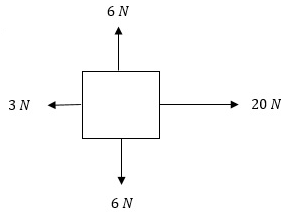
What is the NET FORCE of this diagram?
17 N, right
17 N, left
23 N, right
12 N, up

What is the net force?
40 N left
0 N Balanced
400 N right
40 N right

What does this picture represent
Force,magnetism,acceleration
Force, money, Apples
Force, Mass, Acceleration
Funny, monkeys, Arrive
An object in motion will stay in motion and an object at rest will stay at rest unless acted upon by an outside force. Which of Newton's laws of motion does this describe?
2nd law
1st law
3rd law

When there is a change in motion?
When forces are balanced
When the forces are unbalanced
Whe forces are equal
Never
If an object is at rest, then there are no forces acting upon the object.
True
False
An object would have more mass on Mount Everest than the same object in the middle of the Thames.
True
False
It would take an unbalanced force to cause an object to accelerate from rest
true
false
What Unit do we Measure Force in?
Newtons
Joules
Force
Kilograms
When a student runs and kicks a ball, they have applied an ___________ force to move the ball.
Balanced
Magnetic
Spring
Unbalanced
What is another name for Newton’s 1st law?
Law of Inertia
Law of Acceleration
Law of Action/Reaction
Which one of Newton's laws of motion says that you must push or pull objects harder if they have more mass?
1st
2nd
3rd
4th

The acceleration of objects falling on Earth due to gravity is
10 m/s
10 m/s2
10 g/mL
10 g/m/m


What is the difference between Mass and Weight?
MASS is a measure of the force of gravity acting on an object. WEIGHT is a measure of the amount of matter that an object is composed of
Mass is a measure of the amount of matter that an object is composed of.
Weight is a measure of the force of gravity acting on an object.
MASS and WEIGHT are the same thing. (They are synonyms)
MASS is a measure of how much space an object takes up.
WEIGHT is a measure of
Define acceleration due to gravity.
The force of gravity acting on an object.
The velocity of an object under the influence of gravity.
The acceleration experienced by an object due to gravity.
The force of gravity.
2 kg
9 kg
17.6 kg
24 kg
How strong is the gravitational field if a 40 kg object feels 12 newtons of force while inside the field?
0.3 N
40 N
3.3 N
7 N
An object feel 12 Newtons of gravity here on earth. What is its mass?
1.2 N
4 N
0.8 N
117.6 N
Which law of Newton says an object at rest will stay at rest and an object in motion will stay in motion.
First
Second
Third
Fourth
Objects cannot move without
Force
Strength
Sun
Wind
The force of gravity on an object is called what?
pressure
weight
mass
force

Which of the following will change with different gravitational forces?
mass
weight
amount of matter in an object
kilograms
When gravity is pulling down and no other forces are acting on an object
Air Resistance
Gravity
Free Fall
Weight

