wayground logo

Free Printable Worksheets

Font size

S
M
L
XL
Worksheets

ICP Semester 1 Review

Total questions: 269

Worksheet time: 22hrs 25mins

Name
Class
Date
1.

The liter is a unit of _____________.

a)

mass

b)

volume

c)

length

d)

temperature

2.

98 mm = _________ km

a)

98000000

b)

0.000098

c)

980

d)

0.098

3.

In the SI system of measurement, the unit of length is the:

a)

foot

b)

ounce

c)

meter

d)

smoot

4.

201 mm = _________ cm

a)

201

b)

20.1

c)

2010

d)

0.201

5.

In the metric system, the unit of mass is the:

a)

pound

b)

meter

c)

liter

d)

gram

6.

A student has a body mass of 53 kg. What is their mass in grams?

a)

0.53 g

b)

530 g

c)

53000 g

d)

0.053 g

7.

34 mg = _________ g

a)

340

b)

34000

c)

0.034

d)

0.0034

8.

Which prefix represents the smallest unit in our metric conversion staircase?

a)

Kilo-

b)

centi-

c)

Deka-

d)

milli-

9.

King Henry Doesn't usually drink chocolate ____________

a)

malts

b)

milk

c)

muffins

d)

melons

10.

Which is greater?

a)

990 cm

b)

1 m

11.

The curved upper surface of a column of liquid is called the

a)

meniscus

b)

volume

c)

mass

d)

metric

12.

Which equipment is used to measure mass?

a)

triple beam balance

b)

ruler

c)

graduated cylinder

d)

thermometer

13.

Always read which part of the meniscus?

a)

The bottom part

b)

The top part

c)

Average together the top and bottom part

d)

The side part

14.

What is the base unit for volume in the metric system?

a)

Gram

b)

Liter

c)

Meter

d)

Kilogram

15.
Which measurement would you use to measure the following?
the length of a piece of paper
a)
centimeters
b)
liters
c)
kilograms
d)
meters
16.
Which measurement would you use to measure the following?
the volume of a soda bottle
a)
centimeters
b)
liters
c)
kilograms
d)
grams
17.
Which measurement would you use to measure the following?
your mass
a)
centimeters
b)
liters
c)
kilograms
d)
milliliters
18.

What is the volume of the two red beads?

a)

2.4 cm3

b)

4 cm3

c)

6 cm3

d)

2 cm3

19.

What is the length of the object in centimeters?

a)

3.4 cm

b)

4.3 cm

c)

3.5 cm

d)

1 1/4 inches

20.
What is the volume of the liquid in this graduated cylinder?
a)
19 mL 
b)
35 mL 
c)
24 mL 
d)
1.9 mL
21.

Choose the correct answer.

a)

100.42 g

b)

40.102 g

c)

142 g

d)

140.2 g

22.
What is the length of the screw?
a)
5cm
b)
6cm
c)
5mm
d)
6m
23.

What is the measurement on the triple-beam balance shown?

a)

27g

b)

28g

c)

27.7g

d)

2.7g

24.
Which is the longest?
a)
meter
b)
kilometer
c)
centimeter
d)
milimeter
25.

Metric temperature is measured in:

a)

Fahrenheit

b)

Celcius

c)

Degrees

d)

Pounds

26.
What is this?
a)
Measuring tube
b)
Test tube
c)
Graduated Cylinder
d)
Pipette
27.
Which tool measures mass?
a)
graduated cylinder
b)
triple beam balance
c)
scale
d)
ruler and/or meter stick
28.
What is the volume of this solid?
a)
5 meters
b)
17 meters
c)
2 meters
d)
100 meters
29.
At which point should your eyes be when you read a graduated cylinder? (Hint: see the letter next to the eye)
a)
A
b)
B
c)
C
30.
Frank has an eraser. It has a mass of 4g, and a volume of 2cm3. What is its density?
a)
8 g/cm3
b)
2 g/cm3
c)
1/2 g/cm3
d)
24 g/cm3
31.
Why do some substances float on water?
a)
they are warmer than water
b)
they are cooler than water
c)
they are more dense than water
d)
they are less dense than water
32.
What units are used to measure Density?
a)
cm3/g
b)
g
c)
g/cm3
d)
cm3
33.
Which formula can be used to find the volume of a rectangular prism?
a)
length x width
b)
length x width x height
c)
height x length
d)
length + width + height
34.

If you are given the density and volume of an item, how would you calculate its mass?

a)

M = D/V

b)

M = D x V

c)

M = V/D

35.
Approved eye protection devices (such as goggles) are worn in the laboratory
a)
 to avoid eye strain
b)
to improve your vision
c)
only if you don’t have corrective glasses
d)
 any time chemicals, heat or glassware are used
36.

After completing an experiment, all chemical wastes should be

a)

taken home

b)

dumped in the sink

c)

disposed of according to your teacher’s directions

d)

left at your lab station for the next class

37.
You are heating a substance in a test tube. Always point the open end of the tube 
a)
away from all people
b)
toward another classmate
c)
toward your lab partner
d)
toward yourself
38.
You have been injured in the laboratory (cut, burn, etc.). First you should
a)
apply first aid yourself
b)
tell the science instructor at once
c)
see a doctor after school
d)
visit the school nurse after class
39.
Long hair in the laboratory must be 
a)
tied back or kept entirely out of the way with a hair band, hairpins, or other confining device
b)
always neatly groomed
c)
held away from the experiment with one hand
d)
cut short
40.

Horseplay or practical jokes in the laboratory are

a)

okay if you are working alone

b)

not dangerous

c)

okay

d)

NOT allowed

41.
Hot glass looks the same as cold glass.
a)
True
b)
False
42.
Work areas should be kept clean and tidy
a)
True
b)
False
43.
Laboratory work can be started immediately upon entering the laboratory even if the instructor is not yet present
a)
True
b)
False
44.
Chipped or cracked glassware is okay to use.
a)
True
b)
False
45.
You are allowed to enter the chemical preparation/storage area any time you need to get an item
a)
True
b)
False
46.
It’s okay to pick up broken glass with your bare hands as long as the glass is placed in the trash.
a)
True
b)
False
47.
Never leave a lit burner unattended.
a)
True
b)
False
48.

98 mm = _________ km

a)

98000000

b)

0.000098

c)

980

d)

0.098

49.

201 mm = _________ cm

a)

201

b)

20.1

c)

2010

d)

0.201

50.

34 mg = _________ g

a)

340

b)

34000

c)

0.034

d)

0.0034

51.

Always read which part of the meniscus?

a)

The bottom part

b)

The top part

c)

Average together the top and bottom part

d)

The side part

52.

What is the volume of the two red beads?

a)

2.4 cm3

b)

4 cm3

c)

6 cm3

d)

2 cm3

53.

What is the length of the object in centimeters?

a)

3.4 cm

b)

4.3 cm

c)

3.5 cm

d)

1 1/4 inches

54.
What is the volume of the liquid in this graduated cylinder?
a)
19 mL 
b)
35 mL 
c)
24 mL 
d)
1.9 mL
55.

Choose the correct answer.

a)

100.42 g

b)

40.102 g

c)

142 g

d)

140.2 g

56.

What is the measurement on the triple-beam balance shown?

a)

27g

b)

28g

c)

27.7g

d)

2.7g

57.
What is this?
a)
Measuring tube
b)
Test tube
c)
Graduated Cylinder
d)
Pipette
58.
Which tool measures mass?
a)
graduated cylinder
b)
triple beam balance
c)
scale
d)
ruler and/or meter stick
59.
What is the volume of this solid?
a)
5 meters
b)
17 meters
c)
2 meters
d)
100 meters
60.
Frank has an eraser. It has a mass of 4g, and a volume of 2cm3. What is its density?
a)
8 g/cm3
b)
2 g/cm3
c)
1/2 g/cm3
d)
24 g/cm3
61.
Why do some substances float on water?
a)
they are warmer than water
b)
they are cooler than water
c)
they are more dense than water
d)
they are less dense than water
62.
Which formula can be used to find the volume of a rectangular prism?
a)
length x width
b)
length x width x height
c)
height x length
d)
length + width + height
63.

The independent variable is

a)

The variable that you change in an investigation

b)

The variable that you measure in an investigation

c)

A variable that you keep the same in an investigation

64.

The dependent variable is

a)

The variable that you change in an investigation

b)

The variable that you measure in an investigation

c)

A variable that you keep the same in an investigation

65.

The information you collect while doing your experiment is called

a)

conclusions

b)

data

c)

hypotheses

d)

procedures

66.

How many independent variables should you have in an experiment?

a)

two

b)

as many as possible

c)

four

d)

one

67.
A series of steps used by scientists to solve a problem or answer a question. 
a)
scientific method
b)
recipe
c)
data collection
d)
metric system
68.
This step of the scientific method is an educated guess or a prediction. 
a)
Hypothesis
b)
Research
c)
Observation
d)
Conclusion
69.
What step does every scientific experiment begin with?
a)
hypothesis
b)
question/problem
c)
procedures
d)
conclusion
70.
The summary at the end of an experiment that explains the results. 
a)
conclusion
b)
procedures
c)
materials
d)
responding variable
71.

This is the last step in the scientific method

a)

Draw a conclusion

b)

Record your data as results

c)

Share what you have learned with others

d)

Collaborate with others

72.

Something that you keep the same in an experiment is called a(n) _________________________.

a)

variable

b)

control

c)

procedure

d)

conclusion

73.

Constants should be...

a)

different

b)

same

c)

kind of the same

d)

none of the above

74.

Bias means _____________ one view over another view.

a)

supplementing

b)

favoring

c)

opinioning

d)

hosting

75.

Which statement is most clearly biased?

a)

Basketball is a game played by two teams of five players.

b)

People all over the world play basketball.

c)

Basketball is the most beautiful sports in the world of games and no other sports can beat this record (James Naismith).

76.
Theory or Law???  Is a DESCRIPTION of what a scientists expects to happen every time under a certain set of conditions.
a)
Law
b)
Theory
77.
The information you record in an experiment is called your ____________.
a)
data
b)
conclusions
c)
notebook
d)
inquiry
78.
Scientific theories are based on
a)
general assumptions of how systems work.
b)
mathematical principles that can be proven true.
c)
large amounts of data collected over time.
d)
observations from within only one scientific discipline.
79.
What is a law?
a)
Describes what happens
b)
Explains a process
80.

What are the constant variables?

a)

what we are changing or testing

b)

what we are observing or measuring

c)

what we keep the same to make the experiment fair

81.

If an object has a density of 6 g/mL and you put it into water, will it sink or float?  

a)
sink
b)
float
82.

The one factor that a scientist controls during an experiment. This goes on the x-axis.

a)

Independent Variable

b)

Dependent Variable

83.

The variable that is measured. It goes on the y-axis.

a)

Independent Variable

b)

Dependent Variable

84.
The x-axis shows
a)
time
b)
carbon dioxide concentration
c)
Mauna Loa volcano
d)
science
85.
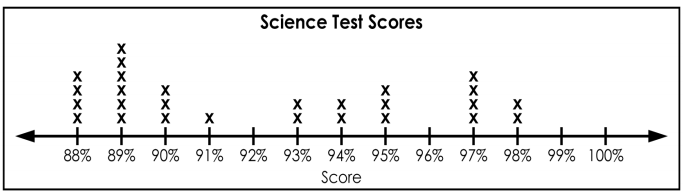
How many total students are in the science class?
a)
13
b)
6
c)
27
d)
25
86.

According to the pie chart, how much of a house's water usage is for showers?

a)

26.7%

b)

13.7%

c)

21.7%

d)

16.8%

87.

What is an independent variable?

a)

the variable that changes because another variable changes

b)

independent variables are only found on pie charts.

c)

a variable most often found on the y-axis

d)

the variable the experimenter changes or manipulates.

88.

What is a dependent variable?

a)

the variable the experimenter changes or manipulates.

b)

the variable that changes because another variable changes

c)

dependent variables are only found on pie charts

d)

a variable most often found on the x-axis

89.

What is a variable?

a)

something used to compare the parts of a whole

b)

Something that is useful for displaying data or information that changes over time

c)

Any display of information with tabs, rows and/or columns

d)

Anything in an experiment that can change and can affect the outcome of the experiment

90.
How many more people have purple for a favorite color than red?
a)
3
b)
5
c)
7
d)
9
91.
How many people have four books in their desks?
a)
2
b)
3
c)
4
d)
5
92.
What is the dependent variable on the graph (y-axis)?
a)
Metro Bicycle Shop Weekly Sales
b)
Bicycles Sold
c)
Types of Bicycles
93.

What is a data table?

a)

Is a visual tool that uses that uses bars to compare data among categories

b)

Used to compare the parts of a whole

c)

Any display of information in tabular form, with rows and or columns named

d)

Is a visual tool that uses that uses lines to compare data among categories

94.
a)

How the mass of the dog changed

b)

How much food the dog consumed

c)

what kinds of food the dog consumed

d)

When the dog was measured each month

95.
a)

The cooler the temperature, the louder the crickets chirp.

b)

The crickets cannot chirp at temperatures lower than 10 degrees C.

c)

The warmer the temperature, the more often crickets chirp.

d)

The temperature and the chirping of crickets are not related.

96.
What is this graph missing?
a)
Axes
b)
Title
c)
Categories
d)
None of these
97.
Which variable is the responding variable, or the variable we measure(results) in an experiment?
a)
Independent Variable
b)
Dependent Variable
c)
Constant Variable
d)
None of these
98.
Which variable does the scientist "control"?
a)
Independent Variable
b)
Dependent Variable
c)
Constant Variable
d)
None of these
99.
Which activity is the least favorite by the 5th grade students?
a)
Collecting seashells
b)
Kite flying
c)
Sandcastle building
d)
Playing beach ball
100.

Independent variable (IV) label units are found on the _______ axis.

a)

Y-axis

b)

X-axis

101.

Dependent variable (DV) label with units is found on the _____ axis

a)

Y-axis

b)

X-axis

102.

In an experiment to find out how the temperature affects the bounce height of a ball, the dependent variable is _____________.

a)
temperature
b)
bounce height
c)
the thermometer
d)
the ruler
103.

What is the independent variable?

a)

Favorite Cereal

b)

Number of Votes

c)

Type of cereal

d)

Life cereal

104.
Explain why this graph may be misleading?
a)
the x-axis does not have equal intervals
b)

The picture of the concierge (the man in the suit carrying a suitcase)

c)
you cannot have percents in a line graph
d)
the y-axis does not have equal intervals
105.

Given the following data. Use the graph below and plot your data. Remember all parts of the graph. Bouncing a Basketball from different Heights.

20 cm -10 cm;

30 cm 25 cm:

50 cm-25 cm

106.
The x-axis shows
a)
time
b)
carbon dioxide concentration
c)
Mauna Loa volcano
d)
science
107.
The y-axis shows
a)
time
b)
carbon dioxide concentration
c)
Mauna Loa volcano
d)
science
108.

According to the pie chart, how much of a house's water usage is for showers?

a)

26.7%

b)

13.7%

c)

21.7%

d)

16.8%

109.

What is an independent variable?

a)

the variable that changes because another variable changes

b)

independent variables are only found on pie charts.

c)

a variable most often found on the y-axis

d)

the variable the experimenter changes or manipulates.

110.

What is a dependent variable?

a)

the variable the experimenter changes or manipulates.

b)

the variable that changes because another variable changes

c)

dependent variables are only found on pie charts

d)

a variable most often found on the x-axis

111.

What is a variable?

a)

something used to compare the parts of a whole

b)

Something that is useful for displaying data or information that changes over time

c)

Any display of information with tabs, rows and/or columns

d)

Anything in an experiment that can change and can affect the outcome of the experiment

112.
What is the independent variable on the graph (x-axis)?
a)
Metro Bicycle Shop Weekly Sales
b)
Bicycles Sold
c)
Types of Bicycles
113.
What is the dependent variable on the graph (y-axis)?
a)
Metro Bicycle Shop Weekly Sales
b)
Bicycles Sold
c)
Types of Bicycles
114.

What is a data table?

a)

Is a visual tool that uses that uses bars to compare data among categories

b)

Used to compare the parts of a whole

c)

Any display of information in tabular form, with rows and or columns named

d)

Is a visual tool that uses that uses lines to compare data among categories

115.
What is this graph missing?
a)
Axes
b)
Title
c)
Categories
d)
None of these
116.

The variable that is measured.

a)

Controlled Variable

b)

Dependent Variable

c)

Independent Variable

117.
Changes in the _________ variable causes changes in the _________ variable.
a)
independent; dependent
b)
dependent; independent
118.

A student wants to test the effects of different types of exercise on heart rate.  What would be the dependent variable of the experiment?

a)

the measurement of heart rate

b)
type of exercise
c)
amount of exercise
d)
time of day exercise occurs
119.

Independent variable (IV) label units are found on the _______ axis.

a)

Y-axis

b)

X-axis

120.

Dependent variable (DV) label with units is found on the _____ axis

a)

Y-axis

b)

X-axis

121.

The x-axis is horizontal (flat).

a)

True

b)

False

122.

The y-axis is vertical (up and down).

a)

True

b)

False

123.

A graph must have a title, axis/variable labels, ______ _______, and scale.

a)

legend/key

b)

colors

c)

unit labels

124.

What are graphs?

a)

An image

b)

A visual representation of data

c)

Lines

d)

Data

125.

Labels show the name of the X & Y axis. Where can we find those labels?

a)

Google

b)

The research

c)

The data table

126.

__________ is the application of knowledge gained from science in practical ways – to solve problems and improve the quality of life.

a)

Science

b)

Technology

c)

Mathematics

d)

Physics

127.

A group of individuals involved in persistent social interaction sharing the same geographical or social territory.

a)

Science

b)

English

c)

Mathematics

d)

Society

128.
Explain why this graph may be misleading?
a)
the x-axis does not have equal intervals
b)

The picture of the concierge (the man in the suit carrying a suitcase)

c)
you cannot have percents in a line graph
d)
the y-axis does not have equal intervals
129.
What would be the best scale for this data?
Days
      Cm
  1            1.0
  2            3.5
  3            5.0
  4            8.5
a)
count by fives to 10
b)
count by tens to 100
c)
count by ones to 5
d)
count by ones to 10
130.
What is the relationship between the independent variable and the dependent variable?
a)
As time increase, distance decreases
b)
As time increases, distance increases
c)
As time decreases, distance decreases
d)
As time decreases, distance increases
131.
Which graph matches the data?
a)
Graph 1
b)
Graph 2
c)
Graph 3
d)
Graph 4
132.
Which graph is misleading?
a)
Neither graph is misleading.
b)
The graph on the left is misleading because the y-axis does not start at zero.
c)
The graph on the right is misleading because the difference should be more than what the graph shows.
133.
The graph shows the results of a survey to determine student's favorite pets. Why is this graph misleading?
a)
The slices are the wrong color
b)
The slices are not the correct size
c)
The percents do not add up to 100
d)
Not misleading
134.
The scatter plot shows the relationship between the number of chapters and the total number of pages for several books.  Use the trend line to predict how many chapters would be in a book with 180 pages. 
a)
12 chapters
b)
15 chapters
c)
18 chapters
d)
21 chapters
135.
After the refrigerator, which appliance is used the most on weekdays?
a)
Television
b)
Heater
c)
Lights
d)
Computer
136.

Look at the bar graph. Can you tell what the bar graph measures?

a)

Kilowatts used by appliances per day

b)

Average Hours appliances were used per day

c)

Number of hours each appliance was used per day

d)

Hours appliance used monthly

137.

Given the following data. Use the graph below and plot your data. Do this on a regular sheet of paper and turn into tray. Remember all parts of the graph. Bouncing a Basketball from different Heights.

20 cm 10 cm;

30 cm 25 cm:

50 cm 30 cm

4 lines
138.

What is the most common state of matter in the universe?

a)

Solid

b)

Liquid

c)

Gas

d)

Plasma

139.

Water collects in a cool glass on a hot summer day. This is an example of:

a)

Freezing

b)

Melting

c)

Sublimation

d)

Condensation

140.

When water begins to boil in a pot, the particles:

a)

Gain energy and spread apart

b)

Gain energy and move closer together

c)

Lose energy and spread apart

d)

Lose energy and move closer together

141.

Particles in this state of matter have the greatest force of attraction and the least energy.

a)

Solid

b)

Liquid

c)

Gas

d)

Plasma

142.

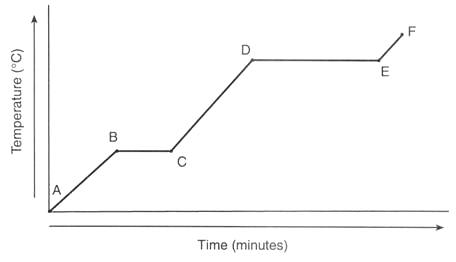
In the following diagram, between what two points is a substance melting?

a)

A and B

b)

B and C

c)

C and D

d)

D and E

143.

Within a substance, atoms that collide most frequently and move more independently of one another are most likely in which state of matter?

a)

Gas

b)

Solid

c)

Liquid

d)

Water

144.

When a solid changes into a gas, skipping the liquid phase, that is called ... ?

a)

Condensation

b)

Evaporation

c)

Sublimation

d)

Melting

145.

At higher temperatures.....

a)

particles in an object have less energy

b)

a gas contracts

c)

particles in an object move faster

d)

thermal contraction occurs

146.

Freezing.....

a)

solid to gas

b)

gas to solid

c)

liquid to solid

d)

liquid to gas

147.

What is condensation?

a)

gas to solid

b)

gas to liquid

c)

solid to gas

d)

liquid to solid

148.

What is temperature?

a)

How hot or cold something is

b)

The measure of average kinetic energy of the particles in a substance

c)

The measure of the speed of the particles in a subtance

d)

The sum of kinetic energy and thermal energy

149.

Which model is demonstrating what molecules in a solid look like.

a)
b)
c)
150.

Which model is demonstrating what molecules in a liquid look like.

a)
b)
c)
151.

Which model is demonstrating what molecules in a gas look like.

a)
b)
c)
152.

If thermal energy is increasing, what is happening to the kinetic energy.

a)

Kinetic energy would be decreasing

b)

Kinetic energy would stay the same

c)

Kinetic energy would be increasing

153.

Which line segment represents the substance only in the solid state?

a)

AB\overline{AB}  

b)

BC\overline{BC}  

c)

CD\overline{CD}  

d)

DE\overline{DE}  

154.
Between which points is the temperature of the substance remaining constant?
a)
A-B only. 
b)
A-B, C-D, E-F
c)
B-C only. 
d)
B-C, D-E
155.
What is water's freezing point?
a)
0 F
b)
32 C
c)
50 C
d)
0 C
156.

Substances that are made up of ONLY one type of atom (element) or compound.

a)

Heterogeneous mixture

b)

Pure substance

c)

Suspension

d)

Homogeneous mixture

157.

Which of the following is classified as a pure substance?

a)

Lemonade

b)

Fruit punch

c)

ketchup

d)

Hydrogen

158.
What is matter?
a)
Anything that has mass and occupies space
b)
Anything that has mass
c)
Anything that is made of air
d)
ALL of them 
159.

Which of the following is NOT a mixture?

a)

milk

b)

lemonade

c)

vegetable salad

d)

carbon

160.

Which of these is an element?

a)

Salt (NaCl)

b)

Water (H20)

c)

Oxygen (O)

d)

Carbon Dioxide (CO2)

161.

Which of these is a compound?

a)

Aluminium (Al)

b)

Carbon Dioxide (CO2)

c)

Nitrogen (N)

d)

Sand

162.

True or False: Elements and compounds are pure substances.

a)

True

b)

False

163.

Identify which images are HETEROGENEOUS MIXTURES! (Check all that apply)

a)
b)
c)
d)
164.

Solutions are ___________ mixtures.

a)

Solid

b)

Homogenous

c)

Heterogeneous

d)

Gas

165.
Max is hungry and he prepares cereal with milk. This is an example of a: 
a)
Homogeneous mixture
b)
Heterogeneous mixture
166.
What are the two types of Mixtures
a)
Elements and Subatomic Particles
b)
Protons and Electrons
c)
Atoms and Compounds
d)
Homogenous and Heterogeneous
167.
Two substances physically combined and that appears the same throughout is classified as
a)
A homogeneous mixture
b)
A heterogeneous mixture
c)
An element
d)
  A compound
168.

What type of mixture does this diagram represent?

a)

Homogeneous

b)

Heterogeneous

169.

Which method can you use to separate sand and iron filings?

a)

Distillation

b)

Magnetism

c)

Filtration

d)

Evaporation

170.
What type of mixture is this?
a)
homogenous mixture
b)
chemical
c)
heterogeneous mixture 
d)
solid mix
171.

A mixture that contains two or more substances uniformly combined

a)

heterogeneous mixture

b)

homogeneous mixture

c)

suspension

d)

colloid

172.

Matter is classified in...

a)

Elements & Compounds

b)

Homogeneous & Heterogeneous

c)

Colloids & Suspensions

d)

Pure substances & Mixtures

173.

Which of the diagrams below represent a mixture?

a)

A

b)

B

c)

C

d)

D

174.

An element is a ___ that cannot be separated into simpler substances by physical or chemical means.

a)

pure substance

b)

mixture

c)

solution

d)

compound

175.

Where can you find examples of elements?

a)

Dictionary

b)

Periodic table of compounds

c)

Periodic table of elements

d)

Your neighbor

176.

Which letter represents a mixture?

a)

D

b)

G

c)

E

d)

A

177.

[check all that apply] Mixtures are

a)

chemically combined

b)

composed of two or more types of matter that can be present in varying amounts

c)

One or more elements chemically combined

d)

can be separated by physical changes

178.

What is air?

a)

Element

b)

Compound

c)

Mixture

179.

Which picture shows a pure substance?

a)
b)
c)
d)
180.

A combination of substances that dissolve into one another--they are evenly mixed so that individual parts cannot be seen or separated.

a)

solutions

b)

mixtures

c)

observations

181.

It shows a Tyndall effect when light is passed through

a)

Solution

b)

Suspension

c)

Colloid

182.

In which of the following do particles sit at the bottom

a)

Solution

b)

Suspension

c)

None of the above

d)

Colloid

183.

Milk

a)

Solution

b)

Suspension

c)

Colloid

184.

Sand in Water

a)

Solution

b)

Suspension

c)

Colloid

185.

Fog

a)

Solution

b)

Suspension

c)

Colloid

186.
Flammability (burns): Chemical or Physical Property
a)
Chemical Property
b)
Physical Property
187.
Reacts with Acid: Chemical or Physical Property
a)
Chemical Property
b)
Physical Property
188.
Melting Point: Chemical or Physical Property
a)
Chemical Property
b)
Physical Property
189.

A chemical change is a change in

a)

an item's properties such as size, shape, density

b)

an item that creates a new substance, releases light or heat

c)

an item's sound

d)

an item's look or state of matter

190.

A physical change is a change

a)

in an item's properties like its shape, size or density.

b)

that creates a new substance or emits light or heat

c)

that creates a smell

d)

that cannot be undone

191.

Bending metal

a)

Physical Change

b)

Chemical Change

192.

Ice cream melting

a)

Physical Change

b)

Chemical Change

193.

Is a rusting bicycle a chemical or physical change?

a)
chemcial
b)
physical
194.

When salt dissolves is water, that is a _____.

a)
physical Change
b)
chemical change
195.
Physical changes can be brought about by
a)
Cutting
b)
Bending
c)
Dissolving
d)
All of the following are correct.
196.
Which one of these is a chemical property?
a)
melting point
b)
boiling point
c)
color
d)
flammability
197.
Physical properties are
a)
properties that can be observed without changing the identity of the substance
b)
properties that describe how a substance changes into a completely different substance
198.

What is a chemical change?

a)

Forming a new substance

b)

When two or more substances combine to make a greater one

c)

When two or more substances combine to make a new chemical substance

d)

Combing substances

199.
If reaction starts with 20g of reactants it should produce 
a)
a total of 40g of products
b)
a total of 10g of products
c)
a total of 80 g of products
d)
a total of 20g of products
200.

The Law of Conservation of Mass States

a)

Energy cannot be created nor destroyed, it can only change form.

b)

Mass cannot be created nor destroyed, it can only change form.

c)

Mass can be created or destroyed, it cannot change form.

201.

Which of the models of a chemical reaction best represents the Law of Conservation of Mass?

a)

A

b)

B

c)

C

d)

D

202.

A student pours hydrochloric acid (HCl) into an open beaker that contains a piece of magnesium (Mg). A chemical reaction occurs, and the data for the reaction is shown in the image. Was there a total mass increase or a total mass decrease for this experiment?

a)

There was a increase in mass.

b)

There was a decrease in mass.

c)

There was no change in mass.

203.

A student dissolved 25 grams of salt into 1,000 grams of water. What should the mass of the saltwater mixture be?

a)

975 grams

b)

1,000 grams

c)

1,025 grams

d)

2,500 grams

204.
Discovered the nucleus
a)
Democritus
b)
Robert Millikan
c)
James Chadwick
d)
Ernest Rutherford
205.
Idea was of an indivisible particle of matter he called "atomos"
a)
John Dalton
b)
Aristotle
c)
Democritus
d)
Plato
206.
Discovered the electron using cathode ray tube
a)
Joseph Thomson
b)
John Dalton
c)
Ernest Rutherford
d)
Robert Millikan
207.
Believed matter was continuous and discredited Democritus' theory
a)
Plato
b)
Galileo
c)
Aristotle
d)
Democritus
208.
Atomic model was termed the "plum pudding model"
a)
Joseph Thomson
b)
Niels Bohr
c)
Ernest Rutherford
209.
Discovered the proton in 1920
a)
James Chadwick
b)
Ernest Rutherford
c)
John Dalton
d)
Niels Bohr
210.
His atomic model was depicted similar to a planetary/solar system
a)
Niels Bohr
b)
Joseph Thomson
c)
Ernest Rutherford
211.
His atomic model included a dense positive core in an atom, surrounded by negatively charged particles
a)
Joseph Thomson
b)
Niels Bohr
c)
Ernest Rutherford
212.
What scientist is best known for his "Plum Pudding" model of the atom?
a)
J.J. Tomson
b)
Ernest Rutherford
c)
John Dalton
d)
Democritus
213.
What contribution did John Dalton make to atomic theory? 
a)
He discovered that every atom was positively charged. 
b)
He discovered that every element consisted of one type of atom.  
c)
He discovered that atoms had nuclei. 
d)
He discovered that atoms could be divided into smaller parts. 
214.
Place the following scientists in order, from earliest to latest: 
A) Ernest Rutherford
B) J.J. Thomson
C) John Dalton
a)
B,C,A
b)
C,A,B
c)
A,C,B
d)
C,B,A
215.
J.J. Thomson provided evidence that an atom...
a)
is the smallest particle of matter
b)
contains negatively charged particles
c)
has an overall negative charge
d)
has an overall positive charge
216.
Who came up with this model of an atom?
a)
J.J. Thompson
b)
Ernest Rutherford
c)
Neils Bohr
d)
James Chadwick
217.
Earth, Air, Fire, and Water were the fundamental elements propose by ___.
a)
Aristotle
b)
Democritus
c)
Plato
d)
Galileo
218.
What is the difference between the Electron Cloud Model and the Bohr Model
a)
placement of the electrons
b)
placement of the neutrons
c)
placement of protons
d)
Bohr model did not include a nucleus
219.
Which particle has a positive charge?
a)
electron
b)
orbital
c)
proton
d)
neutron
220.
Choose the particle that has no charge.
a)
nucleus
b)
neutron
c)
proton
d)
electron
221.
This particle determines what element you have - the elements identity.
a)
electron
b)
proton
c)
neutron
d)
valence shell
222.
An electron has a _____ charge.
a)
negative
b)
positive
c)
neutral
223.
Describe an Electron Cloud?
a)
the mist outside of an atom
b)
home of the protons
c)
where electrons are located
d)
nucleus
224.
Which particles make up the nucleus of an atom?
a)
protons and neutrons
b)
electrons and protons
c)
electrons, protons, and neutrons
d)
electrons and neutrons
225.
What is the number of protons that the element in this image contain?
a)
14
b)
7
c)
15
d)
18
226.
Which of the following is a substance that can not be broken down into a simpler substance?
a)
Isotope
b)
Element
c)
Compound
d)
Atomic Number
227.

What is a small particle that is the building block of matter?

a)

proton

b)

atom

c)

nucleus

d)

electron

228.

What does the Greek word for atoms mean?

a)

unbelievable

b)

uncuttable/indivisible

c)

unstoppable

d)

interchangable

229.

The positive particles of an atom are ___________.

a)

electrons

b)

protons

c)

neutrons

230.

The center of an atom where its neutrons and protons are is called the _____________.

a)

nucleus

b)

electron cloud

c)

center

231.
Each row in a periodic table is called a 
a)
Group
b)
Period
c)
Row
d)
Column
232.
Each column in the periodic table is called a 
a)
period
b)
group
c)
cluster
d)
unit
233.
In the modern periodic table elements are arranged by:
a)
atomic mass
b)
atomic number
c)
valence electrons
d)
number of isotopes
234.
Which is an electron?
a)
A
b)
B
c)
C
235.
How many electrons does Si contain? (click to see image)
a)
14
b)
28
c)
2
d)
4
236.
What is the mass number and name of an element with 8 protons and 8 neutrons?
a)
16 - Carbon
b)
16 - Oxygen
c)
24 - Oxygen
d)
8 - Neon
237.

Using the picture from a periodic table, what is the Atomic Number?

a)

26

b)

Fe

c)

55.845

d)

56

238.

Using the picture from a periodic table, what is the Atomic Mass?

a)

26

b)

Fe

c)

55.845

d)

56

239.

Using the picture from a periodic table, how many PROTONS are in Iron?

a)

26

b)

30

c)

55.845

d)

56

240.

When two atoms of the same element have different masses, they are called ______, and have a different number of ______.

a)

Neutrons; Isotopes

b)

Atoms; Isotopes

c)

Isotopes; Protons

d)

Isotopes; Neutrons

241.

Calcium has the atomic number 20. If it has a mass number of 46, how many neutrons are present?

a)

46

b)

20

c)

26

d)

We cannot tell

242.

An element is identified by

a)

its number of protons

b)

the atomic mass

c)

the type of charge

d)

its number of isotopes

243.

The total number of protons and neutrons in the nucleus of an atom

a)

Atomic Number

b)

Mass Number

c)

Atomic Theory

d)

Electron Cloud

244.

All matter is made of _________.

a)
energy 
b)
atoms 
c)
electrons 
d)
compounds 
245.

The subatomic particles that make up an atom.

a)

solid, liquid, gas

b)

electrons, protons, nucleus

c)

energy, protons, nucleus

d)

electrons, protons, neutrons

246.

A neutron has _________ charge or is ________.

a)

negative ... neutral

b)

positive .... neutral

c)

no .... negative

d)

no ... neutral

247.

The smallest part of any element. Made up of protons, neutrons and electrons.

a)

Atom

b)

AMU

c)

Ion

d)

Isotope

248.

Identifies the number of protons in an atoms nucleus.

a)

Electron Cloud

b)

Atomic Theory

c)

Atomic Number

d)

Mass Number

249.

What is the correct formula for calculating how many neutrons are in an atom?

a)

Protons + Electrons= Neutrons

b)

Atomic mass - Atomic number= Neutrons

c)

Atomic mass + Atomic number = Neutrons

d)

Atomic mass - Protons = Neutrons

250.

How many electrons can the first energy level hold?

a)

1

b)

2

c)

8

d)

Unlimited

251.

How many electrons can the second energy levels hold?

a)

1

b)

2

c)

8

d)

Unlimited

252.

Who created the periodic table?

a)

John Dalton

b)

Marie Curie

c)

Dmitri Mendeleev

253.

An atom has a full first energy level and 7 electrons in its second level. How many electrons does this atom have?

a)

2

b)

7

c)

9

d)

Need more information

254.
Atoms with similar properties are most likely located...
a)
in the same period.
b)
in the same group.
c)
in different periods.
d)
to the right and left of each other.
255.

____________ are the electrons in the outermost energy shell in an atom.

a)

Silly Electrons

b)

Reactive Electrons

c)

Outside Electrons

d)

Valence Electrons

256.

Metals are found on the ______________ side of the periodic table.

a)

nonmetals

b)

left

c)

right

d)

metals

257.

Which of these is incorrect?

a)
b)
258.

Which of these is correct?

a)
b)
c)
259.
Most of the elements on the periodic table are classified as _____.
a)
Metals
b)
Nonmetals
c)
Metalloids
d)
Periods
260.
Where are metals located on the periodic table?
a)
Blue
b)
Green
c)
Red
261.
If a hydrogen atom has 1 proton, 1 electron, and 1 neutron, its atomic number is:
a)
1
b)
2
c)
3
262.
Isotopes are atoms of the same element that have the same number of __________ but different number of __________ . Therefore, isotopes of the same element have different masses. 
a)
protons, neutrons
b)
protons, electrons
c)
neutrons, protons
d)
electrons, protons
263.
What is the name of this element?
a)
Helium
b)
Hydrogen
c)
Argon
d)
Silver
264.

What element is represented in this Bohr Model?

a)

Carbon

b)

Hydrogen

c)

Aluminum

d)

Lithium

265.
What is the name of this element?
a)
Lithium
b)
Boron
c)
Carbon
d)
Neon
266.
What is the atomic number of this atom?
a)
2
b)
4
c)
6
d)
none of the above
267.

What is the atomic number of this element?

a)

17

b)

18

c)

35

d)

35.453

268.

Which element would be in group 16?

a)

V

b)

W

c)

X

d)

Y

e)

Z

269.

This could be the dot diagram of

a)

Mg

b)

Cl

c)

C

d)

O