
 Worksheets
Principles of Engineering Final Exam Review
Total questions: 58
Worksheet time: 1hrs 1mins


What will be the top view of the given isometric object?


Which orthographic view is the arrow pointing to? Be sure to pay close attention to the direction of the arrow.


Which orthographic view is the arrow pointing to? Be sure to pay close attention to the direction of the arrow.


Which orthographic view is the arrow pointing to? Be sure to pay close attention to the direction of the arrow.


Which orthographic view is the arrow pointing to? Be sure to pay close attention to the direction of the arrow.


Which orthographic view is the arrow pointing to? Be sure to pay close attention to the direction of the arrow.


Which orthographic view is the arrow pointing to? Be sure to pay close attention to the direction of the arrow.


Which orthographic view is the arrow pointing to? Be sure to pay close attention to the direction of the arrow.


Which of the figures represents the side view of the solid?


Which is the top view of the solid?


Drawings that shows how something works or is made are called ____________.
Artistic Drawing
Animation Drawing
Technical Drawing

What is the top view?


1. What is the Engineering Design Process?
A computer program about engineering
An assembly line that builds car parts
A test that professional engineers take every year to test their knowledge
A series of steps that engineers follow to come up with a solution to a problem
If an engineer is testing a new product and notices that it does not always perform well, the engineer should
Quit, because only bad engineers have product ideas
Ignore the test results and continue to the next step of the Design Process
Go back and change the design, then test the product again
The Engineering Design Process starts by asking three questions about problems that you observe. Which of the questions below is NOT one of the three questions that help you define the problem for the first step of the Engineering Design Process?
What is the problem or need?
What materials do I need?
Who has the problem or need?
Why is the problem important to solve?
If you wanted to build a new and improved type of sneaker, a good way to do background research and specify requirements for your new shoe would be to
Go to a shoe store and take notes about the important features of the sneakers
Look around at your school and take notes about what type of sneakers are the most popular
Talk to your friends about what they like and do not like about the sneakers they own
All of these
The testing step of the Engineering Design Process usually involves several rounds of testing and redesigning before finding the final design
True
False
The engineering design process is an iterative process. This means
The engineering design process can not be used in all areas of engineering.
New ideas or information might make an engineer repeat parts of the process over and over
An engineer has to go through every step of the process twice before the solution is any good
A prototype is
The description of the problem that we are trying to solve
An operating version of a solution to see if it will work
A document listing the features that must be included in the final product
All of these
The last step of the Design Process is to
communicate results
iterate
create a prototype
analyze data
The problem should be written:
[What] need(s) [who] because [why].
[Who] need(s) [what] because [why].
[What] need(s) [why] because
[who].
[Who] need(s) [why] because [what].
Design solutions may include brainstorming, doodling, and creating sketches
True
False
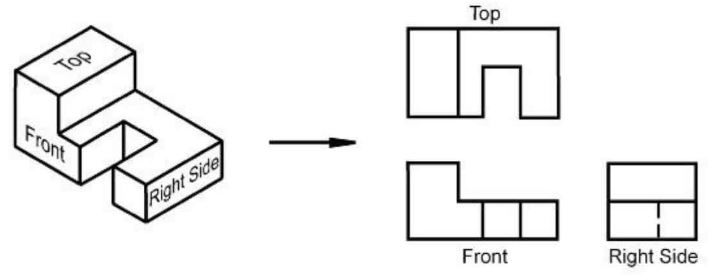
What type of projection is shown on the right?
Sketch
Isometric
Orthographic
Oblique

The drawing shown below is an example of what type of drawing?
Orthographic
P&ID
Cutaway
Isometric

Is the drawing shown orthographic projection or isometric projection?
Orthographic
Isometric

Is the drawing shown orthographic projection or isometric projection?
Orthographic
Isometric

Is the drawing shown orthographic projection or isometric projection?
Orthographic
Isometric

Is the drawing shown orthographic projection or isometric projection?
Orthographic
Isometric
Both
What two things determine whether or not engineering solutions are successful?
If it stays within the constraints
If it looks cool
If it solves a problem
If it meets the criteria
_________________________ is how people change the world around them to meet their needs or to solve problems
Systems
Processes
Technology
Science
Repeating the construct and test step of the Design Process until the prototype meets all of the project criteria.
Criteria
Constraints
Dimension
Iteration
Specific items or details that must be included in the final version of the design.
Criteria
Constraints
Dimension
Iteration
To assess or check whether the design meets the specific project criteria.
Brainstorming
Investigate
Problem Solving
Evaluate
A person who designs any of a variety of things to solve practical problems, using science, technology, and math.
Engineer
Prototype
Problem Solving
Brainstorming
One day in November, Marisol opened her locker and had to quickly jump back to avoid the cascade of her belongings falling to the floor. “Oh no,” she yelled. “This isn’t cool!” Marisol quickly began to scoop her things back into her locker, but after putting everything away, she was late to her next class. Unfortunately, this wasn’t the first time the locker avalanche had happened. “I’ve got to find a way to organize my locker,” she said to herself. What stage of the Engineering Design Process is this?
Identifying/Defining a Problem
Developing Ideas
Evaluating Ideas
Criteria/Constraint
In order to generate possible ideas for her own locker, Marisol used her smartphone to take photographs of her friends’ lockers—or at least photographs of those that were organized. She would have to make an organizer herself. Since her parents only gave her a few dollars a week for allowance, she’d have to make an organizer for less than $3. This would describe what part of the engineering design process?
The constraints
The criteria
Developing Ideas
Evaluating Ideas
What do you have to do before building "a prototype"? Select all that apply
Define the problem
Do a research
Communicate results
Specify requirements
Brainstorm, Evaluate & choose
Why is it important that multiple people be included in the
brainstorming process?
More ideas are uncovered
Different backgrounds will allow for different ideas to take shape
It creates ownership of all members on a team
All of the above

A precise and detailed drawing of an object, as employed in architecture or engineering.
Proportions of freehand sketching
Inches to Millimeter Conversion Rate
Mode
Technical Sketching/Drawing
A method for visually representing three-dimensional objects in two dimensions in technical and engineering drawings.
Multiview Drawing
Isometric View
Oblique View
Front View Determination
You should acquire the proper training before attempting to use a hand tool for the first time.
True
False
Using the incorrect tool for the job can cause:
loss of employment; unintended accidents.
injury to a person; damage to the tool.
unintended accidents; increase in productivity .
damage to the tool, decrease in productivity.
Keeping __________ clean and ______________ clear of debris will help prevent accidents.
floors; workspace
rooms; equipment
tools; gfci
storage rooms; ladders
You should always carry and store tools in a safe and secure manner.
True
False
If a person is too far away, you may throw a tool at him if he needs it.
True
False
Pass tools to others _____________ first.
tip
handle
turned off
stored
Never hold material by hand while _________________.
drilling/sawing
drill press
building
complete
Tools can be taken from the room
at any time.
when you need it outside
never.
You should always carry hand tools by:
The handle
The sharp edge
The Blade
Tools should only be used for,
anything you can think of.
to hit anything.
their intended purpose.
Loose ___________ or ___________ has the potential to catch on power tools/equipment.
hair; shoes
clothing; jewelry
hair net; necklace
headphones; caps

