
NEW
Font size
 Worksheets
Unit 5 review
Total questions: 53
Worksheet time: 43mins
Cell differentiation is critical during embryonic development. The process of cell differentiation results in the production of many types of cells, including germ, somatic, and stem cells. Cell differentiation is most directly regulated by —
DNA
Proteins
Lipid
Carb
In 1917 the biologist Thomas Hunt Morgan conducted studies in which he kept some caterpillars in the dark and placed some others under red, green, or blue lights. Exposure to red light produced butterflies with brightly colored wings. Exposure to green light resulted in dark-colored wings. Exposure to blue light or no light resulted in pale- colored wings. What was the most likely conclusion of Morgan’s research?
The pigment in butterfly wings absorbs light from the environment.
Caterpillars exposed to red and green light are healthier than caterpillars exposed to no light or blue light.
The genes regulating wing color in butterflies are influenced by environmental factors.
The phenotypic expression of wing shape depends on color pigmentation in butterflies.
Tomato plants usually have hairy stems. Hairless stems are present in tomato plants that are homozygous recessive for this trait. If the stem characteristics are determined by a single gene, what is the expected outcome of crossing two tomato plants that are heterozygous for hairy stems?
100% hairy stems
100% hairless stems
50% hairy stems
50% hairless stems
75% hairy stems: 25% hairless stems
In cocker spaniels the allele for a black coat color (B) is dominant over the allele for a brown coat color (b). If a brown cocker spaniel is crossed with a heterozygous black cocker spaniel, which of the following genotypic ratios can be expected?
1 BB: 1 Bb: 2 bb
1 BB: 2 Bb: 0 bb
0 BB: 2 Bb: 2 bb
0 BB: Bb: 4 bb
If several pea plants with the genotype TTYy are crossed with pea plants with the genotype Ttyy, what percentage of the offspring will be expected to have the TTYy allele combination?
25%
30%
50%
75%
In the 1860s Gregor Mendel performed numerous dihybrid crosses between pea plants. Dihybrid crosses involve the study of the inheritance patterns related to two different traits. In guinea pigs the allele for black fur (B) is dominant over the allele for brown fur (b), and the allele for short fur (F) is dominant over the allele for long fur (f). What percentage of the offspring from a BbFf x bbff cross would be expected to be heterozygous for both traits?
35%
50%
25%
100%

The four butterflies in the illustrations represent the offspring in the F1 generation.
Which statement is best supported by the phenotypes of these offspring?
The F1 generation is composed only of males.
Two of the offspring in the F1 generation will not be able to reproduce.
The F1 generation is the result of a dihybrid cross
Two of the offspring in the F1 generation will experience a spontaneous mutation.
Albinism is an autosomal recessive condition. Which answer choice shows the genotype probability when an albino female mates with a male that is heterozygous for the albinism trait?
50% aa and 50%Aa
25%aa 25% Aa and 50% AA
100%Aa
50% AA and 50%aa
From a single fertilized ovum undergoing a series of rapid cell divisions, a human infant develops. The embryonic cells become specialized for a variety of functions. Which of these statements best describes how different cell types develop?
Each cell has an identical copy of DNA with enzymes controlling the expression of specific genes, leading to a variety of cells
Each cell has different copies of DNA with enzymes controlling the expression of specific genes, leading to a variety of cells
Each cell has only one type of DNA controlling the expression of specific genes, leading to a variety of cells
Each cell has sugars controlling the expression of specific genes, leading to a variety of cells
In humans blood type is determined by the A, B, and O alleles. The A and B alleles are codominant to each other and dominant over the O allele. An individual with the AO genotype and an individual with the BO genotype can produce offspring with which of the following phenotypes?
A
A,B,AB, O
A and B
O only
The Himalayan rabbit’s habitat has cold, snowy winters and mild summers. The body is typically covered in white fur except for the nose, feet, tail, and ears, which are covered in black fur.
A scientist shaved an area of white fur on the back of a Himalayan rabbit and placed an ice pack over the shaved area. The shaved area grew black fur.
Which of these best explains why the hair that grew back where the ice pack was placed was black and not white?
The genes for black hair were activated by specific temperatures.
The black hair was under the white hair
White hair only grows in nature not a lab
Black hair only grows inside
Human bone, muscle, and nerve cells all contain the same number of chromosomes with the same complement of genes. What enables these cells to perform specialized activities?
The ability of some cells to remove unnecessary DNA sequences
The mutation of genes within each cell type
The regulation of gene expression within each cell type
The use of different methods of cell division
Crossing-over between nonsister chromatids during meiosis is significant in heredity. This process most likely leads to an increase in which of the following?
Genetic variation
The expression of dominant traits
Number of gametes
The occurrence of polyploidy
Sexual reproduction in animals depends on the production of gametes. Which of these processes produces gametes in animals?
Fertilization
Meiosis
Mitosis
Cloning
Human body cells each have 46 chromosomes in their nuclei. Meiosis is necessary in order to ensure that each gamete produced in the human body has how many chromosomes
23
46
18
9
Normal fruit flies have brownish-yellow bodies, and this body color is dominant. A mutation in the gene for body color can produce flies with an ebony body color. A homozygous normal fruit fly (EE) is crossed with a homozygous ebony fruit fly (ee). What is the predicted outcome of this genetic cross?
All the offspring will have brownish-yellow bodies.
All the offspring will have ebony bodies.
Of the offspring, 75% will have brownish-yellow bodies, and 25% will have ebony bodies
Of the offspring, 75% will have ebony bodies, and 25% will have brownish-yellow bodies.
Male sex chromosomes
XX
XY
HH
Homozygous
Heterozygous
Female sex chromosomes
XX
XY
Hh
Homozygous
Heterozygous
Body cells are also called
somatic cells
sex cells
zygote
cell
How many chromosomes in a human sex cell
46
23
1
92
The process that makes more body cells is called
Mitosis
Meiosis
Reproduction
DNA Replication
Parts of the DNA responsible for traits.
DNA
GENE
PROTEIN
CHROMOSOME
How a trait is expressed is called the:
phenotype
dominant
genotype
recessive
What are the bases in our DNA?
A, T, C, G
A, U, C, G
A , B, C, D
A, U, C, D
What do you call to the point where two chromatids are attach?
centromere
chromosome
telomere
arms
Which of the following is a Homozygous Dominant Genotype?
Yy
XX
zz
Which of the following is a homozygous recessive genotype?
HH
dd
Aa
Which of the following is a heterozygous genotype?
Gg
UU
pp
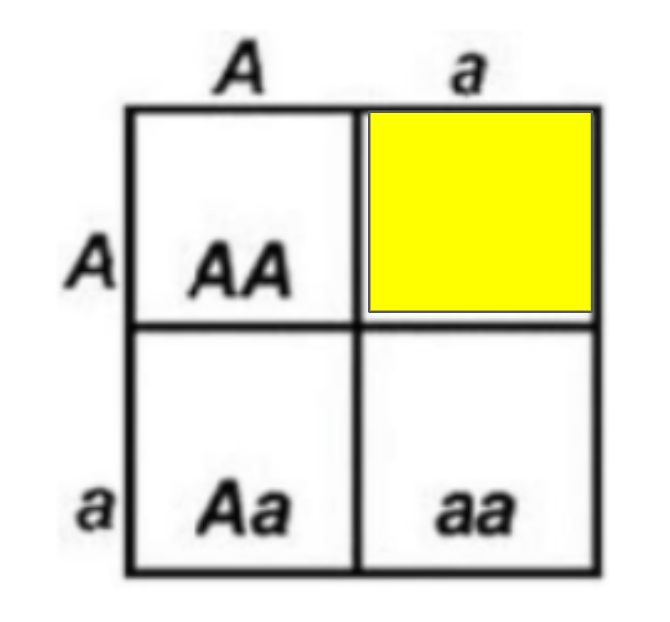
Fill in the Yellow Box
AA
Aa
aa
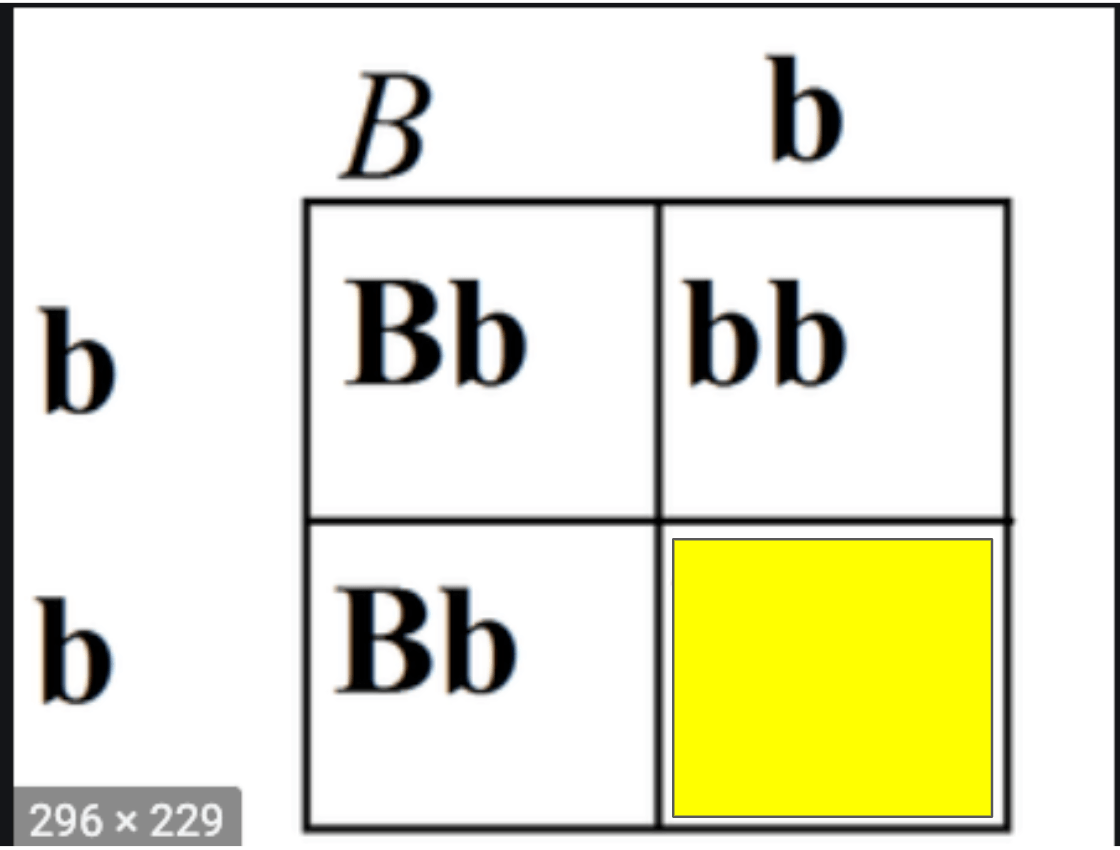
Fill in the Yellow Box
Bb
BB
bb
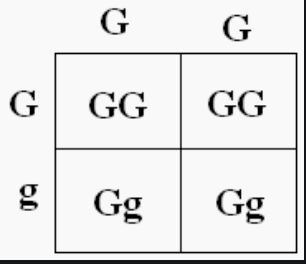
How chance the offspring born from this cross will have a homozygous dominant genotype?
25%
50%
75%
100%
The punnett square is used to tell the color of a frogs skin. "G" means green skin and "g" means brown skin. What is the chance the baby frogs will have brown skin?
0%
25%
50%
100%
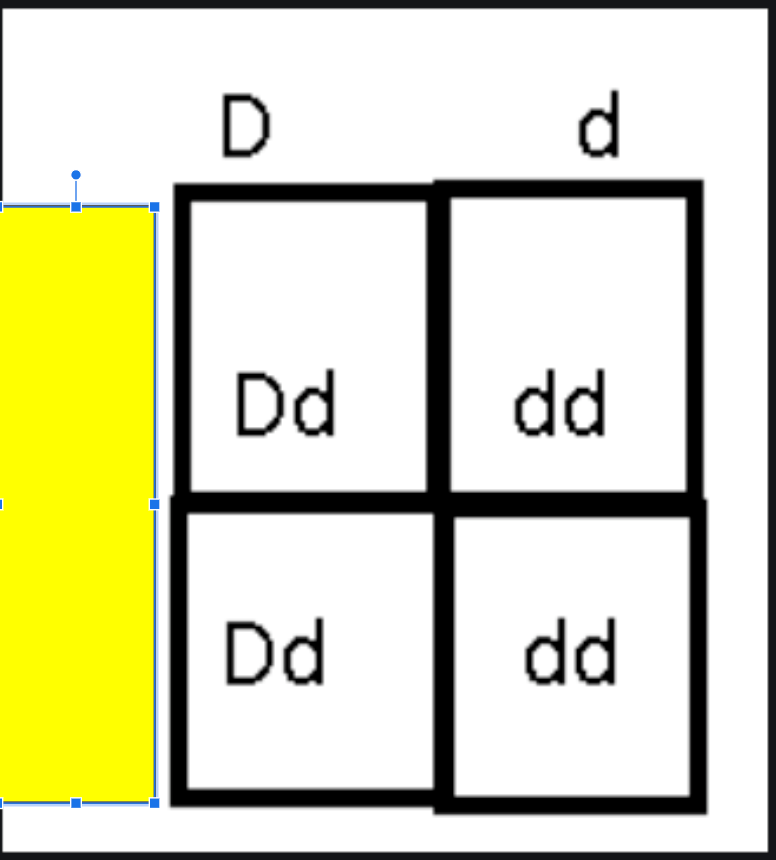
What is the mother's genotype?
DD
Dd
dd

In the punnett square below, what belongs in the missing square


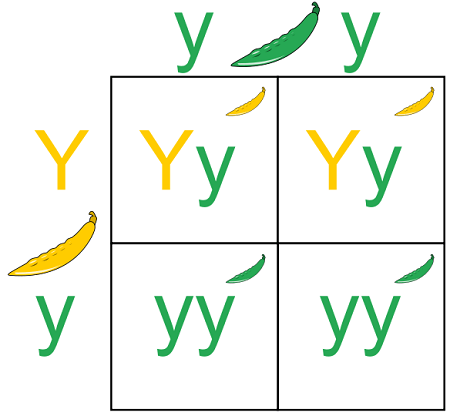
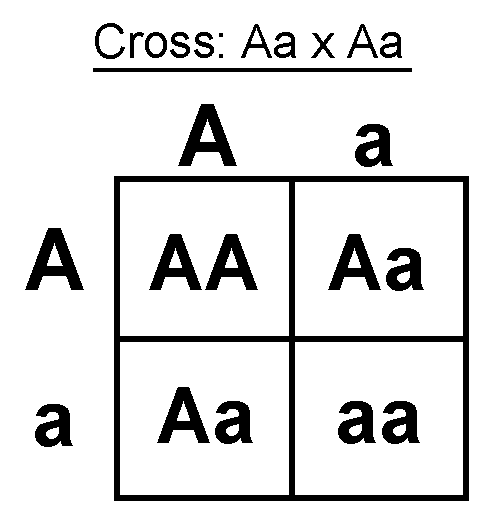

In a certain species of plant, the color purple (P) is dominant to the color white (p).
According to the Punnett Square, what is the probability of an offspring being purple?
25%
0%
100%
50%


A way to predict genetic probability using two different
sets of alleles on two different chromosomes.
Co-Dominance
Incomplete Dominance
Monohybrid Cross
Dihybrid Cross
(RRYY x rryy)
R = round seeds, r = wrinkled seeds Y = yellow seeds, y = green seeds
What percent will have Round and Yellow seeds?


Based off this punnett square, what fraction of the offspring will have wrinkled, yellow seeds?
9/16
3/16
1/16
16/16


Which diagram demonstrates how crossing-over contributes to genetic variety during meiosis?



