
 Worksheets
Topic 3 Semester Exam Review
Total questions: 240
Worksheet time: 9hrs 7mins


What directions would you give?
Reflect over the line: ________


True or False: When a point is reflected across a line of symmetry, it remains the same distance from that line.
True
False
∆QRS contains the points: Q(4, 2) R(5, 1) S(3,7). If the triangle is reflected across the x-axis, what will Q' be?
Q'(4, 2)
Q'(-4, 2)
Q'(-4, -2)
Q'(4, -2)
Level 1: What is this transformation?
(x, y) →(-x, y)
Reflect over the x axis
Reflect over the y-axis
Slide down 1
slide left 1
Triangle XYZ is reflected across the y-axis. If (x,y) are the coordinates of one of its vertices, which ordered pair represents the reflected vertex?
(-x, y)
(y, -x)
(x, -y)
(-y, x)
What changes when an ordered pair, or point, is reflected across the y-axis?
Neither the x-value nor the y-value
y-value only
x-value only
Both the x-value and the y-value

What is the Algebraic Notation for this Reflection? #6
(x, y) → (y, x)
(x, y) → (-x, y)
(x, y) → (-y, -x)
(x, y) → (x, -y)
What is the rule for the reflection over the line y=x?
ry=x(x, y) → (–y, –x)
ry=–x(x, y) → (–y, –x)
ry=x(x, y) → (y, x)
ry=–x(x, y) → (y, x)

What are the coordinates of the image of vertex G after a reflection across the line y = x?
(–4, –5)
(4, 5)
(–5, 4)
(5, –4)

What are the coordinates of the image of vertex F after a reflection across the line y = –x?
(–1, –3)
(3, –1)
(1, 3)
(–3, 1)

Identify the transformation from ABC to A'B'C'.
90o counterclockwise rotation
Reflection across the x-axis
Translation
90o clockwise rotation
(x, y) ----> (-x, y)
Reflections over the x-axis change the __________.
y-coordinate
x-coordinate
The point (-2,5) is reflected over the line x = 1. Find its image.
(4, 5)
( -2 , -5)
(2 , 5)
(2 , -5)

What is the rule for the following reflection?
Reflection across x-axis
Reflection across y-axis
Reflection across y = x
Reflection across y = −x
True or False: Rigid motions preserve angle measure.
True
False
True or False: Rigid motions preserve segment length.
True
False


(x, y) ----> (x + 2, y - 3)


What vector translates triangle ABC to A’B’C’?
<-5, 1>
<5, -1>
<-6, 2>
<6, -2>
The image of point (2, 8) when translated using the rule (x, y) → (x, y-1) is:
(2, 7)
(1, 8)
(1, 7)
(0, 7)
What are the coordinates of R', the image of R(-1, 4), after a translation of 2 units right and 3 units down?
(-3, 1)
(3, 7)
(-1, 7)
(1, 1)
When a shape is translated in the coordinate plane, it has undergone a rigid transformation. Which of the following are definitely true statements about the image of a shape after a translation? Select all that apply.
The size of the shape is the same.
The orientation of the shape is the same.
A translation is in simple terms a flip.
Each point moves the same distance in the same direction.

Translate the blue shape to the pink shape...
5 Right
2 Down
5 Left
2 Up
3 Right
1 Down
3 Left
1 Up

Translate shape B to shape A...
5 Right
3 Up
5 Left
3 Down
3 Right
3 Up
3 Left
3 Down

Slide 3 up and 2 right

When translating left or right on a coordinate plane, what coordinate is affected?
x-coordinate
y-coordinate
When translating up or down on a coordinate plane, what coordinate is affected?
x-coordinate
y-coordinate
(x, y) -----> (x, y +4)
Determine how to translate triangle ABC to triangle A'B'C' ?
(x + 2, y - 5)
(x + 2, y - 9)
(x - 2, y - 9)
(x - 2, y + 9)
What is the algebraic representation of a figure is Translated 9 units right and 3 units down?
(x, y) -->
(x - 9, y + 3)
(x, y) -->
(x + 9, y - 3)
(x, y) -->
(x + 3, y - 9)
(x, y) -->
(9x, 3y)
(x, y) ----> (x - 1, y)
What are the coordinates of M'?
What does the word translation mean in math?
To change an object by flipping it
To change an object by turning it
To change an objects by sliding it

Select the picture showing a translation of:
4 squares right and 1 square up


Select the picture which shows a translation:
4 squares right and 5 squares down


What color is the pre-image?
blue
purple

What color is the image?
red
blue

What is another name for a translation?
Slide
Flip
Mirror
Select the picture showing a translation of:
2 squares right and 1 square up
Select the picture showing a translation of:
4 squares right and 1 square up
Select the picture which shows a translation:
4 squares right and 5 squares down
Find the image of P(3, 4) after the composition of translations (x, y)→(x+1, y−2) and (x, y)→(x−5, y+1) .
(−2, 5)
(4, 2)
(−1, 3)
(2, 6)
Find the image of D(0, −2) after the composition of translations (x, y)→(x+10, y−8) and (x, y)→(x−7, y+15) .
(3, 5)
(10, −10)
(−7, 13)
(−4, 8)

WRITE A TRANSLATION RULE FOR THE IMAGE.
(x + 3, y - 1)
(x - 3, y + 1)
(x + 2, y + 1)
(x + 5, y + 3)

How can this transformation be represented algebraically?
(x, y) → (-x, y)
(x, y) → (7x, 3y)
(x, y) → (x + 7, y -3)
(x, y) → (x - 7, y + 3)
D(3, 4) and D'(5, -13) are the pre-image and image of a given triangle. What is the translation?
(x, y) → (x-2, y+13)
(x, y) → (x+2, y-13)
(x, y) → (x+2, y-17)
(x, y) → (x-2, y+17)


Square ABCD is translated by the rule (x, y) → (x – 3, y + 1). What are the coordinates of D′?
Point D is (1,3)
(–2, 4)
(4, 2)
(0, 0)
(–3, 4)

In the figure, triangle PQR has vertices P(0, −1), Q(3, −1) and R(5, −3). What are the vertices of the image after the translation (x, y) → (x − 5, y + 1)?
P′ (1, −6), Q′ (4, −6), R′ (6, −8)
P′ (−5, 0), Q′ (−2, 0), R′ (0, −2)
P′ (5, −2), Q′ (8, −2), R′ (10, −4)
P′ (−1, 4), Q′ (2, 4), R′ (4, 2)

What is the image for the point (5, 5) and the rule (x, y) → (x + 2, y-3)?
(7, 2)
(7, -4)
(3, 2)

Identify the transformation FROM Δ ABC
TO Δ A'B'C'.
right 8 up 4
left 4 down 4
right 4 up 4

What is the translation rule?
(x, y) →(x - 4, y + 5)
(x, y) →(x + 5, y - 4)
(x, y) →(x + 4, y - 5)
(x, y) →(x - 4, y - 5)

If the quadrilateral is translated 4 units to the left and 5 units down what is the coordinates for Point A'?
(4,0)
(0,4)
(-1,5)
(5,-1)
What transformation is happening?
(x, y) → (x + 2, y - 3)
slide up 2, left 3
slide right 2, up 3
slide right 2, down 3
slide left 3, right 2
What happens to (-9, 3) when it is translated 4 units down and 3 units right?
(-6, -1)
(-13, 6)
(-5, 6)
(-6, 7)
Square ABCD was translated using the rule (x, y) → (x – 4, y + 15) to form A'B'C'D'. What are the coordinates of point D in the pre-image if the coordinates of point D’ in the image are (9, –8)?
HINT: DO THE OPPOSITE OPERATION OF THE RULE
(13, –23)
(5, 7)
(18, 1)
(–6, –4)
Hexagon DEFGHI is translated 8 units down and 3 units to the right. If the coordinates of the pre-image of point F are
(–9, 2), what are the coordinates of F'?
(–17, 5)
(–6, –6)
(–17, –1)
(–12, –6)
Rectangle ABCD has vertices A(–6, –2), B(–3, –2),
C(–3. –6), and D(–6, –6). The rectangle is translated so that the coordinates of the image are A’(–10, 1), B’(–7,1),
C’(–7, –3), and D’(–10, –3).
(x, y) →(x–4, y+3)
(x, y) →(x–4, y+1)
(x, y) →(x+4, y–1)
(x, y) →(x+4, y–3)

The dashed figure is the image of the solid figure. What is the Algebraic Notation for the Translation?
(x, y) → (x - 7, y + 4)
(x, y) → (x + 7, y - 4)
(x, y) → (x + 4, y + 7)
(x, y) →(4x, 7y)
Triangle ABC has vertices at A(6, 1) B(1, 7) and C(-3, -2). The translation to create triangle A'B'C' is (x, y)(x, y) → (x - 1, y + 2). Which will be the coordinates of triangle A'B'C'?
A'(5, 2), B'(0, -4), C'(0, 9)
A'(5, 3), B'(0, -4), C'(0, 8)
A'(5, 3), B'(0, 9), C'(-4, 0)
A'(5, 2), B'(1, -3), C'(0, 9)
What is the image of the point (3, 3) under the translation (x, y)→(x+1, y−4) ?
(4, -1)
(2, 7)
(-1, 4)
(7, 2)
What is the translation rule that maps the point P (4, 1) to the point P' (-3, -5)?
(x, y)→(x − 7, y −6)
(x, y)→(x +7, y + 6)
(x, y) → (x−1, y + 4)
(x, y) → (x+1, y −4)
What is the translation rule that maps the point P (1, -1) to the point P' (-1, 5)?
(x, y)→(x − 2, y +6)
(x, y)→(x +2, y − 6)
(x, y) → (x−2, y + 4)
(x, y) → (x+1, y −4)
Determine how to translate triangle ABC to triangle A'B'C'.
(x - 9 , y + 2)
(x + 2, y - 9)
(x - 2, y + 5)
(x - 2, y + 9)

Which direction is the resultant translation?
up
down
left
right
What is the magnitude of the resultant translation?
2.5
5
10
20


State the image of the point.


State the image of the point.


When you rotate 180 degrees the ( x , y ) becomes ?
( y , x )
( -y , x )
( -x , y )
( -x , -y )

Rotation Rules (clockwise):
90o rotation: (x, y)→(y, -x)
What are the coordinates for A' after a 90⁰ rotation clockwise?
(1, 3)
(3, 1)
(3, -1)
(1, -3)

Rotation Rules (clockwise):
180o rotation: (x, y)→(-x, -y)
What are the coordinates of C' after a rotation of 180° clockwise?
(-3, -1)
(3,1)
(1,3)
(-1, -3)

Rotation Rules (clockwise):
270o rotation: (x, y)→(-y, x)
What are the coordinates of B' after a 270° clockwise?
(4, 4)
(4, -4)
(-3, 4)
(-4, 4)

Does the image show a rotation? If so, what is the angle of rotation?
90° counterclockwise
180° counterclockwise
270° counterclockwise
Not a rotation

Does this image show a rotation? If so, what is the angle of rotation?
90° counterclockwise
180° counterclockwise
270° counterclockwise
Not a rotation
(x, y) ---> ___________
(x, y) ---> ___________
(x, y) ---> ___________
(x, y) ---> ___________


State the image of the point.
When you rotate 180 degrees the ( x , y ) becomes ?
( y , x )
( -y , x )
( -x , y )
( -x , -y )
If (4,-2) → (4,-2) represents a counterclockwise rotation of the point on a coordinate plane, how many degrees is the rotation?
90
180
270
360

Under what composition of transformations does triangle ABC map onto triangle A''B''C''
Reflection over x-axis, then Rotation of 90 Degrees
Rotation of -90 Degrees, then Reflection over y-axis
Reflection over y-axis, then Rotation of -90 Degrees
Rotation of 90 Degrees, then Reflection over x-axis

What is the transformation from Triangle ABC to Triangle A''B''C''?
Reflection x-axis, then rotation of 180 Degrees
Reflection over y-axis, then rotation of 90 Degrees
Rotation of 90 Degrees, then reflection over x-axis
Rotation of 180 Degrees, then reflection over y-axis
A double reflection over the x- and y-axes is the same as a ____________ of ______.
Rotation of 180 Degrees
Rotation of 90 Degrees
Reflection over the x-axis
Reflection over the y-axis

A transformation in which a second transformation is performed on a image of a first transformation is called
composition of transformation
translation
rigid motion
reflection

(x, y) ----> (x + 2, y - 3)

What axis is the triangle being reflected over?
X-axis
Y-axis


Identify the transformation:
Rotation
Reflection
Translation
Dilation
Point A is rotated 180 degrees and then flipped over the y-axis. What is A" if A is (2,7)
(2,7)
(-2, -7)
(-2, 7)
(2, -7)
Find Q''' if Q(-3, 1) is reflected over the x-axis, then rotated 90 degrees, and then translated right 3 and up 4.
(-3, 1)
(4, 1)
(4, -1)
(-3,-1)
Triangle ABC is rotated 90 degrees and then translated up 4 and left 5. What is point A if point A''' is (1,2)?
(2, -4)
(2,6)
(4, -2)
(-2 -6)


Identify the transformations:
translation and rotation
translation and reflection
rotation and reflection
translation and dilation
two translations

What transformation gets you from Triangle ABC to Triangle A"B"C"?
(a)

How do you get from the red triangle to the orange triangle?
reflection over the y-axis and then the x-axis
rotate 270 degrees and reflect over y = 2
reflection over the y-axis and translate up 7
rotate 180 degrees and reflect over y = 2
translate up 7, translate right 6, and then reflect over the x-axis

How do you get from the green triangle to the orange triangle?
rotate clockwise 90 degrees
rotate counterclockwise 180 degrees
translate right 11 and up 9, then translate down 3 and left 2
translate right 12 and up 4
reflect over the y-axis then the x-axis

How do you get from the blue triangle to the red triangle?
reflection over y = 2, translate right 5
rotate 180 degrees
rotate 270 degrees
translate right 5 and reflect over the y-axis
do the cha cha slide
Is the diagram an example of a glide reflection?
Yes, the direction of the translation is parallel to the line of reflection.
No, the direction of the translation is not parallel to the line of reflection.

Which of the following is the correct sequence of transformations that maps triangle ABC onto triangle DEF?
A reflection over the x-axis followed by a translation moving up.
A reflection over the y-axis followed by a translation moving up .
A reflection through the origin followed by a translation moving down.
A translation moving down followed by a reflection over the y-axis.

Which sequence of transformations maps figure 1 onto figure 2 and then figure 2 onto figure 3?
a reflection followed by a translation
a rotation followed by a translation
a translation followed by a reflection
a translation followed by a rotation

Which sequence of transformations maps triangle ABC onto triangle DEF?
a reflection over the y-axis followed by a reflection over the x-axis
a 180 degree rotation about the origin followed by a reflection over the line y=2
a 90 degree clockwise rotation about the origin followed by a reflection over the line y=x
a translation 8 units to the right and 1 unit up followed by a 90 degree counterclockwise rotation about the origin

Is the diagram shown a representation of a glide reflection?
ΔABC≅ΔDEF(*hint* - rename one of the triangles as A'B'C' or D'E'F')
yes
no

Given ΔABC≅ΔRST . Is the mapping considered a glide reflection?
yes
no
What are the coordinates of B' after a reflection over the x-axis then (x,y)->(x+1,y+2). Show all of your work. Label the points.
(5, -2)
(4, -4)
Off the graph
(-4, 4)

Find the image of A( -3, 5) after translating (x,y) --> (x , y - 4) then reflecting across the y-axis. Show your work on the graph. Label each point.
(3,1)
(3, -1)
(-1, 5)
(-1, 3)
What would the coordinate of A" be after being reflected over the x-axis then (x,y)->(x + 3, y + 2)?
(-3, 6)
(-6, 3)
(6, -3)

Name the series of transformations that maps ABC onto DEF.
The coordinates of triangle JRB are ,J(1, -2) , R(-3, 6) and B(4, 5) . What are the coordinates of the vertices of its image after the transformation T(2, -1) o ry-axis ?
(3, 1), (-1, -7), (6, -6)
(3, -3), (-1, 5), (6, 4)
(1, -3), (5, 5), (-2, 4)
(-1, -2), (3, 6), (-4, 5)

A double reflection over two parallel line results in a ____________.
Reflection
Translation
Rotation
Dilation
A double reflection over the x- and y-axes is the same as a ____________ of ______.
Rotation of 180 Degrees
Rotation of 90 Degrees
Reflection over the x-axis
Reflection over the y-axis



How many lines of symmetry does a square have?
1
2
4
8
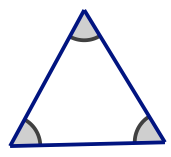
Which of the following shapes show a line of symmetry?
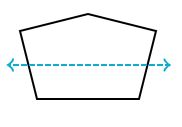
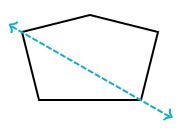
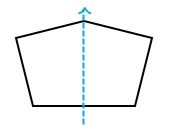


Which of the following transformations carry this regular polygon onto itself?
Rotation of 36 degrees counterclockwise
Rotation of 120 degrees counterclockwise
Rotation of 90 degrees counterclockwise
Reflection across l


Which letter has ONLY rotational symmetry?


What type of symmetry do all 3 images have in common?
rotational
reflectional
both
neither
How many lines of symmetry does a circle have?
0
1
infinitely many
2
Which of the following shapes does not have a line of symmetry?


What kind of symmetry does this figure have?
Reflectional
Rotational
Both
Neither

How many lines of reflection does this image have?
0
1
2
4

What is the angle of rotation?
60 degrees
36 degrees
10degrees
The shape does not have rotational symmetry

What is the angle of rotation?
40 degrees
90 degrees
180 degrees
none

What is the angle of rotation?
60 degrees
90 degrees
120 degrees
180 degrees

What is the angle of rotation?
120 degrees
30 degrees
60 degrees
180 degrees


What is the angle of rotational symmetry?
360°
180°
120°
90°



How many lines of symmetry does a circle have?
0
1
infinitely many
2
Which of the following shapes does not have a line of symmetry?
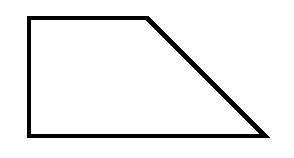
How many lines of symmetry does a square have?
1
2
4
8


Which of the following transformations carry this regular polygon onto itself?
Rotation of 45 degrees counterclockwise
Rotation of 60 degrees clockwise
Rotation of 60 degrees counterclockwise
Rotation of 36 degrees counterclockwise

Which of the following transformations carry this regular polygon onto itself?
Rotation of 45 degrees counterclockwise
Rotation of 72 degrees counterclockwise
Rotation of 60 degrees counterclockwise
Reflection across l

Determine whether the figure has line symmetry, rotational symmetry, both, or neither.
Rotational
Reflectional
Both
Neither
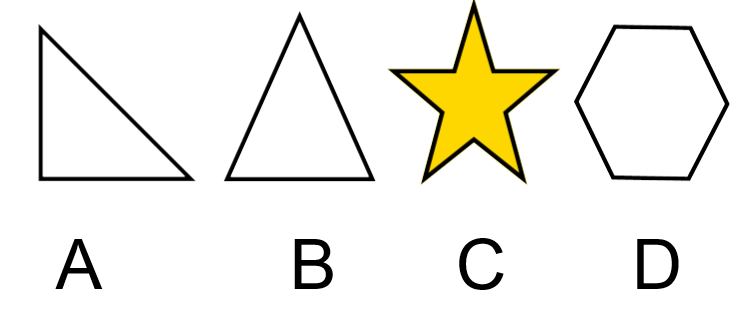

How many lines of symmetry are there on an equilateral triangle?
0
1
2
3
A figure has _______ symmetry when a line (or lines) divide the shape into two equal parts.
Line
Rotational
Point


is symmetrical
not symmetrical

