
 Worksheets
AP Chem practice Quiz
Total questions: 29
Worksheet time: 7hrs 15mins
What are the coefficients that will balance the skeleton equation below?
__Na + __F₂ → __NaF
1, 2, 1
2, 1, 2
1,1,1
2,2,2
What are the coefficients that will balance the skeleton equation below?
___N₂ + __H₂ → __NH₃
1,3,2
1,2,3
3,2,1
1,2,1
What number do I need to balance the following chemical reaction?
C4H8+ _ O2→4CO2+4H2O
2
4
6
8
From the reaction: B2H6 + 3O2 -->2 HBO2 + 2 H2O
What mass of O2 will be needed to burn 36.1 g of B2H6?
B2H6 = 27.68 g/mol
13.8 g O2
3.91 mol of O2
125 g O2
41.7 g O2
Determine the empirical formula for a compound with the following percent composition: 15.8% carbon and 84.2% sulfur
(molar masses: C = 12.011 g/mol, S = 32.065 g/mol)
CS3
CS2
C2S4
C2S
2H2 + O2 --> 2H2O
12 grams of H2 are reacted with 36 grams of O2.
Calculate the amount of excess reactant.
4.5 grams
7.5 grams
12.5 grams
36.5 grams
When you place the metal in boiling water, heat flows from the _________ to the _______.
metal to the boiling water
bottom of the metal to the top half of the metal
bottom of the water to the top of the water
boiling water to the metal
Define ΔH
Change in Specific Heat; Heat by one Degree Celsius
Change in Temperature; the energy we calculate; Degree Celsius
Change in Enthalpy; the energy/heat we calculate
Change in Time; time travel


Shown are the units for....
specific heat capacity
mass
temperature
energy
20 g of water. The specific heat of water is 4.18 J/g°C. temperature changes from 25° C to 20° C, how much heat energy (Q) moves from the water to the surroundings?
Endothermic reactions feel
warm
cold
What does Gibbs Free Energy tell us?
How much energy is given off by a reaction.
The tendency of a reaction to become "random"
How spontaneous a reaction is.
Which of the following would most likely lead to a spontaneous reaction.
A high negative enthalpy.
A low negative enthalpy.
A high positive enthalpy.
A low positive enthalpy.
What are the best conditions to lead towards a spontaneous reaction?
high negative enthalpy, high temp, high negative entropy
high positive enthalpy, high temp, high negative entropy
high negative enthalpy, low temp, high positive entropy
high negative enthalpy, high temp, high positive entropy.
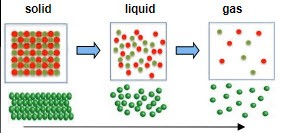
Which represents a decrease in entropy?
sublimation of CO2
boiling water
condensation of steam on cold glass
NaCl dissolving in water
Which sample has the lowest entropy?
HINT - Look at the phase of each chemical....
1 mole of KNO3(l)
1 mole of KNO3(s)
1 mole of H2O(l)
1 mole of H2O(g)
What is a spontaneous process ?
slow process
fast process
process that needs an external intervention to occur
process that does not need external intervention to occur / keep happening
Of the following reactions, which of the following is only spontaneous at high enough temperatures?
∆H –, ∆S +
∆H +, ∆S –
None of the Above
∆H –, ∆S –
∆H +, ∆S +
A chemical reaction has the following changes in enthalpy and entropy.
ΔH=+380kJ
ΔS=+870J/mol
What is the temperature range for this reaction that allow it to be spontaneous?
T>437K
T<437K
T>−437K

