
 Worksheets
Fall Semester Review 2022
Total questions: 65
Worksheet time: 37mins
Earth's atmosphere is made up mostly of which elements? (6.5B)
Carbon dioxide and oxygen
nitrogen and helium
helium and carbon dioxide
nitrogen and oxygen
Which word describes two or more elements that are mixed together in a fixed proportion? (6.5C)
mixture
Compound
Element
Atom
A scientist isolates an element during an experiment. How can he know that it is an element? (6.5C)
It is made up of only one type of atom.
It is made up of exactly two types or atoms.
It is in the periodic table.
It has characteristics.
A student is given a sample of an unknown substance. He is asked to determine if it is classified as a metal, a metalloid, or a nonmetal. He discovered that the unknown element conducted some heat and electricity, had a shine luster, and broke easily. this element is most likely a (6.6A) -
metal
nonmetal
metalloid
cannot be determined
Which of the following correctly list the three main groups of elements from greatest conductivity to least conductivity? (6.6A)
Nonmetals-metalloids- metals
metals-nonmetals-metalloids
metalloids-metal-nonmetals
Metals-metalloids-nonmetals
John was observing the physical properties of elements in order to classify them as either a metal, nonmetal, or metalloid. The first element was dull, brittle, and do not conduct heat, what is the element most likely classified as (6.6A)
metal
metalloid
nonmetal
Which element makes up most of the element of the Earth's crust? Write the element names and its chemical symbol. (6.5A)
Lorena is in the lab trying to demonstrate that she is capable to create a new substance during his experiments. What are the sign of the formation of a new substance? (6.5C)
A chemical reaction where color and temperature change.
A chemical reaction where formation of gas, change of color, and precipitate happens.
A chemical reaction where a formation of gas, change of color, change of temperature, it precipitates, change of odor might happen.
A chemical reaction where a formation of a new substance happens.

Element
Compound Molecule
Mixture
Elemental Molecule

Atom
Compound Molecule
Mixture
Elemental Molecule

Helium
Element
Compound Molecule
Mixture
Elemental Molecule

Neon
Element
Compound Molecule
Mixture
Elemental Molecule
Wind
Sunlight
Moving water
Dung
Is the fact that 'hydroelectricity is efficient and reliable' a advantage or a disadvantage?
It is an advantage
It is a disadvantage
I don't know
Geothermal Energy
Hydroelectric Energy
Fossil Fuel
Nuclear Energy
Solar Energy
Biomass
Wind Energy
Define Physical property?
The ability of a substance to change into a new substance with different properties
A substance whose molecules contain matter from two or more element
A property that can be observed, measured or changed without changing the substance itself
A pure substance made of only one kind of matter
List examples of a chemical property.
Temperature change
Fizzing
Color change
Precipitate formed
Light-when a new substance is formed light energy can be produced
A pure substance made of only one kind of matter
(a)
A substance whose molecules contain matter from two or more element.
(a)
What categories are elements classified on the Periodic Table?
Metals
Nonmetals
Metalloids
Temperature change
Can have properties of both metals and nonmetals.
(a)
What is the formula to calculate density?
volume x density
Density = mass / volume
Length x Width x Height
What units are used to measure density of a liquid?
grams
milliliters
g / mL3

Which element is Na?
neon
sodium
nitrogen
natrium
What is the Atomic Number of CO2 on the Periodic Table?
CO2 is not on the Periodic Table since it is a compound
119
1
22
Hardness, Luster, Color, Streak
Diamond, Crystal, Quartz, Calcite
Hardness, Color, Topaz, Talc
Luster, Color, Streak, Size


Which one is not a property used to identify minerals?
streak
luster
hardness
size
Mass divided by volume
streak
density
hardness
crystal structure

Which of the following would be the best description of the mineral property called luster?
A minerals resistance to being scratched.
The color a mineral gives off.
How a mineral reflects light.
Observing the color of the powder left behind when scraping across a surface.
Which BEST describes the meaning of mass of an object?
The amount of space an object or substance takes up
Mass divided by volume
The amount of matter in an object or substance
The weight of an object only in solid form and in zero gravity
Which of the following BEST describes volume?
How much space an object takes up
Where an object is in space
How much an object weighs
The mass of an object compared to its weight
If an object sinks in water than it is (a) than water and
The formula for finding density is:
The volume divided by the mass.
The mass multiplied by the volume.
The mass divided by the volume.
The volume multiplied by the mass.
You have a rock with a volume of 15cm3 and a mass of 45 g. What is its density? (a) g/cm3
You have a different rock with a volume of 30 m3 and a mass of 60 kg. What is its density? (a) kg/m3
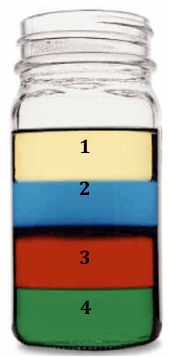
A piece of copper has a mass of 89g and a volume of 10.0 cm3. What would be the density of the copper?
0.89 g/cm3
89 g/cm3
8.9 g/cm3
890 g/cm3

10.0 cm3
15.0 cm3
20.0 cm3
25.0 cm3

Heat transfer always moves ...
cold to hot
east to west
hot to cold
north to south


Near the ceiling of a room the air is warmer. The warm air rises because of ________.
conduction
convection
radiation

The type of heat transfer that creates currents in water is called ________.
conduction
convection
radiation

Hot air inflating a balloon is an example of __________.
Radiation
Conduction
Convection
Objection
A fuel formed naturally in the ground from the remains of living organisms.
Fossil Fuel
Bio Fuel
Eco Fuel
Living Fuel
A fuel formed from living organisms such as plants & animals.
Fossil Fuel
Bio Fuel
Eco Fuel
Plant Fuel
Benefits of Bio Fuels are:
They are renewable
They take thousands of years to form.
Can be produced in the United States
They are obtained mainly in foreign countries.
Which is not a problem caused by burning things as fuel?
Production of carbon dioxide
Pollution
Loss of resources
Purification of the atmosphere
Potential energy is...
energy in motion
stored energy
What two factors affect an object's potential energy?
area and volume
area and height
mass and height
mass and velocity

The least amount of potential energy is at
a
b
c
d

The most potential energy is at
a
b
c
d
Energy cannot be created or destroyed, it just changes form:
Law of conservation of energy
Kinetic Energy
Potential Energy
Velocity
Which is not a form of kinetic energy?
Thermal Energy
Sound Energy
Chemical Energy
Mechanical Energy
Where do humans get the energy to run a mile?
Gravitational potential energy
Elastic energy
Nuclear energy
Chemical energy
A soccer ball is rolling down a hill. At which point is it experiencing the most kinetic energy?
At the top of the hill
Halfway down the hill
At the bottom of the hill
The kinetic energy level is the same the whole time

Where would this tossed baseball have the least amount of kinetic energy?
point W
point X
point y
point z
Where would this tossed baseball have the greatest amount of kinetic energy?
point W
point X
point y
point z

