
 Worksheets
SEMESTER TEST -DAY 2
Total questions: 82
Worksheet time: 1hrs 26mins
There are four groups of stars on the HR Diagram. About 90% of all stars are in the ________.
Supergiants
Giants
White dwarfs
Main sequence

Based on the data, which star would you presume would have the greatest mass? Hint: The larger the apparent brightness, the brighter the star appears.
Star X
Star Y
Star Z

How can you rearrange the words to match the diagram correctly in terms of sizes in space?
Solar systems in the largest circle, then galaxies, followed by the universe in the smallest circle.
Universe in the largest circle, then galaxies, followed by the solar systems in the smallest circle.
Galaxies in the largest circle, then universe, followed by the solar systems in the smallest circle.
The diagram is already correct.

Analyze this HR Diagram. Which group of stars is considered to have a lower than average luminosity as well as a higher than average temperature?
Giants
Main Sequence
White Dwarfs
Supergiants
Analyze this HR Diagram. Which group of stars is considered to have a higher than average luminosity as well as a lower than average temperature?
Giants
Main Sequence
White Dwarfs
Supergiants
A collection of dust and gas where stars can form is called a...
universe
nebula
black hole
supernova
Our sun is located near the edge of a ______ galaxy, named the _______.
Spiral shaped; Milky Way
Spiral shaped; Solar System
Elliptical shaped; Milky Way
Elliptical shaped; Solar System
Stars are classified on the HR Diagram by...
luminosity and brightness.
temperature and absolute magnitude (or luminosity).
temperature and apparent magnitude.
temperature and distance.
Stars radiate thermal energy through space by a process called _____ where the element _____ is converted into helium.
nuclear fusion; hydrogen
nuclear fusion; lithium
nuclear transfer; hydrogen
nuclear transfer; boron
Which of the following best describes the sun's position in the Milky Way galaxy?
The sun is a giant yellow star located close to the galactic core.
The sun is a medium yellow star located approximately 2/3 of the way down one of the galaxy's spiral arms.
The sun is a dwarf star located at the end of one of the spiral arms.
The sun is a medium yellow star located one light year from the galactic core.
Which of the following star types is the BRIGHTEST?
Supergiant
Giant
Main Sequence
White Dwarf
Which of the following star types is LEAST BRIGHT?
Supergiant
Giant
Main Sequence
White Dwarf
Which star stage could belong to Spectral Class K and have the lowest luminosity?
Supergiant
Giant
Main Sequence
White Dwarf
Which star stage could belong to Spectral Class K and have the highest luminosity?
Supergiant
Giant
Main Sequence
White Dwarf
Select ALL star stages that have greater luminosity than our Sun.
Supergiant
Giant
Main Sequence
White Dwarf
Which star stage does our Sun belong to?
Supergiant
Giant
Main Sequence
White Dwarf
Which star stage is generally the HOTTEST?
Supergiant
Giant
Main Sequence
White Dwarf
Which star stage is generally the COOLEST?
Supergiant
Giant
Main Sequence
White Dwarf
Which comparison is correct?
Supergiants are hotter and brighter than White Dwarfs
Supergiants are hotter and less bright than White Dwarfs
Supergiants are cooler and brighter than White Dwarfs
Supergiants are cooler and less bright than White Dwarfs
Which comparison is correct?
Giants are brighter than Superigants
Giants are just as bright as Supergiants
Giants are less bright than Supergiants
Giants do not have a brightness
The action in which sediments are dumped or dropped into a new location.
Weathering
Erosion
Deposition
The process by which rock materials are broken down by the action of mechanical (physical) and chemical processes.
Weathering
Erosion
Deposition
The process by which wind, water, ice or gravity transport soil, rocks, and sediments from one location to another.
Weathering
Erosion
Deposition
A mudslide flowing down a steep hill
Weathering
Erosion
Deposition
Flood waters pounding against a canyon wall and wearing/breaking it down.
Weathering
Erosion
Deposition
Caves being formed by acid rain dissolving (breaking down) underground limestone
Weathering
Erosion
Deposition
Glaciers dropped rock and sand to form terminal moraines (mounds).
Weathering
Erosion
Deposition
Muddy water being carried away by a fast moving river
Weathering
Erosion
Deposition
Water getting into cracks, freezing, and breaking the rocks or pavement
Weathering
Erosion
Deposition
Ponds filling up with sediments because they have been deposited after heavy rains
Weathering
Erosion
Deposition
Sediments settling (stopping) at the base of a cliff
Weathering
Erosion
Deposition
Waves taking/moving sand away after they crashed on the shore line.
Weathering
Erosion
Deposition

Compared to the Sun, Spica is .......
hotter and brighter
cooler and brighter
hotter and dimmer
cooler and dimmer

Ninety percent of all stars are ______ .
white dwarfs
supergiants
red giants
main sequence stars

A star with a temperature of 10,000 K and a luminosity of 5000 times greater than the Sun would be a ____________.
supergiant
red giant
white dwarf
main sequence star


Which best describes stars in area C
Brighter and Hotter
Brighter an Cooler
Dim and Hotter
Dim and Cooler

Which best describes area D?
Brighter and Cooler
Brighter and Hotter
Dimer and Cooler
Dimmer and Hotter


What small, hot, faint objects are found at B?
neutron stars
black holes
white dwarfs
brown dwarfs

The best description of a super giant star would be -
hot and bright
hot and dim
average brightness and temp
cool and bright

What type of light has a wavelength of 10 -12?
visible
infrared
radio
gamma

Which elements are in the mixture?
A only
D only
Z only
A and D
D and Z

Which elements are present in the mixture?
D and E
D and G
E and G
only D
only G


The color of emitted light with the SHORTEST wavelength is
violet
green
red
indigo

Which two element make up most of the sun?
helium and hydrogen
ammonia and methane
hydrogen and oxygen
oxygen and helium

Which of the following has the longest wavelength?
microwaves
UV rays
Infrared
Gamma rays

Which of the following has the most energy?
TV
Microwaves
Radiowaves
Infrared

Small chunk of rock falling through planet's atmosphere
comet
meteor
star
asteroid


A rocky body in orbit around a planet.
Moon
Comet
Meteorite
Nebula
The Milky Way
Star
Moon
Planet
Galaxy
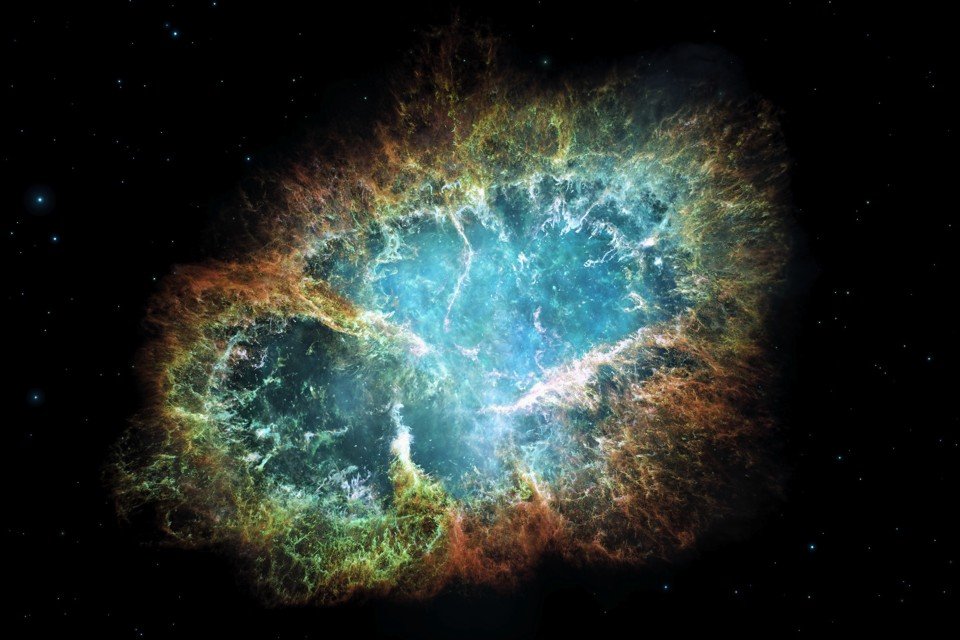

Our sun is in what stage?
planetary nebula
protostar
main sequence
red giant

Why can't we see the entire shape of the Milky Way Galaxy?
Earth is part of the Milky Way
More stars exist outside of the galaxy
the stars in the center are very small
the center of the galaxy is a dense star cluster

This is a model of a galaxy a student made out of sand, each grain of sand would represent-
comet
black hole
asteroid
star
Why does the sun appear brighter than the supergiant star Betelgeuse?
the sun is a different color
the sun is older
the sun is closer
the sun is made of different elements

Scientists detected a small bright object with a fan shaped tail coming close to the sun, what was this object?
asteroid
comet
meteor

The picture is of a galaxy found in the Universe. What is the shape of this galaxy?
Spiral
Elliptical
Obtuse
Irregular



