
 Worksheets
Unit 1 Benchmark Study Questions
Total questions: 84
Worksheet time: 59mins

Which of the following are weather factors? Please select all correct answers.
Temperature
Air Pressure
Wind Speed
Animals
Plants

Which of the following are weather factors? Please select all correct answers.
Elevation
Hurricanes
Wind Direction
Humidity/Relative Humidity
Buildings

Which weather tool measures air pressure?
Barometer
Thermometer
Anemometer
Wind Vane
Hygrometer

Which weather tool measures temperature?
Barometer
Thermometer
Anemometer
Wind Vane
Hygrometer

Which weather tool measures wind speed?
Barometer
Thermometer
Anemometer
Wind Vane
Hygrometer

Which weather tool measures wind direction?
Barometer
Thermometer
Anemometer
Wind Vane
Hygrometer

Which weather tool measures humidity/relative humidity?
Barometer
Thermometer
Anemometer
Wind Vane
Hygrometer

A cold front is formed:
When a cold air mass pushes under a warm air mass, forcing the warm air to rise
When a humid, warm air mass slides up and over a cold air mass
When a warm and cold air mass meet and neither has the force to move the other

A warm front is formed:
When a cold air mass pushes under a warm air mass, forcing the warm air to rise
When a humid, warm air mass slides up and over a cold air mass
When a warm and cold air mass meet and neither has the force to move the other

Mark all of the TRUE statements.
Air has mass
Air can be compressed
Air takes up volume/space
Air has zero mass
Air can only fill certain containers

How does the Sun heat the atmosphere?
Sunlight reaches Earth and heats the atmosphere directly
Sunlight goes through our atmosphere, heats the ground, and the ground radiates the heat upwards
The Sun uses a GIGANTIC hair dryer to heat our planet

According to the Ideal Gas Law, when you decrease the volume of a closed system...
The air pressure inside remains the same
The air pressure inside increases
The air pressure inside decreases

According to the Ideal Gas Law, when you increase the pressure of a closed system...
The temperature inside remains the same
The temperature inside increases
The temperature inside decreases

Which is the correct order of atmosphere layers, starting from CLOSEST TO EARTH?
Troposphere, Stratosphere, Mesosphere, Thermosphere, Exosphere
Stratosphere, Mesosphere, Exosphere, Troposphere, Thermosphere
Exosphere, Thermosphere, Mesosphere, Stratosphere, Troposphere
Mesosphere, Exosphere, Thermosphere, Troposphere, Stratosphere

In which layer of the atmosphere would you find the densest air?
Troposphere
Stratosphere
Mesosphere
Thermosphere
Exosphere

In which layer of the atmosphere would you find the jet stream?
Troposphere
Stratosphere
Mesosphere
Thermosphere
Exosphere

In which layer of the atmosphere would you find the ozone layer?
Troposphere
Stratosphere
Mesosphere
Thermosphere
Exosphere

In which layer of the atmosphere would you find satellites?
Troposphere
Stratosphere
Mesosphere
Thermosphere
Exosphere

In which layer of the atmosphere would you find weather?
Troposphere
Stratosphere
Mesosphere
Thermosphere
Exosphere

In which layer of the atmosphere would you find the Northern/Southern Lights?
Troposphere
Stratosphere
Mesosphere
Thermosphere
Exosphere
What is the PRIMARY ENERGY SOURCE that drives all weather events, including evaporation, hurricanes, and tornados?
Sun
wind
air pressure
ocean currents


In the summer, you would have ______________________.
direct solar energy, tilt toward the sun, more beam spreading, and warmer temperatures
direct solar energy, tilt toward sun, less beam spreading, and warmer temperatures
direct solar energy, tilt toward sun, shorter days, and warmer temperatures
In the winter, you would have _____________________.
cooler temperatures, shorter days, indirect solar energy, less beam spreading
cooler temperatures, shorter days, direct solar energy, less beam spreading
cooler temperatures, shorter days, indirect solar energy, more beam spreading
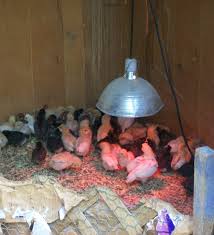


Weather systems in the Earth's atmosphere are due to
conduction
convection
radiation

In a swimming pool, water near the surface is slightly warmer. The warm water rises because of
conduction
convection
radiation
Which of the following are greenhouse gases?
Nitrogen
Oxygen
Carbon Dioxide
Water Vapor

How do ocean currents affect the climate?
Moves ocean pollution to different parts of the world causing global-warming
Circulates heat from one area to another
Helps build a stronger and bigger ecosystem
Scientists believe they have litte actual effect on climate

Cities closer to water most likely will be
more dry
more humid
hotter
Which of the following will heat faster?
water
soil

Cities closer to water most likely have
stable temperatures
extreme temperatures
lower temperatures

What are the two main factors that determine the climate of an area? (Think climographs)
precipitation and humidity
temperature and air pressure
wind conditions and humidity
temperature and precipitation
What causes winds to form on Earth?
solar energy
ocean currents
elevation differences
uneven heating and air pressure on the Earth by the Sun
Climate is...
a long term study of weather, over 30 years
the daily changes in weather
hourly changes in weather
changes in the weather by month
Weather is...
changes in the weather over 30 years
changes in the weather over 100 years
changes in the weather over 500 years
daily changes in the atmosphere

Lake turnover is the natural mixing of water in a seasonal lake. Look at the diagram. When will lake turnover happen?
Summer
Fall
Lake turnover is the natural mixing of water in a seasonal lake. Look at the diagram. Why does lake turnover happen?
The water cools at the surface of the lake and is more dense, so it sinks, causing the warmer water below to float to the surface.
The water warms at the surface of the lake and is more dense, so it sinks, causing the cooler water below to float to the surface.
When is a body of air fully saturated?
When the relative humidity is 25%
When the relative humidity is 100%
When the relative humidity is 48%
When the relative humidity is 85%


___________is the result of the weight of a column of air pushing on an area.
air pressure
density
volume
Where is 97% of Earth's water found?
rivers/streams
oceans
glaciers/ice caps
atmosphere
Where is most of Earth's FRESHWATER found?
rivers/streams
oceans
glaciers/ice caps
atmosphere
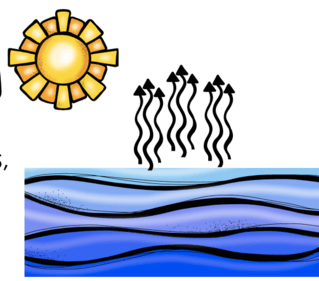
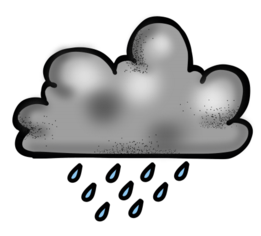

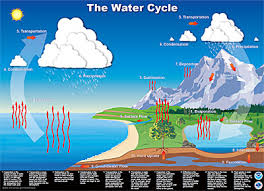
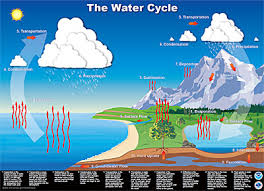
Which stage does excess water move along the surface without being absorbed?
condensation
evaporation
precipitation
runoff

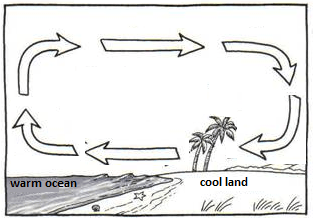

Why do land breezes occur at night?
Land cools off slower than water, so the air above water is cooler.
Water cools off faster than land, so the air above land is warmer.
Land heats up slower than water, so the air stays cooler during the day.
Water cools off slower than land, so the air above water is warmer.

In a sea breeze, the air is warmer above the _____.
land
ocean
sky
beach
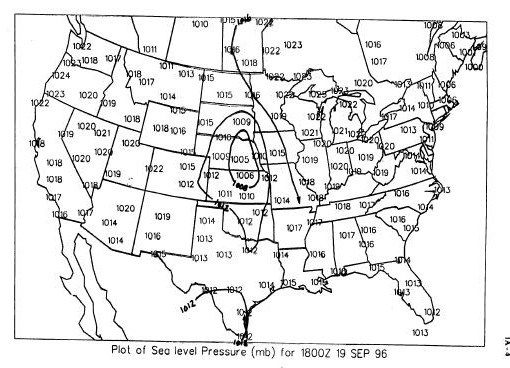
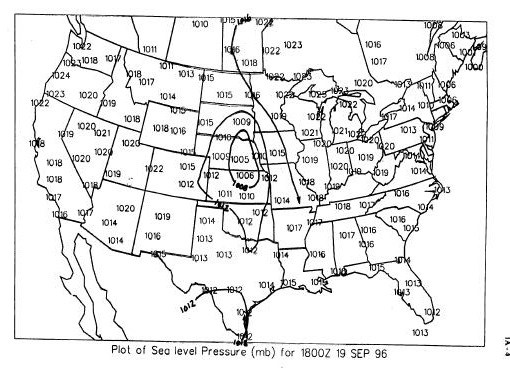
On a pressure map, which way does wind flow?
From high pressure to low pressure
From low pressure to high pressure
From east to west
From west to east

How do we name air masses?
Water and temperature
Air pressure
Humidity and temperature
Cold and warm

What's the humidity and temperature of a continental tropical air mass?
Wet and cold
Dry and warm
Wet and warm
Dry and cold

What's the humidity and temperature of a maritime tropical air mass?
Wet and cold
Dry and warm
Wet and warm
Dry and cold

A wet and cold air mass would be a...
Maritime polar
Continental polar
Maritime tropical
Continental tropical

A dry and cold air mass would be...
Maritime polar
Continental polar
Maritime tropical
Continental tropical
Which kind of pressure system results in clear skies and no wind?


Which kind of pressure system results in rain, wind, & clouds?

Which kind of weather is produced from a cold front?
Thunderstorms
Light rain
It depends

Which kind of weather is produced from a warm front?
Thunderstorms
Light rain
It depends

Which type of front is represented by this symbol:
Cold Front
Warm Front
Stationary Front

Which type of front is represented by this symbol:
Cold Front
Warm Front
Stationary Front
SELECT ALL THAT APPLY: Which of the following will produce some type of precipitation?
A High pressure system
A Low pressure system
A cold front
A warm front

Which of the following influence climate? Select all that apply.
Latitude
Topography/Elevation
Ocean Currents
Longitude
Weather
Which of the following is most likely caused by humans?
Increase in volcanic eruptions
Increase in earthquake activity
Decrease in daylight hours
Increase in the amount of atmospheric carbon dioxide

