wayground logo

Free Printable Worksheets

NEW

Font size

S
M
L
XL
Worksheets

Chemistry Test Review 2020

Total questions: 80

Worksheet time: 2hrs 18mins

Name
Class
Date
1.
The positive particles of an atom are 
a)
electrons 
b)
positrons 
c)
neutrons 
d)
protons 
2.
Particles in an atom that are neutral and have no charge are 
a)
negatrons 
b)
electrons 
c)
neutrons 
d)
protons 
3.
An atoms overall charge is 
a)
positive 
b)
depends on its mood 
c)
neutral 
d)
negative 
4.
The smallest particle of any particular type of matter is known by which of the following terms?
a)
Compound
b)
Atom
c)
Chemical
d)
Element
5.
all matter is made of what 
a)
energy 
b)
atoms 
c)
electrons 
d)
compounds 
6.
If an atom has 3 electrons, how many protons does it have?
a)
1
b)
2
c)
4
d)
3
7.
The subatomic particle with a negative charge is the
a)
electron
b)
proton
c)
neutron
d)
nucleus 
8.
If the number of protons equal the number of _____, the atom will have no charge
a)
protons
b)
neutrons
c)
electrons
d)
nucleus
9.
What is the atomic number?
a)
the number of protons
b)
the number of protons and neutrons
c)
the number of neutrons
d)
the number of protons and electrons
10.
What is the mass number?
a)
the number of protons
b)
the number of protons and neutrons
c)
the number of neutrons
d)
the number of protons and electrons
11.
the central region of an atom where its neutrons and protons are is its 
a)
nucleus 
b)
electron cloud
c)
core 
d)
center 
12.

Which statement best describes an electron?

a)

Mass thousands of times smaller than a proton and a negative charge

b)

Smaller mass than a proton and a positive charge

c)

Greater mass than a proton and a negative charge

d)

Greater mass than a proton and a positive charge

13.
Which statement about the atomic nucleus is correct?
a)
The nucleus is made of protons and neutrons and has a negative charge
b)
The nucleus is made of protons and neutrons and has a positive charge
c)
The nucleus is made of electrons and has a positive charge
d)
The nucleus is made of electrons and has a negative charge
14.
Atoms have no electric charge because they...
a)
have an equal number of charged and non charged particles
b)
have neutrons in their nuclei
c)
have an equal number of electrons and protons
d)
have an equal number of neutrons and protons
15.
Most of the mass in an atom is concentrated in the...
a)
electrons
b)
nucleus
c)
protons
d)
empty space
16.
What is the name of this element?
a)
Helium
b)
Hydrogen
c)
Argon
d)
Silver
17.

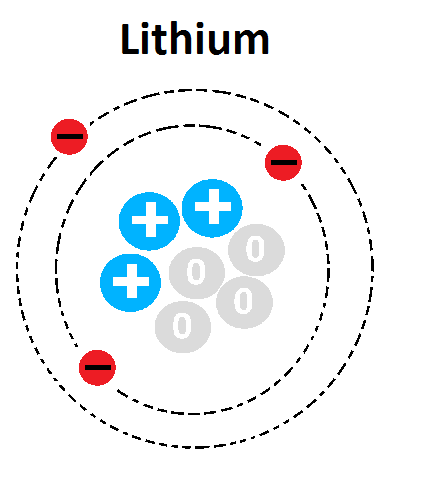
What element is represented in this Bohr Model?

a)

Carbon

b)

Hydrogen

c)

Aluminum

d)

Lithium

18.
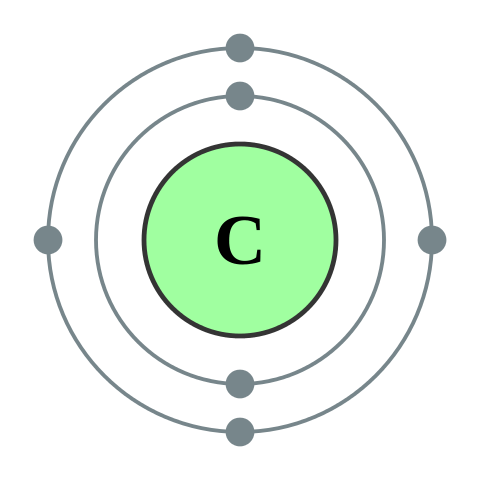
What is the name of this element?
a)
Lithium
b)
Boron
c)
Carbon
d)
Neon
19.
What is the mass number of this atom?
a)
1
b)
3
c)
4
d)
7
20.
What is the atomic number of this atom?
a)
2
b)
4
c)
6
d)
none of the above
21.
What group does this element belong to?
a)
Group 1: Alkali metals
b)
Group 18: Noble Gases
c)
Group 2: Alkaline-Earth Metals
d)
Group 17: Halogens
22.
How many valence electrons?
a)
2
b)
3
c)
5
d)
10
23.
What's a valence electron?
a)
electrons in the second energy level
b)
electrons in the outermost energy level
c)
the atomic number
d)
electrons in the first level
24.

How many valence electrons does carbon have?

a)

4

b)

5

c)

6

d)

7

25.
Rows on the period table are called _____ while columns are called _____.
a)
groups, families
b)
groups, periods
c)
periods, groups
d)
families, groups
26.

The period that an element is in, tells you what?

a)

Number of protons

b)

Number of electrons

c)

Number of valence electrons

d)

Number of shells

27.
How many valence electrons are found in atoms of group 14?
a)
4
b)
3
c)
14
d)
16
28.
Which group has the greatest number of valence electrons?
a)
1
b)
14
c)
18
d)
16
29.

Which elements have the most similar chemical properties?

a)

boron and carbon

b)

oxygen and sulfur

c)

aluminum and bromine

d)

argon and silicon

30.

All atoms are most stable with (or would "prefer") how many electrons in their valence shell?

a)

1

b)

2

c)

8

d)

18

31.
Each column in the periodic table is called a _________ .
a)
period
b)
group
c)
cluster
d)
unit
32.
Two elements chemically bonded form
a)
element
b)
compound
c)
mixture
d)
solutions
33.
What element is will have the most similar physical and chemical properties to the element Lithium (Li)?
a)
Sodium (Na)
b)
Magnesium (Mg)
c)
Beryllium (Be)
d)
Calcium (Ca)
34.
What element is will have the most similar physical and chemical properties to the element Bromine (Br)?
a)
Fluorine (F)
b)
Carbon (C)
c)
Krypton (Kr)
d)
Selenium (Se)
35.
What element is will have the most similar physical and chemical properties to the element Nitrogen (N)?
a)
Phosphorous (P)
b)
Carbon (C)
c)
Oxygen (O)
d)
Sulfur (S)
36.
Periods on the periodic table are __________.
a)
Horizontal Rows
b)
Vertical Columns
37.
Groups on the periodic table are __________.
a)
Horizontal Rows
b)
Vertical Columns
38.
How many Hydrogen are in 4H2O?
a)
6
b)
8
c)
2
d)
4
39.
2H2 + O2 ----> 2H2O What is the product?
a)
------>
b)
2H2O
c)
2H2+ O2
40.
2H2 + O--------> 2H2O What  are the reactants?
a)
----->
b)
2H2O
c)
2H2 +O2
41.
How many elements are in C6H12O6?
a)
1
b)
2
c)
3
d)
4
42.
How many atoms are there TOTAL in:
H2SO4
a)
6
b)
5
c)
7
d)
3
43.
How many Sodium (Na) are in 6NaCl?
a)
1
b)
12
c)
6
44.
Which is the correct formula for:
 three hydrogen (H)
one sulfur (S)
four oxygen (O)
a)
H3SO4
b)
HSO4
c)
H4S3O
d)
H2O
45.
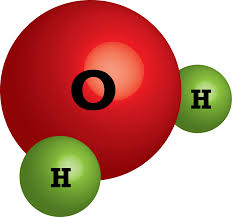
How many atoms of Hydrogen are in this compound
a)
1
b)
2
c)
3
d)
4
46.
A subscript is the small number below a(n) ________ that tells the number of _______ of that element.
a)
element symbol; atoms
b)
atom; element symbol
c)
subscript; protons
d)
compound; elements
47.
Is this equation balanced?
a)
yes
b)
no
c)
Not enough information
48.
What is a coefficient?
a)
The small number on the right of the chemical symbol.
b)
The large number to the left of a formula.
49.
Which side of a chemical equation is the reactant side?
a)
Left (before the yields sign)
b)
Right (after the yields sign)
50.
The law of conservation of matter states that
a)
chemical reactions change matter.
b)
in chemical reactions, the identity of reactants and products is conserved.
c)
atoms are neither created nor destroyed in chemical reactions.
d)
a chemical equation must be balanced.
51.
A pure substance that cannot be broken down into simpler substances.
a)
element
b)
compound
c)
molecule
d)
carbon dioxide
52.
Which of the following is not a compound?
a)
HCl
b)
Cl
c)
NaCl
d)
CO2
53.
Which of the following represents an element?
a)
H2O
b)
H2
c)
NaCl
d)
CaCO3
54.
What cannot be broken down into other substances?
a)
Compound
b)
Mixture
c)
Solids
d)
Element
55.
What is made up two or more elements that are chemically combined?
a)
Element
b)
Mixture
c)
Compound
d)
Solids
56.
This picture represents which of the following?
a)
element
b)
compound
c)
mixture
57.
This picture represents which of the following?
a)
element
b)
compound
c)
mixture
58.
Element or Compound?
H2O
a)
Element
b)
Compound
59.
Element or Compound?
H2SO4
a)
Element
b)
Compound
60.
Element or Compound?
As
a)
Element
b)
Compound
61.
Element or Compound?
Oxygen
a)
Element
b)
Compound
62.
What is the term for combining 2 or more atoms together?
a)
atoms
b)
elements
c)
molecules
d)
compounds
63.
Are these molecules also compounds?
a)
YES
b)
NO
64.
Are these molecules also compounds?
a)
YES
b)
NO
65.
Freezing Juice?
a)
Physical Change
b)
Chemical Change
66.
Exploding Fireworks?
a)
Physical Change 
b)
Chemical Change 
67.
Melting a chocolate bar?
a)
Physical Change
b)
Chemical Change 
68.
Rotting bananas?
a)
Physical Change
b)
Chemical Change
69.
Is sqeezing organges to make orange juice a phyical or chemcial change?
a)
physical
b)
chemical
70.
What happens when a piece of wood burns?
a)
A physical change takes place.
b)
A chemical change takes place.
c)
The wood loses its gravity.
d)
The wood loses its inertia.
71.
Which answer makes a correct statement?
a)
Physical change only changes the size.
b)
Physical change only changes the color.
c)
Physical changes begin and end with the same matter.
d)
Physical changes change the matter into something total different.
72.
A change that does not result in a new substance.
a)
Physical Change
b)
Chemical Change 
73.
A teacher is demonstrating physical and chemical changes to her class. Which action should she use to demonstrate a chemical change?
a)
cutting a piece of paper
b)
folding a piece of paper
c)
tearing a piece of paper
d)
burning a piece of paper
74.
A student is creating a potting soil mix. She combines 100 grams of sand, 200 grams of soil, and 200 grams of pebbles to make her potting soil. What is the mass of the potting soil?
a)
100 grams 
b)
200 grams
c)
300 grams
d)
500 grams
75.
A group of students investigated physical and chemical changes using paper.  The students recorded their observations in a table.
Which student correctly recorded all the changes that took place?
a)
Student 1
b)
Student 2
c)
Student 3
d)
Student 4
76.
Which of the following is a sign that a chemical reaction has occurred?
a)
change in shape
b)
melting
c)
formation of a gas
d)
dissolving
77.
Fizzing, foaming, and burning are all examples of
a)
Chemical change
b)
Physical change
78.

Rust on an iron bar is an example of chemical change.

a)

True

b)

False

79.
Digesting your food is an example of 
a)
chemical change
b)
physical change
80.
Which is an example of a chemical reaction?
a)
paper cut into small pieces
b)
chocolate melting in a pan
c)
flour and sugar mixed in a bowl
d)
cookies baking in an oven