wayground logo

Free Printable Worksheets

NEW

Font size

S
M
L
XL
Worksheets

2nd Nine Weeks Review

Total questions: 75

Worksheet time: 1hrs 5mins
Name
Class
Date
1.
Air in the atmosphere is 78%
a)
Einsteinium
b)
nitrogen
c)
oxygen
d)
carbon dioxide
2.
The atmosphere is 21%
a)
nitrogen
b)
oxygen
c)
argon
d)
flatulence
3.
Altitude is the  (use the internet for this answer)
a)
distance between the moon and the sun
b)
weight of a mountain divided by the ocean
c)
place where things drop from the sky
d)
height of an object above the ground or sea level
4.
As altitude increases, the air pressure 
a)
decreases
b)
stays the same
c)
increases
d)
all of the above
5.
Most of Earth's weather occurs in the 
a)
troposphere
b)
stratosphere
c)
mesophere
d)
thermosphere
6.

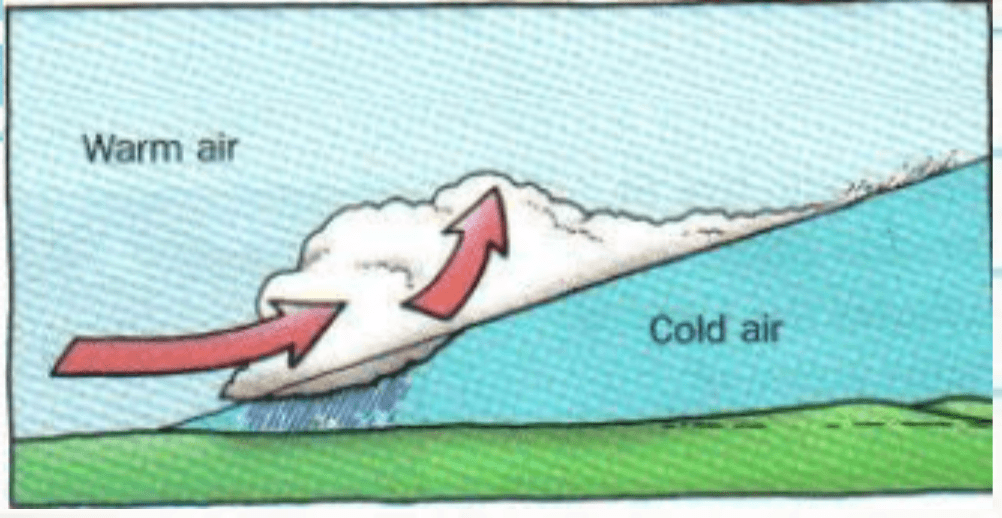
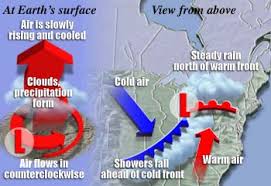
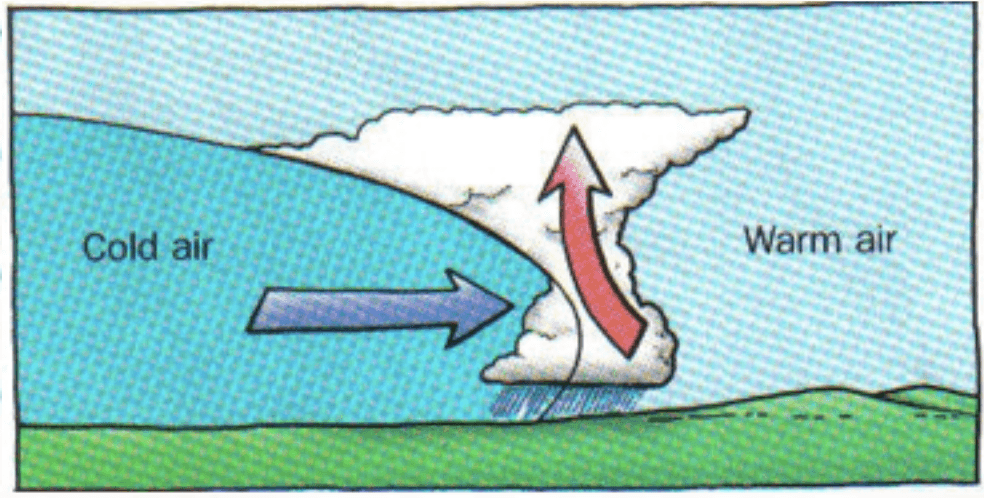
Name that front.

a)

Cold Front

b)

Warm Front

c)

Stationary Front

d)

Occluded Front

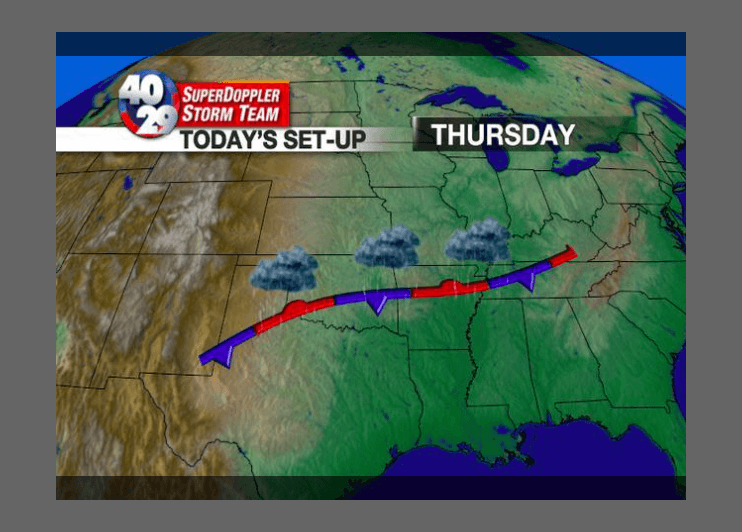
7.

Name that front.

a)

Cold Front

b)

Warm Front

c)

Stationary Front

d)

Occluded Front

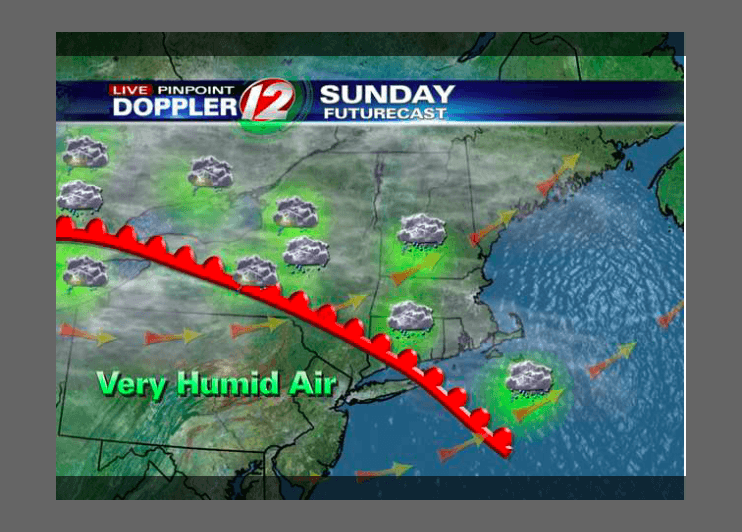
8.

Name that symbol.

a)

Cold Front

b)

Warm Front

c)

Stationary Front

d)

Occluded Front

9.

Name that symbol.

a)

Cold Front

b)

Warm Front

c)

Stationary Front

d)

Occluded Front

10.

Name that symbol.

a)

Cold Front

b)

Warm Front

c)

Stationary Front

d)

Occluded Front

11.

Neither air mass really takes over the other.

a)

Cold Front

b)

Warm Front

c)

Stationary Front

d)

Occluded Front

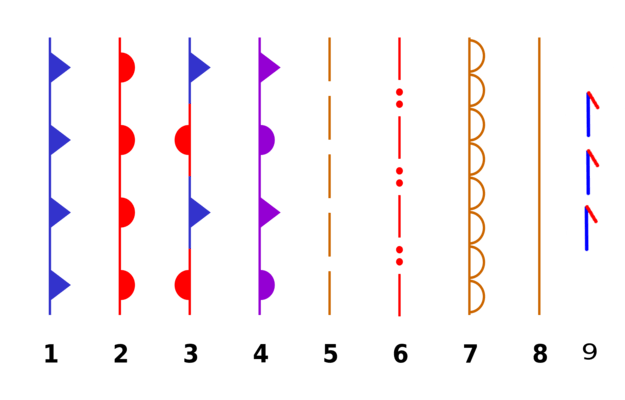
12.
What does symbol # 3 mean?
a)
stationary front
b)
occluded front
c)
warm front
d)
cold front
13.
Which most likely produces clear, cool weather?
a)
zero air pressure
b)
stable air pressure
c)
a low pressure system
d)
a high pressure system
14.
Which system results in rainy or stormy weather?
a)
high pressure
b)
low pressure
c)
hurricane
d)
weather system
15.
Wind is caused mainly by air pressure differences that result from...
a)
a. uneven heating of the Earth's atmosphere.
b)
b. absorption of ultraviolet radiation by Earth's land masses.
c)
c. radiation of heat from Earth's land masses to water bodies.
d)
d. rotation of Earth on its axis.
16.
What kind of breeze is this & what time of day/night would it form?
a)
Land breeze - daytime
b)
Land breeze - nighttime
c)
Sea breeze - daytime
d)
Sea breeze - nighttime
17.
Which statement correctly defines wind?
a)
Wind is the movement of air from areas of low pressure to areas of high pressure
b)
Wind is the movement of air to a colder area in the atmosphere.
c)
Wind is the movement of air from areas of high pressure to areas of low pressure.
d)
Wind is the movement of air pushed around and bouncing off Earth's surface.
18.
The curving of air to the right in the Northern hemisphere is caused by ___________ and is called the _________ effect.
a)
Earth's rotation...Coriolis
b)
Earth's revolution...Coriolis
c)
Earth's rotation...Doppler
d)
Earth's revolution...Doppler
19.
There are 3 roles an organism can play in an ecosystem are:
a)
producer, consumer, decomposer
b)
herbivore, carnivore, omnivore
c)
producer, director, actor
d)
predator, prey, scavenger
20.
An organism that can make its own food is called a 
a)
consumer
b)
producer
c)
decomposer
d)
composer
21.
An organism that obtains energy by feeding on other organisms is called a
a)
consumer
b)
producer
c)
decomposer
d)
brujeria
22.
A community of all living and nonliving things in an area is called an...
a)
environment
b)
biome
c)
ecosystem
d)
Middle School
23.
Living parts of an ecosystem are called
a)
biotic factors
b)
abiotic factors
c)
crazy critters
d)
animals and plants
24.
Nonliving parts of an ecosystem are called
a)
abiotic factors
b)
biotic factors
c)
rocks and dirt
d)
funiture
25.

Which ecosystem would you be most likely to find a cactus in?

a)

Tundra

b)

Desert

c)

Temperate Grassland

d)

Tropical Savanna

26.

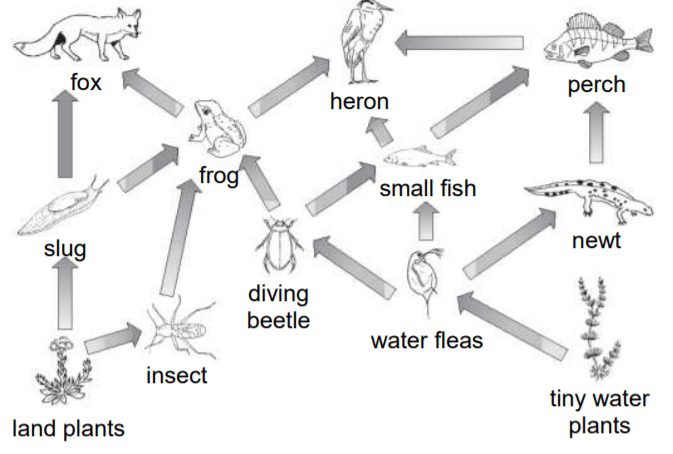
Arrows in a food web represent...

a)

eating

b)

sunlight

c)

energy

d)

matter

27.

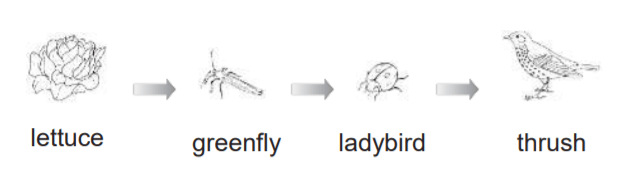
Who is the producer?

a)

lettuce

b)

greenfly

c)

ladybird

d)

thrush

28.
a)

This is a food chain

b)

This is a food web

c)

This is an energy pyramid

29.

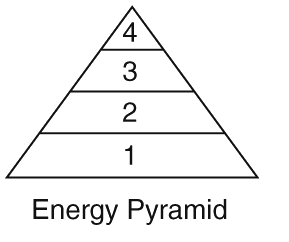
Level 1 on the pyramid

a)

Producers

b)

Primary Consumer

c)

Secondary Consumer

d)

Tertiary Consumer

30.

Level 2 on the pyramid

a)

Producers

b)

Primary Consumer

c)

Secondary Consumer

d)

Tertiary Consumer

31.

Level 3 on the pyramid

a)

Producers

b)

Primary Consumer

c)

Secondary Consumer

d)

Tertiary Consumer

32.

Level 4 on the pyramid

a)

Producers

b)

Primary Consumer

c)

Secondary Consumer

d)

Tertiary Consumer

33.
Which of the following would be the most likely effect, if there were a sudden increase in the cricket population?
a)
There would be a decrease in the small bird population.
b)
There would be a decrease in the grass/flowers population.
c)
There would be a decrease in the mice population.
d)
There would be an increase in the grass/flowers population.
34.
What does a Primary Consumer eat?
a)
Tertiary Consumers
b)
Secondary Consumers
c)
Producers
35.
Which organism receives the least amount of energy from the producer?
a)
Owl
b)
Grasshopper
c)
Lilypad
d)
Mouse
36.
Which organisms from the Food Web is consuming the Insects?
a)
Lynx, Hare
b)
Shrew, Red fox
c)
Lynx, Red Fox
d)
Hawk, Shrew
37.
A giraffe has a long neck in order to better reach leaves to eat.  This is an example of _____. 
a)
an adaptation
b)
environment
c)
response
d)
stimulus
38.
Polar bears have an adaptation that allows them to swim. What is most likely this adaptation?
a)
White coat
b)
Fat belly
c)
Small eyes
d)
Webbed Feet
39.

Why are bur seeds able to be dispersed by animals?

a)

It is light and has wing-like structure

b)

It has hooks to hook onto the fur of animals

c)

It has a fibrous husk that makes it float

d)

It has dry pods that split open

40.
Cattle egrets forage (feed) in fields among cattle. The egret gets easy access to flying insects stirred up by the cattle, and the cattle don't care if they are there or not.
a)
mutualism
b)
commensalism
c)
competition
d)
parasitism
41.
A relationship between two organisms in which one organism benefits and the other is unharmed...
a)
Mutualism 
b)
Competition
c)
Parasitsm 
d)
Commensalism 
42.

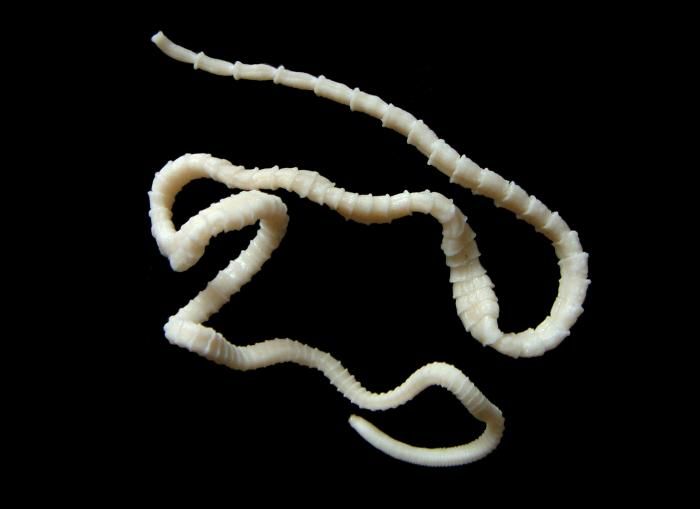
A tapeworm lives in the intestine of a cat absorbing nutrients through its skin. A tapeworm and a cat have this type of relationship.

a)

mutualism

b)

parasitism

c)

commensalism

d)

competition

43.
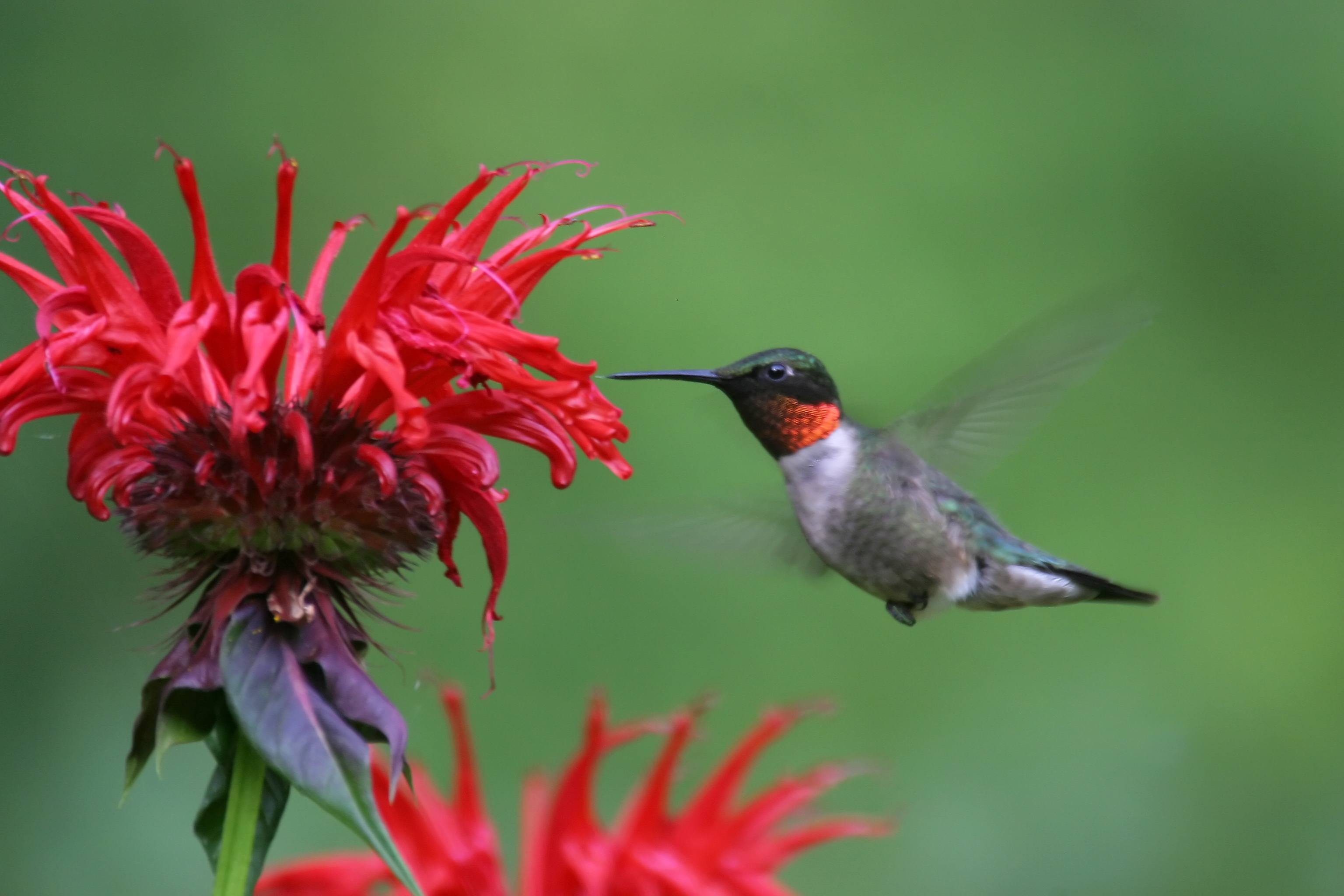
What type of symbiosis?  Hummingbirds feed on nectar from flowers.  The flowers are pollinated by hummingbirds as they move from flower to flower.
a)
commensalism
b)
mutualism
c)
parasitism
d)
predation
44.
Which symbols best describe parasitism?
a)
+,+
b)
+,-
c)
+,0
d)
-,0
45.
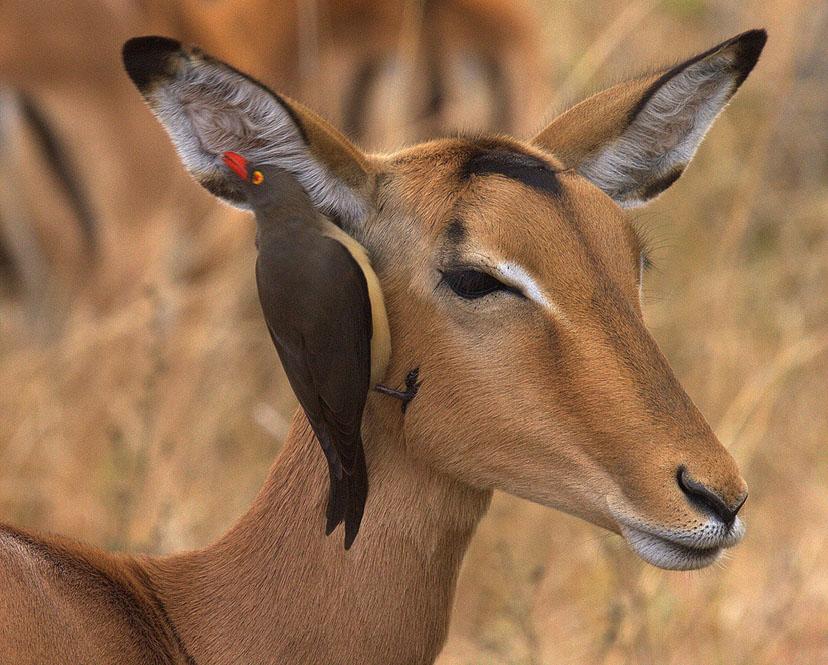
Red-billed oxpeckers are birds that often feed on parasites that infest impala.  This is an example of _______.
a)
commensalism
b)
mutualism
c)
neutralism
d)
competition
46.
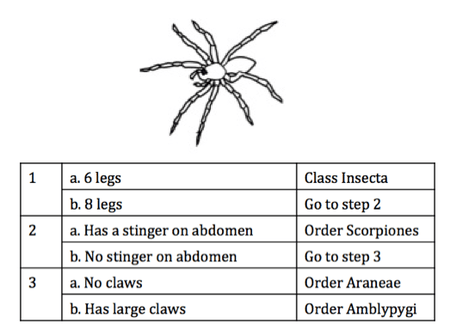
An illustration and a dichotomous key are given. What is the correct classification for this organism?
a)
Class Insecta
b)
Order Amblygygi
c)
Order Araneae
d)
Order Scorpiones
47.
A dichotomous key for trees is provided. Hikers found a tree that has large brown cones and single sharp needles. What species of tree have the hikers found?
a)
Juniper
b)
Pine
c)
Spruce
d)
Fir
48.
What step do we always start with when using dichotomous keys?
a)
1
b)
2
c)
3
d)
4
49.
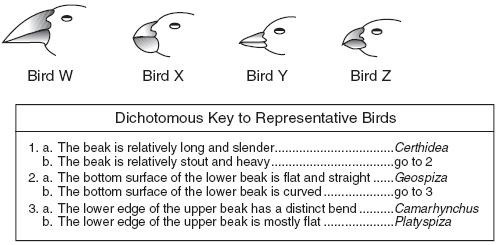
What is the name of bird W?
a)
Certhidea
b)
Geospiza
c)
Camarhynchus
d)
Platyspiza
50.
What are examples of pioneer species in a primary succession?
a)
Bushes and Shrubs
b)
Oak trees
c)
Mossess and Lichens 
d)
A rose Bush
51.
A pioneer species is...
a)
a large organism
b)
the first organisms to adapt to a new environment 
c)
The best organism 
d)
Abiotic organisms 
52.
A climax community is ….
a)
the beginning of a new ecological succession.
b)
the rocks in a new environment.
c)
the fire that will cause destruction.
d)
an area that reaches its greatest growing potential.
53.
What is the difference between primary and secondary succession?
a)
Primary succession already has soil.
b)
Primary has soil and secondary does not
c)
soil is present in both
d)
primary has no soil and secondary has soil
54.
Which is the correct order in primary succession?
a)
Rocks, Lichens & Mosses, Bushes & Shrubs, Trees
b)
Lichens & Mosses, Rocks, Trees, Bushes & Shrubs 
c)
Trees, Bushes and Shrubs, Lichens & Mosses, Lichens & Mosses
d)
Rocks, Grass, Trees, Bushes & Shrubs
55.
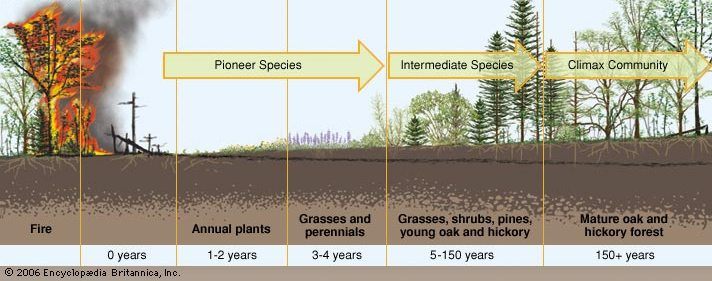
The picture shows what type of succession?
a)
primary
b)
secondary
c)
tertiary
d)
quadanary
56.
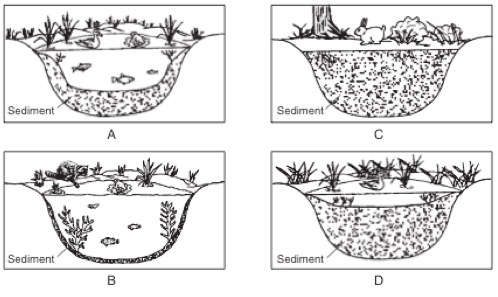
What is the correct order from oldest (happened first) to youngest (happened last) in this pond succession?
a)
A, B, C, D
b)
D, C, B, A
c)
B, A, D, C
d)
C, D, A, B
57.
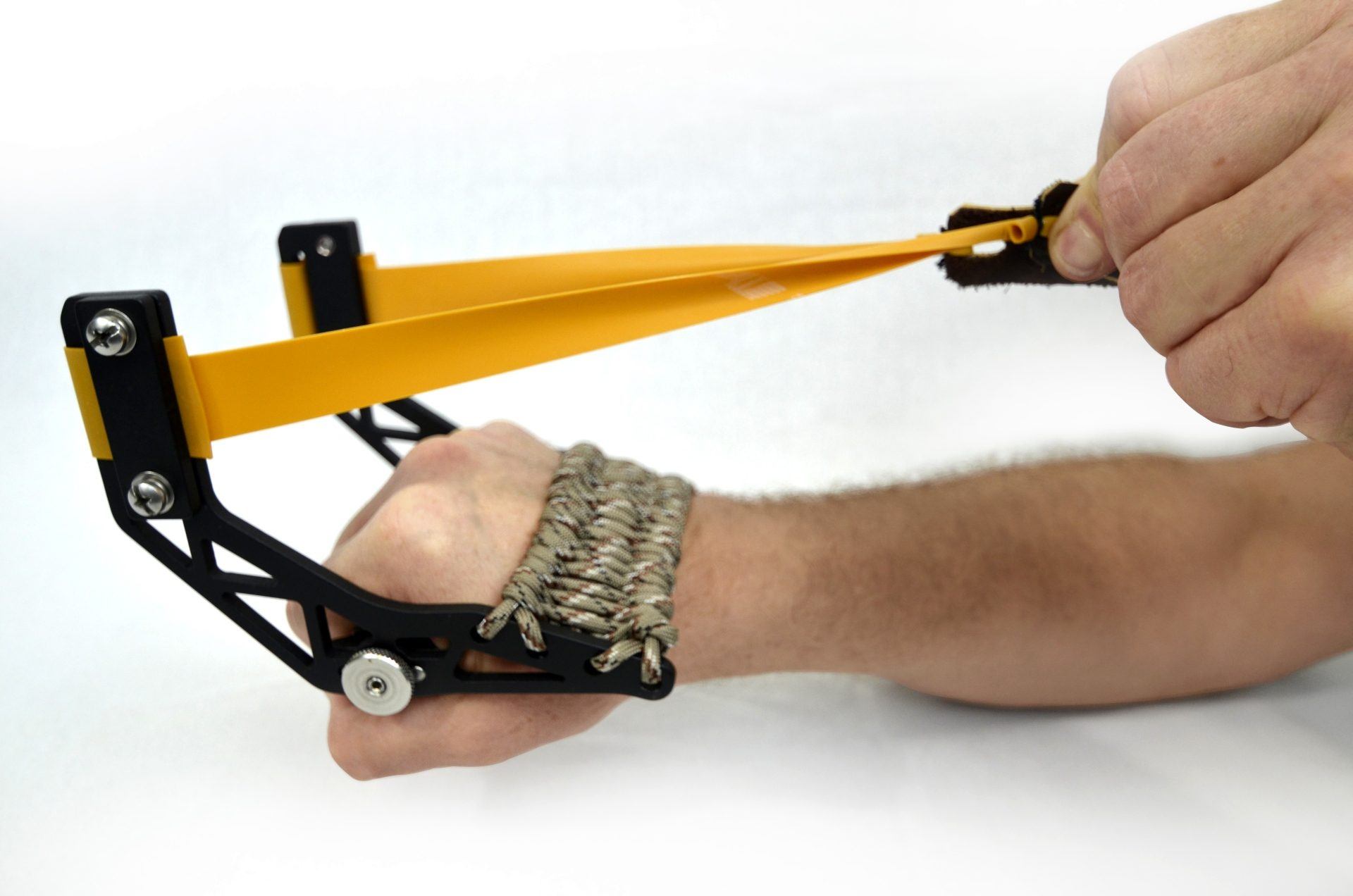
What type of energy is in this picture?
a)
Kinetic
b)
Potential
c)
Chemical
d)
Sound
58.
On a roller coaster, where is maximum potential energy?
a)
At the bottom of a big hill
b)
When going around a corner
c)
When going upside down
d)
At the top of a big hill
59.
On a roller coaster, where is maximum kinetic energy?
a)
At the bottom of a big hill
b)
When going around a corner
c)
When going upside down
d)
At the top of a big hill
60.
At what position does the rock have the greatest kinetic energy?
a)
A
b)
B
c)
D
d)
E
61.
Wood, batteries, gasoline, and  food are all examples of ________________________.
a)
gravitational potential energy
b)
elastic potential energy
c)
chemical potential energy
d)
None of the above
62.
The faster an object moves, the ________ kinetic energy it has. 
a)
more
b)
less
c)
none of the above
d)
all of the above 
63.

If these are all moving at the same speed, the vehicle with the greatest KE would be

(Think about their sizes)

a)
b)
c)
d)
64.
What is the energy transformation?
a)
Kinetic to Mechanical to Electrical
b)
Kinetic to Mechanical to Kinetic
c)
Electromagnetic to Mechanical to Electrical
d)
Kinetic to Sound to Electrical
65.
What is the energy transformation?
a)
Kinetic to Mechanical and Electrical
b)
Chemical to Thermal and Electromagnetic (light)
c)
Electromagnetic to Chemical and Electrical
d)
Kinetic to Sound and Chemical
66.
What is the energy transformation?
a)
Electromagnetic to Electrical
b)
Mechanical to Electrical
c)
Electrical to Thermal
d)
Kinetic to Sound
67.

What is the energy transformation?

a)

Chemical to Electrical to Light

b)

Mechanical to Electrical to Light

c)

Electrical to Thermal to Mechanical

d)

Kinetic to Sound to Potential

68.
What is the energy transformation?
a)
Mechanical to Kinetic to Sound
b)
Mechanical to Electrical to Light
c)
Electrical to Thermal to Mechanical
d)
Kinetic to Sound to Potential
69.

What happens if a population grows past its carrying capacity?

a)

The population keeps growing

b)

The population starts to die off

c)

The entire species will go extinct

d)

The carrying capacity just increases

70.

This may cause a population to increase

a)

increase of food supply

b)

removal of predators

c)

removal of disease

d)

all of these

71.

The largest number of individuals that an environment can support long term is...

a)

carrying capacity

b)

emigration

c)

immigration

d)

population density

72.
Which of the following would INCREASE the carrying capacity of an ecosystem?
a)
increase in predators
b)
disease
c)
increase in available food
d)
drought
73.

When death rate is equal to birth rate...

a)

population increases

b)

population decreases

c)

population stays the same.

d)

population rapidly increases then becomes stable

74.

In the graph to the right, what is the population of deer at the carrying capacity of the environment?

a)

3

b)

7

c)

70

d)

40

75.
When a specific population grows past the ecosystem's carrying capacity, what happens to the population?
a)
Density Independent limiting factors start to occur resulting in the population going farther above carrying capacity.
b)
Density Dependent limiting factors start to occur resulting in the population going back below carrying capacity.
c)
The population will go extinct due to lack of resources
d)
The population grows then finds a new carrying capacity