
 Worksheets
Grade 7 Progress Test 2 Revision
Total questions: 77
Worksheet time: 1hrs 6mins

What happens when unbalanced forces act on an object?
It will accelerate
It will keep moving at a constant velocity
It will stay at rest
There is no way to know

Are all of the forces on this object balanced?
Yes
No
There is no way to tell from the diagram

What direction will it accelerate? (What direction is the net force?)
Up
Left
Right
Down
Which of these animals would probably cause the greatest pressure on the ground?
A fat cow with big feet
A fat cow with small feet
A baby cow with big feet
A baby cow with small feet
Where would you find the largest pressure?
At the bottom of the ocean
At the top of Mt Everest
At the beach in Da Nang (sea level)
At the top of the Landmark building
Pressure can be measured in Pascales (Pa) or Newtons per square metre.
1 Pa = 1 N/m2
True
False
What is the equation used to calculate pressure?
pressure = force / mass
pressure = mass / volume
pressure = area / force
pressure = force / area
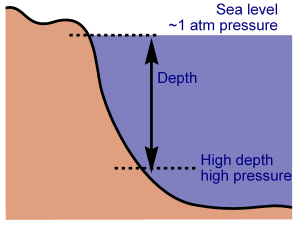
When you increase your depth under water, the water pressure on your body
increases
decreases
stays the same
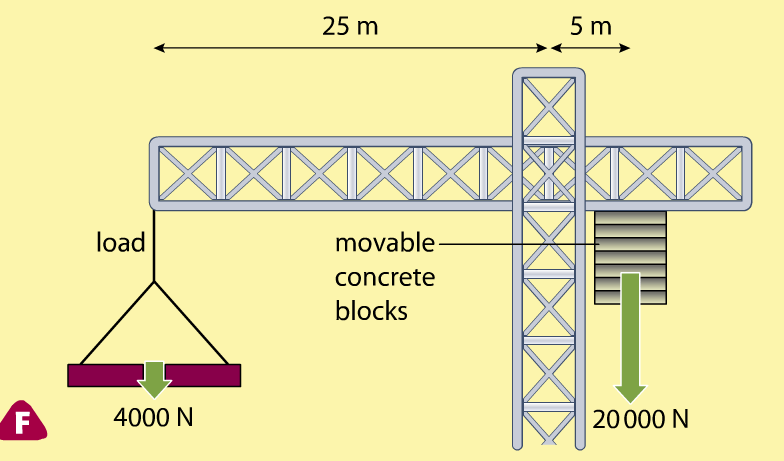

What is the equation for calculating the moment acting on an object?
moment = force x distance (from pivot)
moment = force / distance (from pivot)
moment = distance (from pivot) / force

Would this tool turn clockwise or anticlockwise?
Clockwise
Anticlockwise

Calculate the moment acting on the door handle.
0.05 Nm
20 N/m
5 Nm
9.5 N/m

If F1 and F2 are equal, which direction will the seesaw rotate?
It will not rotate, the moments are balanced
It will rotate anticlockwise
It will rotate clockwise

Is this see-saw balanced or unbalanced?
Balanced
Unbalanced
What is the speed of a car travelling 50m in 4s?
200 m/s
12.5 m/s
12.5 m
200m
How long does it take a car to travel 40m at 12m/s?
4.8 s
480 s
3.33 s
33.3 s
How far does a truck move if it's travelling at 15m/s for 20 min?
18000 m
300 m
0.75 m
180 km
How far does a lorry move if it is travelling at 12m/s for 180s?
2160 m
0.06 m
15 m
21.6 m

Which of the lines on the graph shows something at rest?
A
B
C
D

Which of the graphs shows something accelerating?
Left graph
Middle graph
Right graph
None of these graphs

Find the velocity of the object shown in the graph from 0 to 5 seconds.
25 m/s
5 m/s
-5 m/s
-25 m/s

What is a small particle that is known as the basic building block of matter?
molecule
compound
element
atom

H2O is most accurately described as a ___________________.
molecule
compound
element
atom

Which vocabulary words can be used to describe this image? (check all that apply)
molecule
compound
element
atom

Oxygen, Nitrogen, Hydrogen, and Calcium are all examples of ______________________.
molecules
compounds
atoms
elements
Which one of the following is a compound?
NaCl
O2
H2
He2

Which of these models can be described as a compound?
water
carbon dioxide
amonia
methane
All of them are compounds

Which of these is only a molecule and NOT a compound?
a
b
c
d

Which of the images represents a mixture.
pepper
salt
What is climate?
the condition of the atmosphere at any given time and place
cloud cover and temperature
precipitation and humidity at a given time and place
weather conditions in an area over a long period of time
Which two factors determine the climate in a particular region?
temperature and latitude
precipitation and humidity
temperature and precipitation
humidity and air pressure
These areas is located between 66.5°N and the North Pole and 66.5°S and the South Pole. It has low temperatures and very little precipitation.
Polar Climate Zones
Temperate Climate Zones
Tropical Climate Zones
The Arctic Climate Zones
What are the three main climate zones?
tropical, thermal, polar
tropical, temperate, polar
cold, super hot, blah
polar, tropical, humid
What climate zone is located near the equator where the sun is directly overhead all year?
polar
tropical
desert
temperate
The most abundant greenhouse gas in the atmosphere is ___________________.
oxygen
nitrogen
carbon dioxide
argon


What does the pencil in this picture show about light?
Light is refracted when it hits a curved object.
Light is reflected when it hits a curved object.
Light is refracted when it passes from air into water.
Light is reflected when it passes from air into water.

Which color has the SHORTEST waves?
Red
Green
Blue
Violet

The law of reflection states that the angle of incidence is _____ the angle of reflection.
less than
more than
the opposite of
the same as
As an object moves away from a source of light, the shadow gets smaller because the object is blocking _____ light than if it were closer.
more
less
the same

Why do red objects appear red?
All colours of light are absorbed EXCEPT for red. Red light is reflected.
All colours of light are reflected EXCEPT for red. Red light is absorbed.
All colours of light are refracted EXCEPT for red. Red light is absorbed.
All colours of light are absorbed EXCEPT for red. Red light is refracted.

What are the primary colours of light?
red, yellow, and orange
blue, magenta, and cyan
red, yellow, and green
red, green, and blue
What are the secondary colours of light?
red, yellow, and orange
yellow, magenta, and cyan
red, yellow, and green
red, green, and blue

What colour(s) of light can transmit (pass through) a blue filter?
Every colour EXCEPT blue
Green and red
Only blue
Magenta and yellow
What colour(s) of light can transmit (pass through) a yellow filter?
Every colour EXCEPT blue
Green and red
Only blue
White


I am located between Mars and Jupiter.
Comet belt
Asteroid belt
Meteor belt
Stars
Ceres is the largest asteroid, and it is spherical.
True, it retains is shape because of it's massive size.
False, it is only a midsize asteroid.
False, it is lumpy like deimos
False, it is actually a moon.
How many stars are in a galaxy.
billions
thousands
hundreds
Ten
Which nutrient is the starches and sugars in foods?
lipids
proteins
carbohydrates
vitamins
Which nutrient is a compound that helps regulate many vital processes, including digestion, absorption and metabolism of nutrients?
minerals
vitamins
water
carbohydrates
Examples of a Ball & Socket Joint are found in the
Shoulder
Knee
Hip
Ankle
A hinge joint allows
A wide range of movements
Circumduction
Rotation
Movement in only one direction (ie. backwards & forwards)

