
 Worksheets
Cells - Stayin Alive!
Total questions: 36
Worksheet time: 54mins
Which cells are more efficient at getting rid of waste?
Small Cells
Medium Size Cells
Large Cells
X-Large Cells
Which cells are least efficient at getting rid of waste?
Small Cells
Medium Size Cells
Large Cells
X-Large Cells
Large cells will most likely
Survive
Die
As cell size increases, its surface area to volume ratio usually
Increases
Decreases
As cell size decreases, its surface area to volume ratio usually
Increases
Decreases
Large cells can adapt to better survive by (click all that are true).
increasing their volume
being long and thin
being flat
Increasing their size
Surface area of a cube=
LXWXH
(length X length)6
none of these are correct.
surface area /volume
Glucose is a molecule that can move across the cell membrane. if the concentration of glucose is higher OUTSIDE the cell than inside the cell, then what will happen by the process of diffusion?
Glucose molecules will disappear by diffusion
Glucose molecules will stay where they are
Glucose molecules will diffuse out of the cell
Glucose molecules will diffuse into the cell
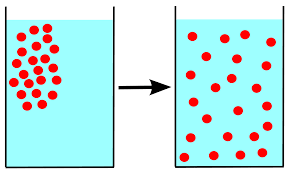
The picture below is an example of _________________.
osmosis
isotonic
diffusion
active transport

What is DIFFUSION?


When does diffusion stop?
After a day and a night
When the particles are evenly spread out
When there are no particles left
When all the particles leave the system
water moves from high to low concentration
large or oddly shaped molecules move across a cell membrane
water moves when energy is used
proteins are built


Volume of a cube=
LXWXH
(length X length)6
none of these are correct.
surface area /volume

After examining this diagram showing the concentration of water inside and outside of the cell, identify the tonicity of the solution.
hypertonic
hypotonic
isotonic

The solution surrounding the cell in Diagram B, would be defined as:
hypertonic
hypotonic
isotonic


What will happen to the cell in the given solution?
Swell up
Shrink
Stay the same


Movement of SOLUTE through the cell membrane from high to low concentration is called.....
diffusion
active transport
facilitated diffusion
osmosis

Nemo and other ocean dwelling fish cannot survive in freshwater because......
freshwater is hypertonic to Nemo's cells and will result in water leaving them causing the cells to shrink
freshwater is hypotonic to Nemo's cells and will result in water leaving them causing the cells to shrink
freshwater is hypertonic to Nemo's cells and will result in water entering them causing the cells to swell and burst
freshwater is hypotonic to Nemo's cells and will result in water enter them causing the cells to swell and burst
A cell has a volume of 64 units and total surface area of 96 units. What is the cell's surface area to volume ratio?
1.5
2.8
3.4
4.7

Which of the following is least efficient?
A
B
C
D

Which of the following has the largest surface area to volume ratio?
A
B
C
D

