Wayground logo

Free Printable Worksheets

Font size

S
M
L
XL
Worksheets

Electromagnetic Spectrum and Wave Communication

Total questions: 40

Worksheet time: 22mins

Name
Class
Date
1.
All electromagnetic waves have the same...
a)
frequency
b)
speed
c)
wavelength
d)
energy
2.
_______ waves carry the greatest amount of energy. 
a)
x-rays
b)
gamma rays
c)
infrared rays
d)
visible light
3.
Put the visible light colors in order from shortest wavelength to longest wavelength
a)
Violet, Indigo, Blue, Green, Orange, Yellow, Red
b)
Red, Yellow, Green, Orange, Violet, Blue, Indigo
c)
Red, Orange, Yellow, Green, Blue, Indigo, Violet
d)
Violet, Indigo, Blue, Green, Yellow, Orange, Red
4.
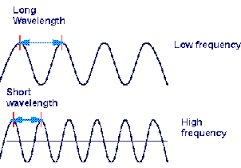
A wave with a large wavelength will have a ______ frequency and _____ energy
a)
high, low
b)
high, high
c)
low, high
d)
low, low
5.
What type of wave is pictured?
a)
Longitudinal
b)
Transverse
c)
Light
d)
Standing
6.
Which waves are the type that can give us suntans and sunburns?
a)
Infrared radiation
b)
Ultraviolet radiation
c)
Radio waves
d)
X-rays
7.
Which rays can be felt as heat?
a)
X-Rays
b)
Infrared Radiation
c)
Ultraviolet Radiation
d)
Microwaves
8.
________________ are waves used by Police Officers to test the speed of your car with RADAR.
a)
Ultraviolet
b)
Infrared
c)
Radio
d)
Microwaves
9.
Cancer can be treated with_______________waves.
a)
Penicillin
b)
Radio
c)
Infrared
d)
Gamma
10.
The green arrow on the image is measuring the _________________________. (click text to see image)
a)
wavelength
b)
amplitude
c)
crest
d)
trough
11.
How much of the electromagnetic spectrum is visible?
a)
All of it
b)
None of it
c)
Most of it
d)
Only a small part
12.
What is a wave called in which the particles of the medium move perpendicularly to the direction the wave is traveling
a)
A. surface wave
b)
B. transverse wave
c)
C. electromagnetic  wave
d)
D. longitudinal wave
13.
What do we call the top of a transverse wave?
a)
crest
b)
trough
c)
amplitude
d)
frequency
14.
The distance between which two letters is a wavelength?
a)
C-A
b)
A-D
c)
A-A
d)
A-B
15.
What kind of wave is this?
a)
Transverse Wave
b)
Longitudinal Wave
16.
What kind of wave is this?
a)
Transverse
b)
Longitudinal
17.
What kind of wave is this?
a)
Transverse
b)
Longitudinal
c)
Compression
d)
Rarefraction
18.

1. What portion of the EM Spectrum is used for cellular phones, satellite, and wireless LAN communications?

a)

A. Radio waves

b)

B. Microwaves

c)

C. Infrared

d)

D. none of the above

19.

2. Microwave radiation improves communication technology. Which of the following descriptions is a result of this improvement?

a)

A. Increase the use of wireless mobile telephony.

b)

B. Increase the risk of having cancer.

c)

C. Increase the demand of digital wireless system.

d)

D. Increase the chance of having birth defects

20.

3. When a police officer uses radar for speed control, the officer is using what kind of electromagnetic waves?

a)

A. radio waves

b)

B. gamma rays

c)

C. ultraviolet rays

d)

D. X-rays

21.

5. Broadcasting stations can send their signals around the world using

a)

A. cellular telephones.

b)

B. television satellites

c)

C. pagers.

d)

D. Global Positioning System.

22.

5. Global Positioning System signals can tell you

a)

A. what television station you are tuned to.

b)

B. your exact location on Earth.

c)

C. how many satellite orbiting a message

d)

D.

who is sending a message to your pager.

23.

7. How do signals travel through optical fibers?

a)

A. As microwaves

b)

B. As radio waves

c)

C. As infra-red radiation

d)

D. As gamma radiation

24.

8. An advantage of wireless communications over wired communications is:

a)

A. Wireless signals can be blocked by walls.

b)

B. Wireless devices can be portable.

c)

C. Wireless devices must be in range of a transmitter.

d)

D. Wireless signals cannot be blocked by walls

25.

8. What electromagnetic wave is sometimes called heat rays?

a)

A.gamma rays

b)

B. radio waves

c)

C. infrared

d)

D. visible light.

26.

9. Which type of electromagnetic radiation is used when mobile phones communicate with their base stations?

a)

A. Radio waves

b)

B. Microwaves

c)

C. Infrared radiation

d)

D. Ultraviolet radiation

27.

10.Which electromagnetic waves carries more energy than the others?

a)

A. microwaves

b)

B. radiowaves

c)

C. UV radiation

d)

D. visible light

28.
The shortest wavelength in visible light is______.
a)
violet
b)
red
c)
blue
d)
yellow
29.
This wave has the second highest frequency on the spectrum. 
a)
microwaves
b)
visible light
c)
x-rays
d)
gamma ray
30.
The higher the frequency the ______ the energy. 
a)
higher
b)
lower
c)
neither, stays the same
31.

The lower the frequency the ______ the energy.

a)

higher

b)

lower

c)

neither, stays the same

32.

Wavelength and Frequency are related in that...

a)

they are always the same

b)

when one increases, the other decreases (inversely proportional)

c)

there is no correlation

d)

they both vary in an irregular pattern

33.

High frequency in EM waves equals

a)

high energy and short wavelength

b)

high energy and long wavelength

c)

low energy and short wavelength

d)

low energy and long wavelength

34.
Which type of light has the lowest energy of this group?
a)
Radio
b)
Microwave
c)
Infrared
d)
Ultraviolet
35.
Which type of light has the highest energy of this group?
a)
red
b)
yellow
c)
green
d)
blue
36.

Electromagnetic waves vary in

a)

the speed they travel in a vacuum.

b)

wavelength and frequency.

c)

the way they reflect.

d)

the orientation of their electric and magnetic fields.

37.

Utilized in treating cancer, the radiotherapy

a)

gamma ray

b)

x-ray

c)

visible light

d)

microwave

38.

Plays important role in wireless communication

a)

ultraviolet

b)

visible light

c)

infrared

d)

microwave

39.

Helpful in military night vision goggles

a)

radio wave

b)

microwave

c)

infrared

d)

light

40.

Used in medical technology specifically in generating images of lungs and bone fractures

a)

infrared

b)

visible light

c)

ultraviolet

d)

x-ray