
 Worksheets
Q2 Exam Review US History
Total questions: 111
Worksheet time: 1hrs 9mins

What is militarism?
Building an army
Creating partnerships
Seizure of territory by a stronger country
Proud of your heritage

What is an alliance?
Building partnerships
Seizure of territory by another country
Proud of your heritage
Building an army

What is imperialism?
Proud of your heritage or country
Building an army
Seizure of a country from a stronger country
Creating partnerships

What is nationalism?
Being proud of your heritage or country
Creating partnerships
Seizure of country from stronger country
Building an army

What is No Man's Land?
Land between the opposing trenches
Land used for battlefields
Land used for the bathroom
Land behind the trenches

Which country dropped out of WWI due to their country's revolution?
Germany
France
Russia
Great Britain

Why did the United States enter World War I?
German submarines sunk the Lusitania killing 128 Americans
Germany sent Zimmerman telegram to Mexico asking them to join the war
United States wanted to help their allies Great Britain and France
Italy asked the United States to help in the war
This peace treaty made Germany take the blame for the war and pay $30 billion in reparations.
Treaty of Versailles
Peace of Westphalia
Paris Accords
Armistice Treaty

Guerrilla Warfare
Total Warfare
Subwarfare
Trench Warfare

A major reason many Russian people supported the Bolsheviks in the November 1917 revolution was that the Bolsheviks called for
an immediate peace settlement with Germany
a heavy investment in industry
the collectivization of agriculture
the abolition of all religion
What was the name of the agreement made in 1928 in which 61 countries promised not to use war to solve problems?
The Kellogg-Briand Pact
The Dawes Pact
The Peace Pact
The Stresemann Act

In June 1917, at the request of the Wilson administration, Congress passed the ____________________. The law provided penalties for spying, sabotage, and obstructing the war effort.
Espionage Act
Seditions Act
Prominent Socialist Act
Demographics Act
a group of Russian radicals, led by Vladimir Lenin, who played a major role in the 1917 revolution in Russia
Red Scare
Communism
Bolshevik
Arms Race
widespread fear of communism
Red Scare
Palmer Raids
Reparations
Arms Race
a series of government attacks on suspected radicals in the United States led by the U.S. Attorney General
Bolshevik
Communism
Deportation
Palmer Raids
U.S. Attorney General and opponent of communism; he ordered the raids against radicals and aliens during the Red Scare of 1919 and 1920
Mitchell A. Palmer
Henry Ford
Warren G. Harding
Calvin Coolidge
American business leader; he revolutionized factory production through the use of the assembly line and popularized the affordable automobile
Mitchell A. Palmer
Henry Ford
Warren G. Harding
Calvin Coolidge
paying for an item over a period of time with a series of small payments
Installment Buying
Credit
Reparations
Productivity
a system of borrowing money from banks to make purchases, and then paying it back later with interest
Credit
Productivity
Installment Buying
Deportation
29th president of the United States; his policies favored business, but his administration was known for its scandals
Mitchell A. Palmer
Henry Ford
Warren G. Harding
Calvin Coolidge
30th President of the United States he became president of the U.S. upon the death of Harding. He was known for his honesty and pro-business policies.
Mitchell A. Palmer
Henry Ford
Warren G. Harding
Calvin Coolidge
What was the purpose of the Washington Conference in 1921?
to discuss economic aid for Europe
to discuss disarmament
to address war reparations
to negotiate for the League of Nations
The Roaring Twenties were characterized by-
internment camps, the rationing of goods, and the first use of an atomic bomb
bank failures, the New Deal, and bread lines
installment plans, prohibition, and flappers
brinkmanship, McCarthyism, and a policy of containment
Which pull factor contributed to the Great Migration?
The availability of land grants for homesteaders
Economic opportunities in industrialized cities
Better soil conditions in previously uncultivated areas
The lower cost of living in urban areas
During the 1920s, what was one result of innovations in US transportation technology?
Commercial airplanes replaced ocean liners as the primary means of travel to Europe.
Mass-produced automobiles made travel more affordable for many people.
Cable cars provided a comfortable means of quick travel to any city within a state.
Container ships delivered agricultural goods to ports along the Pacific coast.
The establishment of speakeasies in the 1920's was an unintended consequence of which federal government action?
The taxation of imported luxury goods
The deportation of suspected communist sympathizers
The prohibition of the sale of alcoholic beverages
The implementation of immigration restrictions

Which inference about the 1920s is supported by this illustration?
Women confronted discrimination in employment and education.
Women challenged traditional attitudes and social norms.
Reform organizations targeted women's issues.
Mass media reflected trends popular in rural communities.
Attorney-General A. Mitchell Palmer conducted a series of raids... The most spectacular of the "Palmer Raids" occurred in January 1920.
-"Start-up of the Department and WWI, 1913-1921," U.S. Department of Labor, www.dol.gov (accessed November 21, 2013)
What was the primary reason for the raids described in this excerpt?
To prevent workers from joining labor organizations
To block civil rights advocates from staging public protests
To suppress the teaching of evolution in college
To halt the spread of communist ideas by radicals
Which of these resulted from the prohibition of alcohol during the 1920s?
A decline in immigration rates
A growing fear of communism
The expansion of the consumer economy
The rise of organized crime
Which of the following was a major contribution of the Harlem Renaissance to US culture?
It led to the increased popularity of vaudeville stage performers.
It brought the most significant beat poets together.
It established jazz as a prominent musical form.
It focused attention on the antiwar literary genre.

Americans used what to purchase new appliances during the 1920s?
Credit / Installment Buying
Debit
Cheques
Which of these helped create popular culture throughout the United States?
the radio
prohibition
women's suffrage
the KKK
At its heart, the Scopes Trial was a clash between
religion and science
biology and science
evolution and science
education and science
The literature of the Harlem Renaissance
explored the pains and joys of being African American in America
explored the origins of jazz
was written by Marcus Garvey
argued for the separation of races
Change in the constitution which gave women the right to vote.
19th Amend
18th Amed
21st Amend
1st Amed
Ida B. Wells was a founding member of this organization.
CORE
NAACP
IWW
WASP
This person disagreed with people like Booker T Washington who urged integration into white society and instead believed in separatism?
Marcus Garvey
Booker T Washington
WEB DuBois
Ida B Wells
Believed in a Back to Africa plan?
Marcus Garvey
WEB DuBois
Ida B Wells
Booker T Washington
Believed that the African community needed to become an important part of US workforce
Ida B Wells
Marcus Garvey
Booker T Washington
WEB DuBois
On October 29th, 1929 the stock market took an all time drop with millions losing their life savings this is known as
Black Wednesday
Black Tuesday
Black Saturday
Stock Monday
Which of the following BEST describes farmers during the Great Depression
Many farmers found success through out the depression selling their items to other countries
Many farmers found success through out the depression selling their items to hungry Americans
a drought and low prices forced many farmers into poverty and foreclosures
Shantytowns and homes made by homeless people from scrap wood and tins become known as
Depressionville
Government homes
Hooverville
After President Hoover failed to help the public, who ran for election on the slogan a New Deal for Americans?
Franklin D Roosevelt
Harry S Truman
Calvin Coolidge
Herbert Hoover
Who was president at the time of the Stock Market Crash of 1929?
Franklin Roosevelt
Calvin Coolidge
Herbert Hoover
Which economic factor contributed most directly to the start of the Great Depression?
low worker productivity
high income taxes
decreasing tariff rates
buying stocks on margin
The Bonus Army incident in 1932 best illustrates the idea that
F.D.R.'s relief programs were unsuccessful.
many felt that Herbert Hoover was not handling the Depression well.
protests by veterans during the Depression were effective.
the U.S. Army had increased in size and power during the Depression.

Using the media through Fireside Chats, this president had a great relationship with the public.
Franklin D. Roosevelt
Teddy Roosevelt
Warren Harding
Herbert Hoover

New Deal
Great Deal
Social Security
the New Liberalism

On What Date did the attack on Pearl Harbor Occur?
December 6th, 1941
December 7th, 1941
May 2nd, 1942
December 7th, 1942

What Important meeting WW2 is depicted in this Photograph?
The Allied Powers meeting.
The Yalta Conference
The meeting of 1943
The Meeting of London

What Two Countries Signed a non-aggression pact in WW2?
Germany and The U.S.A
Britain and Italy
The Soviet Union and Germany
Japan and The U.S

What U.S president Made the decision to drop an atomic bomb on Japan?
Franklin Roosevelt
Dwight Eisenhower
Herbert Hoover
Harry S. Truman

On what day did D-day occur?
June 6th, 1944
July, 8th 1943
October 2nd, 1944
June 5, 1945
What treaty caused the start World War II?
Treaty of Versailles
Treaty of Paris
Paris Peace Accords
Treaty of Lasting Peace

Which two cities were attacked with atomic bombs by the United States?
Nagasaki & Hiroshima
Tokyo & Kyoto
Tokyo & Yokohama
Osaka & Kyoto
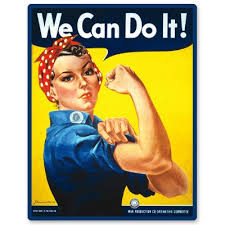
Who is this a image of and what did she a symbol of .....
June the Fighter symbol of women's suffrage
Susan the solider symbol of women working on airplanes
Rosie the Riveter symbol of women working in factories during the war.
Why was World War Two started?
The French invading Spain
The Germans invading Poland
The Germans threatening France
The Polish taking over Germany
What was the Allied invasion of France called?
Operation Barbarosa
Operation Overlord
Operation France
Rhineland Takeover
When Germany invaded the USSR, what was it called?
Operation Sea Lion
Operation D-Day
Operation Overlord
Operation Barbarosa
Who captured Berlin?
The USA
The USSR
The UK
France
Who was the leader of the Soviet Union during WW2?
Adolf Hitler
Benito Mussolini
Joseph Stalin
Winston Churchill
Who was the leader of Italy during WW2?
Adolf Hitler
Benito Mussolini
Joseph Stalin
Winston Churchill

The Japanese conducted the attack on Pearl Harbor because they thought that __________. (Complete the sentence using the best answer below)
second to Midway Island, Pearl Harbor would be a pivotal battle zone between the United States and Japan in the Pacific.
an overwhelming strike against the United States would push them immediately out of World War II.
the United States was preparing to attack the Japanese empire in reprisal for the Massacre of Nanking.
Pearl Harbor would be a pivotal base for the Japanese naval fleet as they tried to conquer the Pacific.
To confine someone as a prisoner, especially for military or political purposes, is called what?
Determent
Intermittent
Internment
Intermental
According to Order 9066, which people on the west coast were to be relocated?
People of Japanese ancestry
People of Hawaiian ancestry
People of Native American ancestry
People of French ancestry


On June 6, 1944, Allied troops landed on 5 beaches and is known as D-Day.
Stalingrad
Bulge
Britain
Normandy
Hitler wanted to take over a main Soviet industrial and communication city.
Stalingrad
Bulge
Britain
Normandy

The last island before Japanese mainland to be taken, see's 50,000 American troops losing their lives, as soldiers are forced to go through the whole island in fierce close fighting as Japanese would not surrender.
Battle of Iwo Jima
Battle of Midway
Battle of Coral Sea
Battle of Okinawa
Known as Hitler's last major offensive push...
Battle of Britain
Battle of Bulge
Italy invasion
Battle in which Hitler committed suicide as the Allies surrounded him and his troops
Battle of Bulge
Battle of Berlin
Battle of Stalingrad
D-Day

Known as the turning point in the Pacific Theater, as American forces sank ALL 4 Japanese aircraft carriers
Battle of Coral Sea
Battle of Iwo Jima
Battle of Guadalcanal
Battle of Midway
An assignment so secretive that each scientist was not told the final product, nor able to work with another. But it was what President Truman thought could end the war without costing millions of American lives.
Brooklyn Project
Bombing Project
Manhattan Project
New York Project

Tuskegee Airmen
Brooklyn Bombers
Saskatchewan Sabers
New England Patriots


First regular army corps for women
Women's Fighting Corps
Women’s Army Corps
GIs
Women's National Army Corps
During WWII the military was strictly...
segregated
whites only
women only
open to all

What does the term imperialism refer to?
A policy of giving away a country’s power to another nation as a gift
A policy of extending a country’s power and influence through diplomacy or military force
A policy of trading goods between two states or nations
A policy in which the government debates over paying someone to purchase another country

Hostility towards Spain increased as Americans were persuaded by _____________, which is a style of newspaper reporting that emphasizes sensational news.
Muckraking
Yellow Fever
Yellow Journalism
Wall Street Journal

Leading up to the Spanish-American War, the sudden explosion of the _____________ off of the coast of Cuba led Americans to believe that _______________ was to blame, despite there being no concrete evidence.
U.S.S. Maine; Cuba
U.S.S. Alabama; Spain
U.S.S. Maine; Spain
U.S.S. Maryland; France

In 1901, the __________________ made Cuba a legal protectorate of the United States.
20th Amendment
16th Amendment
Platt Amendment
Elastic Clause

The ________________ was an extension of the Monroe Doctrine and enabled the United States to intervene in Latin American countries struggling with unstable conditions.
Yellow Journalism
Great White Fleet
Rough Riders
Roosevelt Corollary
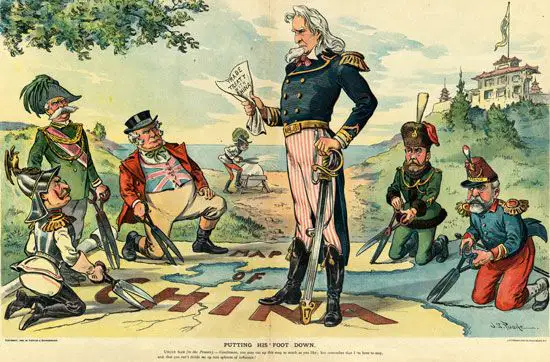
An _________________ for trade allowed the United States and other nations to trade “openly” with the Chinese and other countries.
Closed Door Policy
Open Door Policy
Roosevelt Corollary
American Expansionist
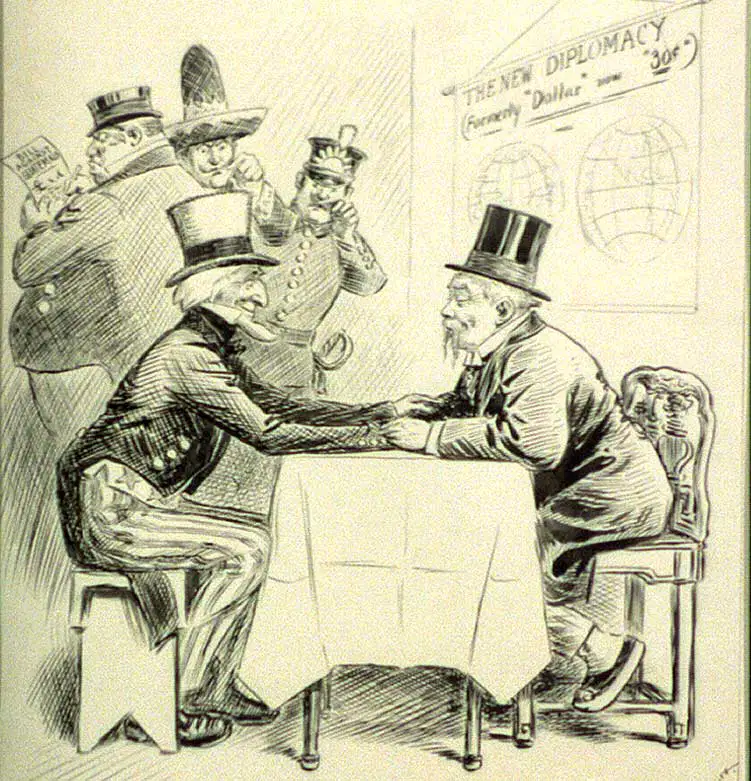
The term ________________ refers to the idea that through financial investment in foreign nations, the United States would develop a scope of influence that would provide both stability and economic opportunity.
Roosevelt Corollary
Dollar diplomacy
Open Door Policy
Interventionist
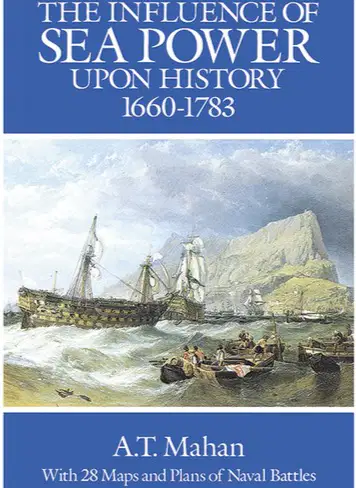

As a result of the Spanish- American War, the US became a political power in
The Hawaiian Islands
Puerto Rico, Guam, and the Philippines
Samoa
Panama

This passage describes events that led to the U.S. acquisition of what territory?


