Wayground logo

Free Printable Worksheets

Font size

S
M
L
XL
Worksheets

KCHS IPC Midterm Review

Total questions: 45

Worksheet time: 1hrs 25mins

Name
Class
Date
1.

Subatomic particles with a negative charge

a)

Electrons

b)

Neutrons

c)

Protons

d)

Quarks

2.
Subatomic particles with a positive charge
a)
neutrons
b)
atomic mass
c)
protons
d)
isotopes
3.
Subatomic particles that are neutral in charge
a)
Neutrons
b)
Protons
c)
Nucleus 
d)
Electrons
4.

Look at this picture of Argon off the periodic table. Which of the following is true for this element?

a)

18 protons

b)

40 protons

c)

22 protons

d)

21.9 protons

5.

Which part of an atom is used to identify it?

a)

number of protons

b)

number of neutrons

c)

number of electrons

6.

The atomic mass of an atom is equal to

a)

number of protons plus number of neutrons

b)

number of protons plus number of electrons

c)

number of electrons plus the number of neutrons

7.
Outside the nucleus of an atom are these
a)
protons
b)
neutrons
c)
quarks
d)
electrons
8.
These are found on the Periodic Table.
a)
Compounds
b)
Elements
c)
Mixtures
9.

a collection of atoms of one type that cannot be broken down into simpler substances by ordinary chemical or physical means

a)

element

b)

subatomic particle

c)

electron

d)

matter

10.
The atomic number of this pictured element is
a)
28
b)
58.6934
c)
Ni
d)
Nickel
11.
What is the atomic mass of Neon?
a)
10
b)
30
c)
10.18
d)
20.18
12.
How many protons are in this element?
a)
79
b)
196
c)
117
d)
Cannot be determined
13.
How many neutrons are in a Gold atom?
a)
79
b)
196
c)
118
d)
275
14.
What element is will have the most similar physical and chemical properties to the element Sulfur (S)?
a)
Carbon (C)
b)
Phosphorous (P)
c)
Oxygen (O)
d)
Neon (Ne
15.
Elements that are arranged in __________ have the most similar physical and chemical properties to each other.
a)
periods
b)
groups
16.

Elements which are shiny, conduct electricity and heat are called

a)

metal

b)

nonmetal

c)

metalloid

d)

nonexistent

17.
Which is an electron?
a)
A
b)
B
c)
C
18.
How many atoms of carbon (C) are in C6H12O6?
a)
3
b)
6
c)
12
d)
24
19.
How many Sodium (Na) are in 6NaCl?
a)
1
b)
12
c)
6
20.
Which of the following reactions is balanced?
a)
2CH4 + O2 -> CO2 + H2O
b)
CH4 + 2O2 -> CO2 + H2O
c)
CH4 + 2O2 -> CO2 + 2H2O
d)
None of the chemical equations are balanced.
21.
In chemical reactions, what does the principle of conservation of mass mean?
a)
Matter is not created or destroyed.
b)
The total mass of the reactants is greater than the total mass of the products.
c)
The total mass of the reactants is less than the total mass of the products.
d)
Matter is not changed.
22.
How many elements are found in the following molecule? Mg(ClO3)2
a)
1
b)
4
c)
3
d)
5
23.

Is the following equation balanced?

a)

True

b)

False

24.
Which of the following is a sign that a chemical reaction has occurred?
a)
change in shape
b)
melting
c)
formation of a gas
d)
dissolving
25.
Which of the following is NOT an example of a physical change?
a)
crumpled paper
b)
pencil sharpening
c)
shrunken clothing
d)
rust
26.
Fizzing, foaming, and burning are all examples of
a)
Chemical change
b)
Physical change
27.

Which of the following is a sign that a physical change has occurred?

a)

Bubbles forming

b)

The object being broken into smaller pieces

c)

Heat being produced

d)

Light being produced

28.

Your friend decides to toast a piece of bread, but leaves it in the toaster too long. The bread is black and the kitchen is full of smoke.

a)

Physical Change

b)

Chemical Change

29.
What are the states of matter?
a)
solid, liquid, and juice
b)
solid and liquid
c)
solid and gas
d)
solid, liquid, and gas
30.
Which state of matter has particles arranged like this?
a)
solid
b)
liquid
c)
gas
31.
Which state of matter has particles arranged like this?
a)
solid
b)
liquid
c)
gas
32.
Which state of matter has particles arranged like this?
a)
solid
b)
liquid
c)
gas
33.

During which segment did the car come to a complete stop?

a)

Segment A to B

b)

Segment B to C

c)

Segment C to D

d)

Segment D to E

34.

During which segment did the car travel back toward its starting position?

a)

Segment A to B

b)

Segment B to C

c)

Segment C to D

d)

Segment D to E

35.

During which segment did the car travel the fastest?

a)

Segment A to B

b)

Segment B to C

c)

Segment C to D

d)

Segment D to E

36.

What distance had the car traveled at 10 hours?

a)

60km

b)

50km

c)

60

d)

50

37.
Acceleration occurs when an object changes its speed or ______.
a)
direction
b)
force
c)
inertia
d)
mass
38.
A car driving at 50 miles per hour drives for 2 hours. What distance did it cover?
a)
50 miles
b)
25 miles
c)
100 miles
d)
75 miles
39.
What does this graph represent?
a)
Constant Speed
b)
Acceleration
c)
Not moving
40.
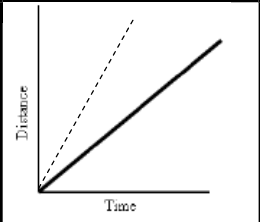
Which line represents an object moving at a faster speed?
a)
A
b)
B
41.
A runner races in the 100 meter dash.  It takes her 10 seconds to finish.  What is her average speed?
a)
10 m/s
b)
1000 m/s
c)
100 seconds
d)
10 seconds
42.
Alan travels 100 km in 5hrs. Find his average speed in km/h
a)
5km/hr
b)
10km/hr
c)
50km/hr
d)
20km/hr
43.

When heat is added to water, it turns into __________.

a)

solid

b)

liquid

c)

water vapor

d)

precipitate

44.

What phase change must take place in order to make ice cubes?

a)

melting

b)

freezing

c)

evaporation

d)

condensation

45.

Melting is a change from solid to liquid when the temperature is ___________.

a)

increased

b)

lowered

c)

constant