
 Worksheets
24-25 S2 2nd term Sci Exam Revision (Eyes and Ears)
Total questions: 41
Worksheet time: 3hrs 25mins

Human have 5 senses for detecting stimuli in the environment.
Which of the following matchings between sense organs and stimuli is correct?
A
B
C
D
E
Astigmatism (散光) is caused by the unevely curved lens or cornea. It cannot be corrected by wearing suitable glasses.
True
False
Which of the following apparatus can be used to observe animal cells?
Binoculars
Hand lens
Microscope
Telescope
Which of the following are correct methods of protecting the eyes?
(1) Do not rub our eyes with hand.
(2) Wear sunglasses to protect our eyes from strong light.
(3) Eating enough food that contains vitamin A.
(4) Using distilled water to wash the eyes every day
(1), (2) and (4) only
(1), (3) and (4) only
(1), (2) and (3) only
(1), (2), (3) and (4) only
We cannot perceive the image that falls on the blind spot, because
no image can be formed on the blind spot.
the light-sensitive cells cannot sent signals to the brain.
there are no light-sensitive cells on the blind spot.
it is where the optic nerve leaves the eye.
Which of the following will happen when a person is looking at a distant object?
(1) The lens relaxs.
(2) The ciliary muscles (focusing muscles) relax.
(3) The len becomes thinner
(1) and (3) only
(1) and (2) only
(2) and (3) only
(1), (2) and (3)
Evan is now entering a dark room. Which of the following statements must be
correct?
(1) His pupils become larger.
(2) The rod cells become more essential in sensing the sight in the room.
(3) The focusing muscle is contracting.
(1) and (2) only
(1) and (3) only
(2) and (3) only
(1), (2) and (3)
Jane suffers from an eye defect that she cannot see distant objects clearly.
Which of the following is/are the cause(s) of this eye defect?
(1) The lens being too thin
(2) The lens being too thick
(3) The eyeball being too short
(1) only
(2) only
(1) and (3) only
(2) and (3) only

According to the diagram showing how the light rays go through the eyeball of Peter, which of the following combinations is correct?
A
B
C
D
Draw a labelled diagram to show how short sight can be corrected with suitable lens.

Draw a labelled diagram to show how long sight can be corrected with suitable lens.
What image is formed on our retina when we look at the letter ‘b’
b
d
p
q
The pupil can control its size by itself.
True
False
Which of the following combinations about cone cells and rod cells is correct?
Cone cells: Sensitive to dim light;
Rod cells: Sensitive to bright light
Cone cells: Three different types;
Rod cells: Two different types
Cone cells: Found all over retina;
Rod cells: Found on the blind spot only
Cone cells: Can detect colours;
Rod cells: Cannot detect colours
Retina is the outer layer of the eyeball which protects the eyeball.
True
False

When we are looking at the attached diagram, which of the following is the image formed on the retina?


Which of the following statements about colour-blindness is/are correct?
(1) It is caused by a defect in one or more types of rod cells.
(2) It is an inherited disease.
(3) It is more common in elderlies.
(1) only
(2) only
(3) only
(1) and (2) only
If we are seeing a car departing, what changes will occur to the lens of the eyeball?


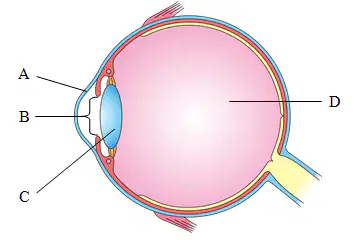
If a person suffers from cataract, which part of the eye becomes cloudy?
A
B
C
D

If a person suffers from astigmatism, which part of the eye is/are unevenly curved? (Choose more than one answer)
A
B
C
D
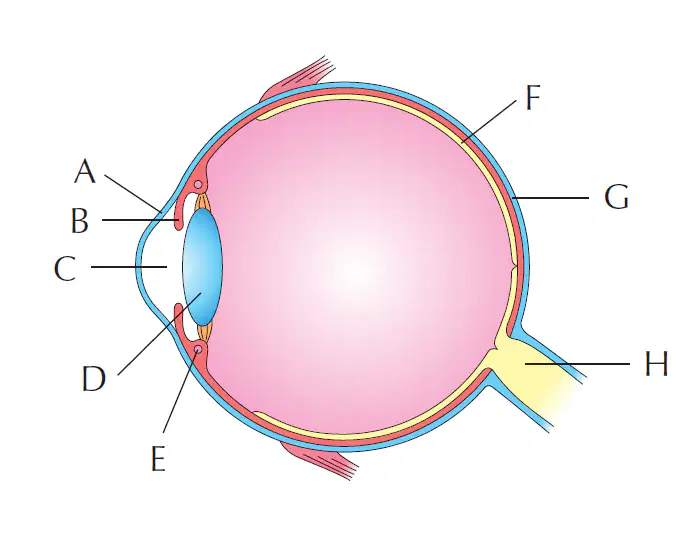
Which part(s) is/are muscle(s) in the eye?
A & D
B & E
C & F
G & H
What is the function of C?
regulates the amount of light entering the eye
controls the size of the pupil
its thickness changes to help focus light
protects the eyeball
Long sight can be caused by the lens being too thick.
True
False
Which of the following matchings between different parts of the human eye is INCORRECT?
A
B
C
D
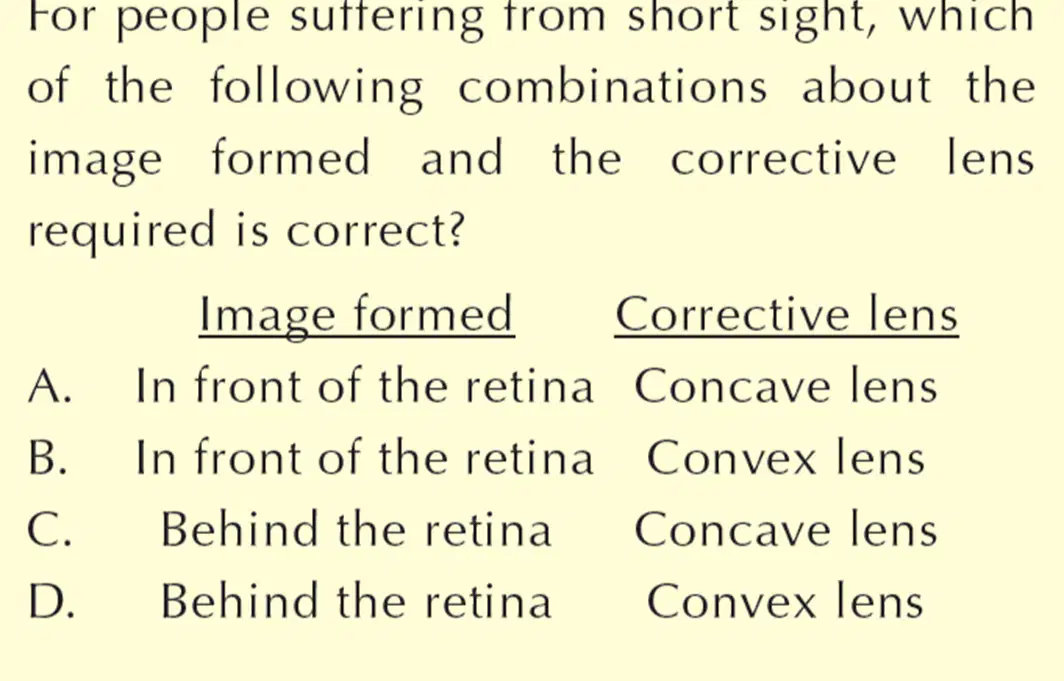
For people suffering from short sight, which of the following combinations about the image formed and the corrective lens required is correct?
A
B
C
D
Leo taps 2 tuning forks of different lengths. Which of the following combinations about the pitch and frequency of the sound produced by the long tuning fork is correct?
A
B
C
D
The number of vibrations per second made by a vibrating object is called frequency.
True
False
One of the functions of an eardrum is to detect vibration.
True
False
The eardrum amplifies sound vibrations.
True
False
The unit of sound level is hertz (Hz).
True
False
The higher the sound frequency, the louder the sound.
True
False
The slower an object vibrates, the lower the frequency of the sound it produces.
True
False
Eardrum can convert gas vibration into solid vibration.
True
False
Which of the following parts of the ear vibrate when we detect sounds?
X and Y only
X and Z only
Y and Z only
X, Y and Z
Which of following statements about audible frequency range is/are INCORRECT?
(1) Different people have different audible frequency ranges.
(2) The audible frequency range of humans is from about 200 Hz to 20 000 Hz.
(3) The upper limit of hearing is usually higher in older people than that in young people
(1) only
(3) only
(1) and (2) only
(2) and (3) only
The graph shows the audible frequency ranges of some animals.
Which animal has the narrowest audible frequency range?
Animal P
Animal Q
Animal R
Animal S
Which of the following structures in the ear may have been damaged if a person cannot hear any sound?
(I) Auditory nerve
(II) Cochlea
(III) Eardrum
(I) and (II) only
(I) and (III) only
(II) and (III) only
(I), (II) and (III)
In which of the following media is sound transmitted most slowly?
Wood
Soft drink
Glue
Water
Sound cannot be transmitted in vacuum. Which of the following are the explanations for this?
(I) Sound is transmitted through the vibration of particles.
(II) No particles are present in vacuum.
(III) There is empty space in vacuum.
(I) and (II) only
(I) and (III) only
(II) and (III) only
(I), (II) and (III)
Which of the following tuning forks produces the highest pitch of sound?
A fork of 5 cm long
A fork of 10 cm long
A fork of 8 cm long
A fork of 20 cm long
The blind spot:
(1) is a spot on the retina.
(2) is the spot where the optic nerve leaves the eyeball.
(3) only contains rod cells.
(2) only
(3) only
(1) and (2) only
(1) and (3) only

