
 Worksheets
Mid Year Practice Questions
Total questions: 29
Worksheet time: 20mins
What is the difference between characteristics and traits?
They are exactly the same thing.
Characteristics are specific (green, round) and traits are in general terms (seed color, seed shape).
Characteristics are general (seed color, seed shape) and traits are specific (green, round).
Characteristics are for animals and traits are for plants.
What are genes?
Segments of DNA found in chromosomes.
Another word used for chromosomes.
Several chromosomes put together.
An article of clothing.
What are alleles?
Different versions of a chromosome
Different versions of DNA
Different versions of a gene
Different versions of a phenotype
What is the difference between genotype and phenotype?
Genotype is observable traits, Phenotype is the combination of alleles that you inherit.
Genotype is the combination of alleles that you inherit, Phenotype is observable traits.
They are identical
Phenotype is used to describe physical traits, and Genotype is used to describe personality traits.
Which is true about a dominant allele?
Dominant alleles contribute to the phenotype only when two copies are present in the genotype.
Dominant alleles don't contribute to the phenotype at all.
Dominant alleles are the only contributors to the phenotype.
Dominant alleles contribute to the phenotype if one or two copies are present in the genotype.
How can recessive alleles still be expressed in the phenotype?
When two copies of the recessive allele are present.
When zero copies of the recessive alleles are present.
When one copy of the recessive allele is present.
They can never be expressed in the phenotype.
Some characteristics, such as the color of your skin, hair, and eyes, are the result of several genes....
Being absent completely
Acting independently
Acting together
Canceling each other out
Which of the following is NOT an example of a single gene influencing many traits?
Skin, hair, and eye color in humans.
A white tiger's fur and blue eye color.
All of the traits associated with sickle cell anemia.
The arctic fox has a white coat in the winter and a brown coat in the summer. This is an example of...
The environment's influence on traits.
The different types of foxes.
Genetic engineering on foxes.
The personality of the arctic fox.
Pink snapdragons are produced by a cross between a red snapdragon and a white snapdragon. This is an example of...
Complete dominance
Zero dominance
Incomplete dominance
Random results
An example of codominance is seen in the genes that determine human blood types. True or False.
True
False
What is heredity?
The passing of money from parents to offspring.
The passing of genetic material from parents to offspring.
The passing of opinions from parents to offspring.
The passing of education from parents to offspring.


Radiant energy used in photosynthesis is captured by the
leaves
chlorophyll
roots
cytoplasm
Plants utilize ____________ given off by humans to assist in making glucose.
oxygen
water
carbon dioxide
nitrogen


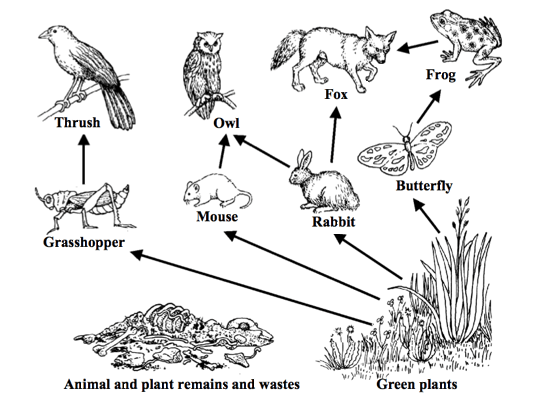
When looking at energy pyramids, only _____ of the energy is passed from one tropic level to the next. This is because organisms uses 90% of the energy for mechanical and thermal energy.
10%
50%
1%
none of the above
What do the arrows in a food chain or food web indicate?
The loss of energy in the chain or web.
The importance of organisms in the chain or web.
The flow of energy in the chain or web.
None of the above

In the energy pyramid, each level receives 100% of the energy from the level below it.
True
False

