
 Worksheets
Final Review
Total questions: 91
Worksheet time: 1hrs 8mins
Who were the founding leaders of Christianity?
Muhammad
Moses
Abraham
Jesus
Who is the prophet and founder of Islam?
Muhammad
Jesus
Caesar
Hammurabi
Judaism is monotheistic. This means they believe in:
One God
Many Gods
One prophet
Reincarnation
Who is considered the founder of Judaism?
Moses
Abraham
Jesus
Muhammad
Hinduism is polytheistic. What does that mean?
Hindus believe in one God.
Hindus believe in multiple gods and goddesses that control the universe.
Hindus believe in more than one version of heaven.
Hindus believe in multiple classes of people.
Who was the founder of Buddhism?
Confucius
Ashoka
Siddhartha Guatama
Attila

Name the civilization that is associated with the following:
- Nile River
- Hieroglyphics
- Pyramids
Egypt
Mesopotamia/Sumer
India
China

Name the civilization that is associated with the following:
- Huang He (Yellow) River
- Calligraphy writing
- Paper and Silk
Egypt
Mesopotamia/Sumer
India
China

Using the map, which river valley is shaded in yellow?
Egypt
Mesopotamia/Sumer
India
China

Using the map, which river valley is shaded in pink?
Egypt
Mesopotamia/Sumer
India
China

Name the River Valley Civilization that is shaded in purple on the map.
Egypt
Mesopotamia/Sumer
India
China

Name the River Valley Civilization that is shaded in orange on the map.
Egypt
Mesopotamia/Sumer
India
China
What was Spartan society notable for?
A higher standard of living than most Greek city-states
An emphasis on military and athletic ability
Great intellectual and artistic accomplishment
Being the birthplace of democracy
What is the primary quality of the type of democracy found in Athens?
Have representatives
Gossip in the marketplace
Meet on a hill
Vote directly on laws
Alexander the Great marched his military as far south as Egypt and as far east as:
The Indus River valley.
China.
Thailand.
Great Britain.

Which of the following is NOT a Muslim mathematical achievement?
Arabic numerals
Roman Numerals
Algebra
Use of Zero
The monarch whose desire for a male heir led him to break with the Catholic Church over his need to divorce and remarry. He did this 6 times.
Henry the 7th
Henry the 8th
Louis the 14th
Who was Hammurabi?
Hammurabi was a god in Ancient Sumer.
Hammurabi was a king from Mesopotamia.
Hammurabi was a warrior.
Hammurabi was a farmer from Mesopotamia.
What is Hammurabi famous for?
He was the first to use cuneiform (writing).
He was the first emperor.
He had a powerful army.
He was the first to produce written laws.

Who founded the belief system of Confucianism?
Lao Tzu
Winnie the Pooh
Confucius
Qin Dynasty

Who is considered the founder of Daoism?
Confucius
Lao Tzu
Sun Tzu
Mao Zedong
Daoists emphasized the importance of ____________ and ___________.
peace, harmony
punishment, strictness
rules, restrictions
kings, queens
According to Confucius, how should rulers govern?
By the law.
By military might.
By a monopoly on natural resources.
By setting a good example.
Rome's government began as a _______ and changed to an _________.
democracy, republic
republic, empire
empire, republic
tyranny, empire
When Rome divided it split into?
Northern and Southern Empire
New Rome and Ancient Rome
Eastern and Western Empire
Old and New Rome

The East Roman Empire became known as the _____________.
Holy Roman Empire
Persian Empire
Byzantine Empire
Assyrian Empire
The split of the Christian church into two churches was known as the —
Crusades
Eastern Split
Roman Crusade
Great Schism
What is the title of the head of the Roman Catholic Church?
King
Pope
Tsar
Emperor
What is the name of the Church in the west?
Roman Catholic
St. Augustine
Orthodox Church
Hagia Sophia
What is the name of the church in the Byzantine Empire?
Hagia Sophia
Orthodox Church
St. Augustine
Roman Catholic

What is a Manor?
A soldier in the past who had a high social rank and who fought while riding a horse and usually wearing armor
A social system that existed in Europe during the Middle Ages in which people worked and fought for nobles who gave them protection and the use of land in return
A large area of land that was ruled over by a lord in medieval times: a feudal estate
An estate under a lord with a variety of rights over land and tenants
What is FEUDALISM?
A system of government where the king allows some democracy to exist.
A series of promises and exchanges between lords, vassals and serfs on a manor.
The type of government that King Harold of England had before 1066.
A series of promises where the lord promised freedom for serfs for good work done.
The feudal system meant that different classes had certain responsibilities and obligations.
True
False
Before the revolution in France, members of the Third Estate had:
a smaller tax burden than the other estates
greater political influence than the clergy
a voice in government equal to that of the First and Second Estates
a high tax burden and little political power
The idea that society should be guided by reason rather than tradition, which helped cause the French Revolution, came from:
The Declaration of Independence
The Scientific Revolution
The Enlightenment
All of the above
Most of the people of France belonged to which estate?
1st Estate
2nd Estate
3rd Estate
4th Estate
Which of these contributed to the French Revolution?
Defeat and occupation by the Prussian army
Rejection of Enlightenment ideas
Participation in the American Revolution
The rise of Napoleon
The religion of ancient Rome was influenced by which civilization?
Greece
Mesopotamia
Persia
Egypt
Scientists named ______________________ after Roman gods and goddesses.
Elements
Weather events
Planets
Animals
Greek Mythology was chronicled in
The Iliad
The Aeneid
The Bible
The Tora

The part of the slave’s journey aboard the ship between Africa and the American colonies was known as the _________________
Triangular Trade Route
Middle Passage
Northwest Passage
Bermuda Triangle
Who was responsible for capturing Africans for slavery?
Americans
Other Africans
Europeans
Brazilians
Which continents were included in the Atlantic Slave Trade?
North America, South America, and Brazil
North America, South America, Europe, and Africa
North America, Europe, and Africa
South America, Asia, and Europe
What did Johannes Gutenberg invent?
Libraries
Paper
The Printing Press
Whiteboards
A political, social, economic, and cultural 'rebirth' from the 1300s to the 1500s C.E.
Middle Ages
Reformation
Classical Era
Renaissance
Who painted the Mona Lisa and The Last Supper?
Jan van Eyck
Machiavelli
Michelangelo
Leonardo da Vinci
Renaissance artist who painted the Sistine Chapel ceiling and sculpted The David.
Jan van Eyck
Michelangelo
Machiavelli
Leonardo da Vinci
Invented the movable type printing press.
Petrarch
Johann Gutenberg
Erasmus
Sir Thomas More
Which is NOT an impact of the Gutenberg Press
Books were cheaper
Literacy rates increased
People began to study the Bible for themselves
Literacy rates decreased

What is one significance of the Columbian Exchange?
It brought many new ways of life to the Old and New Worlds
The plants brought to the Old World didn't survive there
Many Native Americans would move to Europe for a better way of life
Native Americans became very wealthy off the trade with Europeans
The exchange of goods and people between Europe, Africa, and the Americas is the ________________?
Cartaz system
Mercantilism
Capitalism
Columbian Exchange

What caused many Native Americans to die during the time of the Columbian Exchange?
A movement against the Roman Catholic Church that began in 1517; it resulted in the creation of Protestant churches
Reformation
Purgatory
Protestant
Indelugence
What document, written by Luther, began the reformation
95 Theses
Indulgences
Lutherans Protest
30 year war
How did the Nazis feel about the Treaty of Versailles?
They hated it and wanted to scrap it.
The loved it and wanted to stick with it
They thought it was too lenient
The agreed with some of it.
How did the Nazis feel about Jewish people?
They had no opinion about them
They generally liked them
They thought they were inferior
They thought they made a valuable contribution to society
What does Lebensraum mean?
Lightning War
Farming Space
League of Nations
Living Space
What was the Nazi policy on German-speaking people living in other countries?
They should be protected
The should move to Germany
Their land should unify with Germany
They should stay away from Germany

The persons pictured were the World War II leaders of the
Axis Powers
League of Nations
The Allies
Central Powers

The persons in the pictures were World War II leaders of the
League of Nations
Axis Powers
The Allies
Central Powers

The systematic attempt to rid Europe of all Jews during
World War II was called
the Progressive Movement
Internment camps
the Marshall Plan
the Holocaust


What is the first period in Prehistory?
Metal Age
Neolithic
Palaeolithic
Middle Age
When did Prehistory end?
when hominids appeared
When fire was discovered
When writing was invented
When Christ was born
Define "civilization:
An advanced state of development of a society as judged by such things as having artistic expression, freedom of speech, and free will.
An advanced state of development of a society as judged by such things as NFL Football, NBA Basketball, and Tidepod challenges
An advanced state of development of a society as judged by such things as having a system of government and laws, using a written language, and keeping written records
Agricultural Surplus, Government, Written language/records, Job Specialization, Social Classes, an Economic System, Technology, Religion/belief system are ALL characteristics of what?
clans
tribes
villages
civilization
Which of these best describes the Scramble for Africa?
Imperialist powers sliced Africa amongst themselves by drawing borders on a map
Diplomats worked with tribal leaders to determine how to colonize countries in Africa
European countries worked to finance capital expansion in African nations through loans.
The United States used the Roosevelt Corollary to prevent nations from colonizing Africa.
Define "imperialism."
the policy of extending the rule or authority of an empire or nation over foreign countries, or of acquiring and holding colonies.
loyalty and devotion to a nation
the power to do as one pleases
an area of land under the jurisdiction (rule) of a ruler or state.

In the late 1800s, an increased demand for raw materials and a desire for new markets contributed to the United States adopting a policy of
isolationism
collective security
imperialism
pacificism
How did nationalism emerge in Europe during the 19th century?
Using Napoleons conquests to make France weak
During the French Revolution, spreading by Napoleon's conquests
Surrounding Europe with weak countries to make Napoleon look stronger so he could prevents further aggression
Nationalism is most likely to develop in an area that has
a weak economic system and a weak military
common customs, language, and culture
diverse beliefs and cultures

What is the name of the yellow continent?
Australia
North America
The United States
Australia
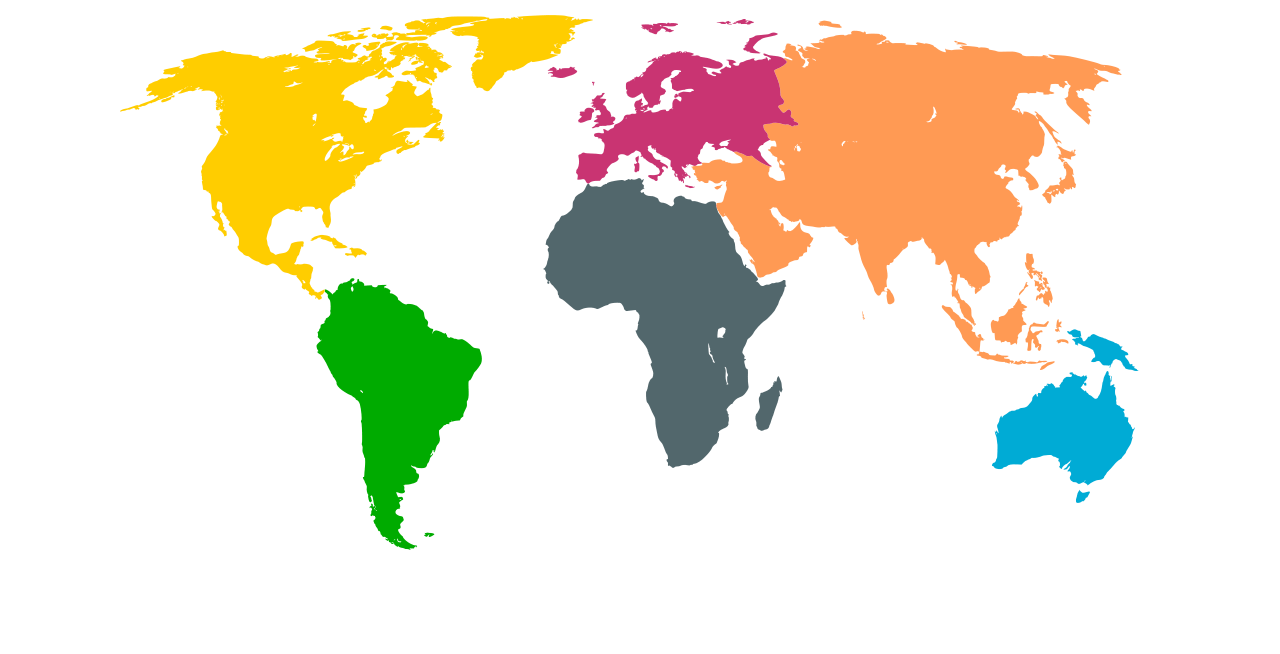
What is the name of the grey continent?
North America
South America
Africa
Asia

What is the name of the green continent?
North America
Brazil
South America
Africa

What is the name of the blue continent?
Africa
Asia
Australia
Orange

What is the name of the orange continent?
Europe
Asia
Russia
China

What is the name of the pink/red continent?
Europe
Asia
North America
Australia

Which ocean is this?
Atlantic
Pacific
Indian
Southern
Artic

Which ocean is this is?
Indian
Atlantic
Southern
Pacific
Antarctic

Which ocean is this?
Indian
Southern
Antarctic
Pacific
Atlantic

Which ocean is this?
Southern
Atlantic
Pacific
Artic
Indian

Which ocean is this?
Arctic
Southern
Indian
Pacific
Atlantic

