
 Worksheets
CCA Review 2: Populations & Human Impact
Total questions: 35
Worksheet time: 8hrs 47mins
The cardinal is a type of bird. Which of the following would increase the size of a population of cardinals in a forest?
an increase in the birth rate of cardinals
an increase in the death rate of cardinals
increased emigration of young cardinals from the forest ecosystem
increased immigration of cardinal predators into the forest ecosystem

The green sea turtle is an endangered species. The graph below shows the estimated number of green sea turtle nests on a beach in Costa Rica between 1970 and 2003. Based on the information in the graph, which of the following is the most likely way humans affected the green sea turtle population during this time?
Humans passed laws preventing the collection of green sea turtles.
Humans collected more green sea turtle eggs for scientists to study.
Humans passed laws protecting animals that eat green sea turtle eggs.
Humans built more hotels on the beach where green sea turtles build nests.

The graph below shows the changes in the population size of a mammal species introduced onto an isolated island in 1957. Which of the following conclusions is best supported by the data?
Every year, more individuals were born than died.
A predator of this mammal was removed from the island in 1990.
The population decreases were the result of low immigration rates.
In the 1980s, the mammal’s population size stayed around its carrying capacity.
Which of the following statements best explains why introduced species often threaten native species in an ecosystem?
Introduced species often have less genetic diversity than native species.
Introduced species often lack natural predators in their new environment.
Introduced species often form mutualistic relationships with native species.
Introduced species often cause short-term droughts in their new environment.
The oceans have become increasingly acidic in recent years as the water absorbs more and more carbon dioxide from the atmosphere. This increased acidity interferes with the ability of corals to maintain their skeletons. In addition, an increase in water temperatures worldwide is causing coral bleaching, another condition that threatens the health of coral reefs. Based on this information, which of the following would most improve the health of coral reefs?
reducing the use of fossil fuels
eliminating nuclear power plants
removing more natural gas embedded in rocks
replacing offshore oil drills with onshore oil drills
A population of grasshoppers increased in size over a five-year period. Which of the following best explains this increase?
The death rate was higher than the birth rate, and the immigration rate was equal to the emigration rate.
The emigration rate was higher than the birth rate, and the immigration rate was equal to the death rate.
The immigration rate was higher than the death rate, and the emigration rate was equal to the birth rate.
The emigration rate was higher than the immigration rate, and the birth rate was equal to the death rate.

The zebra mussel is a highly invasive species that was accidentally introduced to the Great Lakes region of the United States in the 1980s. The map below shows the distribution of zebra mussels in 2010. What is the primary reason the large-scale spread of zebra mussels concerns scientists?
Zebra mussels are a freshwater species.
Zebra mussels are a desired food for humans.
Zebra mussels are eaten by some fish and birds.
Zebra mussels outcompete native mussel species.

The graph below shows changes in the size of a mammal population in the early 1900s. Which of the following explanations is the most likely reason for the dramatic population change between 1915 and 1925?
a decrease in the birth rate of the mammal population
an increase in the death rate of the mammal population
a large decrease in the number of the mammal’s predators
a large increase in snowfall for several months in the mammal’s habitat

Kudzu is an invasive plant that can grow as much as one foot in a day. A partial food web for an ecosystem is shown. Suppose kudzu invades this ecosystem. Select three organisms that would most likely compete with kudzu in this ecosystem
Oak tree, grass, wildflower
Deer, squirrel, butterfly
Oak tree, deer, coyote
Butterfly, swallow, hawk
Select all of the processes the biological processes that release carbon into the atmosphere.
Combustion
Respiration
Decomposition
Photosynthesis
Select the process that removes and stores carbon from the atmosphre.
Photosynthesis
Combustion
Decomposition
Respiration
Which process in the carbon cycle is responsible for cycling carbon FROM atmosphere TO biosphere?
Photosynthesis
Combustion
Respiration
Decomposition

Factors like predation can have a positive benefit to the population of prey organisms because predators tend to keep prey populations below their ___________.
carrying capacity
sustainibility number
exponential growth point
competition level
High biodiversity is a sign of a healthy ecosystem.
True
False
What are some ways we can help in maintaining biodiversity?
Get involved with ecological restoration in your area.
Prevent invasive species from overpopulating.
Don't use chemical pesticides on crops.
All of the above
A stable ecosystem typically has high biodiversity.
True
False
The primary cause of the introduction of invasive species introduction is ---
too much food.
human action.
weather events.
asteroids.
Which of the following would be most effective method to slow down destruction of certain species of birds and small mammals from over hunting?
increase the demand for meat and pelts from these animals
Prevent nature documentaries from being made about these animals
Decrease the size of their habitat.
Regulate the number of animals that can be hunted in a certain area at certain times

The largest number of individuals that an environment can support long term is...
carrying capacity
emigration
immigration
population density
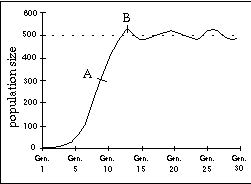
What is the carrying capacity of the graph?
around 500
more than 800
less than 300
around 700
Invasive species can have a major impact on the ecosystem.
TRUE
FALSE
Which of the following is one way that energy flows in an ecosystem?
from producer to producer
from carnivore to producer
from herbivore to carnivore
from herbivore to herbivore
Select two factors that are responsible for the inefficiency of energy transfer from one trophic level to another.
Carnivores obtain energy from consumers only.
Organisms lose energy to the environment as heat.
Some parts of organisms are not eaten by consumers.
Omnivores get energy from producers and consumers.

In this food web, what trophic level is the mouse?
Secondary and Tertiary Consumer
Primary Consumer
Secondary Consumer
Primary and Secondary Consumer

A partial food web is shown below. Which of the following describes the relationship between the earthworms and the beetles in the food web?
The earthworms and the beetles both compete for fungi.
The earthworms and the beetles both compete for robins and moles.
The earthworms help the beetles survive, and the beetles do not harm the earthworms.
The earthworms help the beetles survive, and the beetles help the earthworms survive.

