Wayground logo

Free Printable Worksheets

Font size

S
M
L
XL
Worksheets

Biology Semester 1 Review

Total questions: 76

Worksheet time: 56mins

Name
Class
Date
1.

Which of these can change when new evidence is presented?

a)

theory

b)

law

2.
Scientific theories are based on
a)
general assumptions of how systems work.
b)
mathematical principles that can be proven true.
c)
large amounts of data collected over time.
d)
observations from within only one scientific discipline.
3.
What  are the three parts of the cell theory?
a)
all living things are unicellular; the cell makes up everything; cells come from free cell formation
b)
all things are made of cells; the cell is the basic unit of life; cells come from other cells
c)
All living things are made of one or more cells; the cell is the basic unit of life; all cells come from other cells
d)
Cells are cool; cells are fun; let's all eat a cinnamon bun
4.
Which of the following is a generalized description of a fact of nature that is observed over and over again? 
a)
scientific theory
b)
scientific law
c)
hypothesis
d)
observation 
5.
Who first observed cells using a piece of cork & coined the term "cell?" 
a)
Robert Hooke
b)
Anton van Leeuwenhoek
c)
Matthias Schleiden
d)
Theodor Schwann
6.

What is this graph showing you?

a)

The worlds population has been growing and will continue to grow

b)

The worlds population was growing but now is decreasing

c)

The worlds population is staying the same

7.
What property of water allows it to be such a versatile solvent that it is often called the "universal solvent?"
a)
Purity
b)
Polarity and cohesion
c)
High heat capacity
d)
Expansion upon freezing
8.
Water striders can walk across the surface of calm water. Their feet push the surface of the water down slightly, but they do not break the surface. Why?
a)
The insects are light enough so they do not break the hydrogen bonds holding the water molecules together
b)
The insects actually use their wings to hover slightly above the water’s surface and they only skim it with their feet.
c)
The insect’s feet are non-polar, so they are repelled by the polar water molecules and are pushed away from the water’s surface.
d)
The insects are small enough to see the individual water molecules, so they are able to step carefully from one molecule to the next
9.
Why does water move from the roots to the leaves of plants?
a)
Water is pushed by solutes
b)
Capillary action pulls the water molecules like a chain
c)
Water is pulled by gravity
d)
Water’s cohesion causes it to “pull” towards the leaves
10.
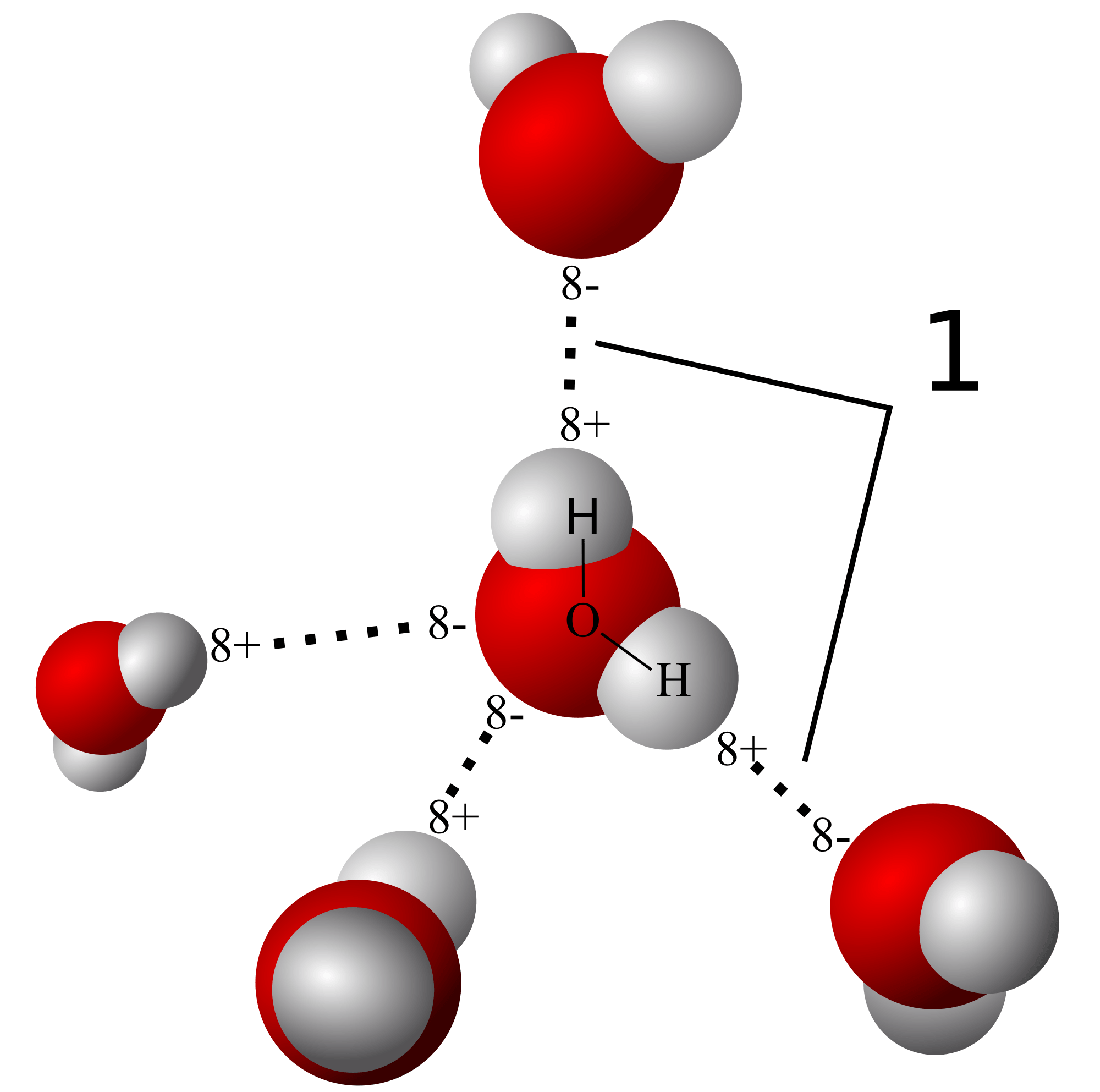
Attractions between water molecules are called
a)
Covalent bonds
b)
Ionic bonds
c)
Polar bonds
d)
Hydrogen bonds
11.
Why does ice float?
a)
As water freezes, it expands and its density decreases.
b)
As water freezes, it takes up more hydrogen from the atmosphere, causing it to have a greater buoyancy.
c)
As water freezes, air becomes trapped between the hydrogen bonds of water molecules.
d)
As water freezes, it takes up more oxygen from the atmosphere, causing it to have a greater buoyancy.
12.
Water is polar because...
a)
The unequal sharing of electrons gives the water molecule a slight negative charge near its oxygen atom and a slight positive charge near its hydrogen atoms.
b)
The molecule has two poles, at which the it is colder than other regions of the molecule.
c)
The unequal sharing of electrons gives the water molecule a slight negative charge near its hydrogen atoms and a slight positive charge near its oxygen atom.
d)
The water molecule is neutral.
13.

Important to the structural integrity of plant cells, this is the single most abundant polysaccharide in the world.

a)

Starch

b)

Glycogen

c)

Cellulose

d)

Chitin

14.

Which of the following are almost always hydrophobic?

a)

carbohydrates

b)

lipids

c)

proteins

d)

nucleic acids

15.

What kind of macromolecule is hemoglobin?

a)

carbohydrate

b)

lipid

c)

protein

d)

nucleic acid

16.

The parts of a nucleotide are:

a)

nitrogen, sulfur, phosphate group

b)

DNA, RNA, ATP

c)

nitrogenous base, ATP, glucose

d)

nitrogenous base, 5-carbon sugar, phosphate group

17.

Most enzymes are composed of .....

a)

Lipids

b)

Carbohydrates

c)

Proteins

d)

Nucleic Acids

18.
Where do substrates bind on an enzyme?
a)
voltage-gated channels
b)
surface receptor
c)
calcium channels
d)
active site
19.
With what 3 letters do enzymes typically end?
a)
-ose
b)
-ase
c)
-ese
d)
-tic
20.
What is a substance called if it speeds up a chemical reaction?
a)
reusable
b)
catalyst
c)
specific
d)
fragile
21.
The function of nucleic acids, such as DNA are for building proteins and carrying the ___________ info.
a)
genetic
b)
disease fighting 
c)
bone building 
d)
energy
22.
The three main elements that make up all life on Earth are?
a)
hydrogen, oxygen, sulfur
b)
hydrogen, oxygen, carbon
c)
carbon, oxygen, uranium 
d)
oxygen, carbon, helium.  
23.

Humans get most of their energy (fast, immediate energy) from eating what type of food?

a)

protein

b)

carbohydrates

c)

lipids

d)

meat

24.

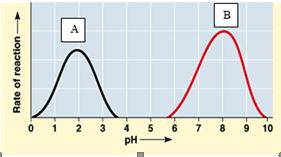
Cells can only work if their enzymes are functioning. What can you infer from the graph?

a)

Cells function best at low pH values

b)

Cells function fine at all pH values

c)

Cells function best at high pH values

d)

Cells do not function well if the pH is too high or too low
25.

What is the optimal pH of enzyme A?

a)

8

b)

2

c)

5.7-10

d)

10

26.
The graph shows the relative rates of action of four enzymes, A, B, C, and D. Which enzyme shows the greatest change in its rate of action with the least change in pH?
a)
enzyme A 
b)
enzyme B 
c)
enzyme C
d)
enzyme D
27.

Jared observes a cell in biology lab with the light microscope. The cell has the following structures: nucleus, cell wall, and chloroplast. Identify the type of cell that Jared is observing.

a)

animal

b)

plant

c)

fungus

d)

bacteria

28.

Carrie observes an electron micrograph of a cell during biology lab. The cell has a flagellum, ribosomes, cell wall, and no apparent nucleus. Which of the following is likely true of the cell that Carrie is observing?

a)

The cell also contains mitochondria.

b)

The presence of the organelles proves that the cell is eukaryotic.

c)

The cell is a plant because of the cell wall.

d)

The cell is prokaryotic.

29.

Which of the following best describes the function of smooth endoplasmic reticulum?

a)

Modifies carbohydrates and proteins, placing them into vesicles

b)

Manufactures proteins and nucleic acids using the DNA code

c)

Modifies and transports proteins after the ribosome makes them

d)

Manufactures lipids and then transports them to a new location

30.

Which structure in the cell destroys invaders such as bacteria and viruses, while also helping with the digestion of food particles?

a)

cell membrane

b)

endoplasmic reticulum

c)

Golgi apparatus

d)

lysosomes

31.

Prokaryotes do not have a nucleus. Which of the following organelles is also NOT found in a prokaryote?

a)

cell wall

b)

ribososme

c)

flagellum

d)

mitochondria

32.

Due to energy needs, muscle cells usually have a lot of which organelle?

a)

ribosomes

b)

mitochondria

c)

Golgi apparatus

d)

lysosomes

33.

All cells are divided in two major groups called...

a)

Prokaryotic and Eukaryotic

b)

Prokaryotic and bacteria

c)

Eukaryotic and Plants

d)

Plants and animals

34.

This cell type is extremely small and much simpler than the other type (no fancy organelles)

a)

Prokaryotic

b)

Eukaryotic

35.

This type of cell is surrounded by a cell membrane made of lipids

a)

prokaryotic

b)

eukaryotic

c)

ALL cells have this

d)

Animal Cell

e)

Plant cell

36.

TRUE or FALSE: ALL cells have DNA, but NOT ALL cells have a nucleus

a)

TRUE

b)

FALSE

37.
Active Transport typically uses ______ to transport materials across the cell membrane.
a)
ATP
b)
Glucose
c)
Na+
d)
K+
38.
When the concentration of particles inside of a cell is the same as the concentration of particles outside of the cell. 
a)
active transport
b)
concentration
c)
diffusion
d)
equilibrium
39.
Cells transport material across a cell membrane without using energy (high to low concentration)
a)
Passive transport
b)
Concentration
c)
Endocytosis
d)
Active Transport
40.

What macromolecule is embedded into the lipid bilayer and helps to transport molecules?

a)

Carbohydrate

b)

Lipid

c)

Protein

d)

Nucleic Acid

41.
Molecules diffusing with the concentration gradient through a protein channel is...
a)
Facilitated Diffusion
b)
Simple Diffusion
c)
Active Transport
d)
Osmosis
42.
Which type of cellular transport moves molecules from low concentrations to high concentrations?
a)
Osmosis
b)
Diffusion
c)
Passive Transport
d)
Protein Pumps
43.
Please select who performs cellular respiration: 
a)
Animals 
b)
Both animals and plants 
c)
plants 
44.

What is the equation for photosynthesis?

a)

O2+ H2O → C6H12O6 + CO2

b)

CO2+ Light → C6H12O6 + O2

c)

CO2+ H2O+ light → C6H12O6 + O2

45.

Energy is required for which of the following cellular functions?

a)

metabolism

b)

movement

c)

growth

d)

all of these require energy

46.
The diagram below shows the relationship between photosynthesis and cellular respiration and the organelles in which they occur.Which statement describes how photosynthesis and cellular respiration are interrelated?
a)
 Oxygen is produced during cellular respiration and stored during photosynthesis.
b)
Carbon dioxide and water released by cellular respiration are used in photosynthesis.
c)
Photosynthesis releases the energy that is stored during the process of cellular respiration.
d)
 Glucose is used during cellular respiration to produce food that is broken down during photosynthesis.
47.

The rate of photosynthesis can be influenced by...

a)

Temperature

b)

Carbon dioxide levels

c)

Light intensity

d)

Oxygen concentration

48.

Temperatures that are too high can slow photosynthesis because

a)

stomata stay open

b)

enzymes are ruined

c)

there is not enough CO2

d)

there is too much water

49.
During which phase of the cell cycle does the cell spend the most time?
a)
Mitosis
b)
Cytokinesis
c)
Interphase
50.

Uncontrolled cell division which usually leads to tumors and disease is called:

a)

Metaphase

b)

Cytokinesis

c)

Cancer

d)

Diabetes

51.
Put the following actions in order: DNA replicates, cell grows, cell divides, cell prepares for mitosis. 
a)
DNA replicates, cell grows, cell prepares for mitosis, cell divides
b)
cell grows, cell prepares for mitosis, DNA replicates, cell divides
c)
cell grows, DNA replicates, cell prepares for mitosis, cell divides
d)
DNA replicates, cell prepares for mitosis, cell grows, cell divides
52.

Nuclear membranes form, cell begins to pinch to begin splitting describes:

a)

Prophase

b)

Anaphase

c)

Telophase

d)

Metaphase

53.

If there are 20 chromosomes in the nucleus before mitosis how many will there be in each new daughter cell after cytokinesis?

a)

20

b)

10

c)

40

d)

200

54.
What causes genetic variation in meiosis?
a)
chromosomes lining up
b)
crossing over of chromosomes
c)
separation of chromosomes
d)
chromosomes pulling apart
55.
What kind of cells are made in MEIOSIS?
a)
Haploid cells
b)
Diploid Cells
c)
Skin Cells
d)
Liver Cells
56.
When homologous chromosomes match up, they form a structure call a ___________.
a)
tetrad (pair of chromosomes, one from mom and one from dad)
b)
triad
c)
diploid
d)
quad (group of 4 replicated chromosomes, 2 from mom and 2 from dad)
57.
Meiosis makes sperm and egg cells. In humans, sperm and egg cells each have _____ chromosomes. Therefore a fertilized human egg cell (sperm and egg cell combined) would create a cell with _____ chromosomes.
a)
23, 46
b)
46, 23
c)
2, 4
d)
50, 100
58.

What is the difference between the parent cell (pre-meiosis) and one of the four daughter cells?

a)

The daughter cells have half as much genetic information as the parent cell; one copy of each chromosome instead of a pair of each chromosome

b)

The daughter cells have the exact same amount of genetic information as the parent cell

c)

The daughter cells have a random amount of genetic information.

d)

The daughter cells have twice as much genetic information as the parent cell due to DNA replication; four copies of each chromosome.

59.
DNA replication results in two DNA molecules,
a)
each one with two original strands
b)
each one with two new strands
c)

each one with one new strand and one original strand; semiconservative

d)
one with two new strands and the other with two original strands
60.
Why is DNA important?
a)
it is very small and very complicated
b)
it's in everything
c)
it serves as the blueprint for traits of all living things
d)
because we eat it every day for energy
61.
Which of the following would result in a frameshift mutation?
a)
Insertions only
b)
Substitution only
c)
Deletion only
d)
Insertions and Deletions
62.
Original: A A U U G G C C
Mutated: A U U U G G C C
What kind of mutation occurred?
a)
Substitution
b)
Addition
c)
Deletion
d)
Frameshift
63.

During transcription, this type of ribonucleic acid is responsible for copying the DNA and brining it out of the nucleus.

a)

tRNA

b)

mRNA

c)

rRNA

d)

dRNA

64.

Why must transcription occur in the nucleus?

a)

because DNA can't leave the nucleus

b)

because ribosomes are in the nucleus

c)

because DNA polymerase is found there

d)

because helicase unzips the DNA

65.

A type of transformation that results in an organism that that contains genes from different species.

a)

Hybridization

b)

Recombinant DNA

c)

Transgenic

66.

Humans deciding what plant or animal traits they want in a future offspring is known as....

a)

Biotechnology

b)

Selective Breeding

c)

Transformation

d)

Transgenics

67.

The process of making changes in an organism's DNA is known as?

a)

Genetic Engineering

b)

Hybridization

c)

DNA Recombination

d)

DNA

Fingerprinting

68.

What type of DNA fragment will move the farthest in a gel electrophoresis?

a)

Large

b)

Small

c)

Dense

d)

Medium

69.
What does it mean for something to be anaerobic?
a)
It requires CO2
b)
It does not require CO2
c)
It requires oxygen
d)
It does not require oxygen
70.
Fermentation involves
a)
aerobic respiration
b)
anaerobic respiration 
71.
This image shows the detailed structure of the tiny mitochondria organelle.  Which microscope most likely took this image?
a)
Compound Light
b)
Scanning Electron
c)
Dissecting
d)
Transmission Electron
72.
Which microscope took a 3D image of this fly's head?
a)
Compound Light
b)
Transmission Electron
c)
Dissecting
d)
Scanning Electron
73.
Which type of microscope would you use to see the outside of a paramecium at 1000X magnification?
a)
Compound Light
b)
Scanning Electron 
c)
Dissecting
d)
Transmission Electron
74.

What is genetic recombination?

a)

The combination of genes produced by crossing over and independent assortment.

b)

When genes located close to each other on the same chromosome tend to travel together during meiosis.

c)

A map that shows the sequence of genes on a chromosome.

d)

The occurrence of one or more extra sets of chromosomes.

75.

What is the difference between mitosis and meiosis?

a)

Mitosis and meiosis produce the same number of daughter cells.

b)

Mitosis and meiosis produce daughter cells with identical genetic information.

c)

Mitosis and meiosis occur in the same phase of the cell cycle.

d)

The main difference between mitosis and meiosis is the number of daughter cells produced and the genetic variation in the daughter cells.

76.

What is the significance of independent assortment in meiosis?

a)

Independent assortment in meiosis increases genetic diversity.

b)

Independent assortment in meiosis decreases genetic diversity.

c)

Independent assortment in meiosis has no effect on genetic diversity.

d)

Independent assortment in meiosis only occurs in plants.