wayground logo

Free Printable Worksheets

Font size

S
M
L
XL
Worksheets

Revision of LO2.4 Enzymes

Total questions: 52

Worksheet time: 31mins

Name
Class
Date
1.
Enzymes are ...
a)
lipids
b)
carbohydrates
c)
proteins
d)
nucleic acids
2.
What can happen to enzymes at very high temperatures?
a)
They work faster
b)
They freeze
c)
They work slower
d)
They become denatured
3.
What is made and used by cells to speed up the rate of reaction?
a)
carbohydrates
b)
ph regulators
c)
nucleic acids
d)
catalysts
4.
What is the purpose of enzymes?
a)
slow down chemical reactions in a cell
b)
regulate the size of a cell
c)
regulate the shape of a cell
d)
speed up chemical reactions in a cell
5.
Enzymes are very specific, generally catalyzing only one chemical reaction.
a)
True
b)
False
6.
Which of the following conditions is LEAST likely to denature an enzyme?
a)
high temperature
b)
extreme change in pH
c)
low temperature
7.
Regulators of enzymatic reactions are classified as ...
a)
inhibitors
b)
converters
c)
enders
d)
activators
8.
What are the reactants of enzyme-catalyzed reactions?
a)
active sites
b)
subunits
c)
substrates
d)
products
9.
Enzymes are lipids that act as biological catalysts.
a)
True
b)
False
10.
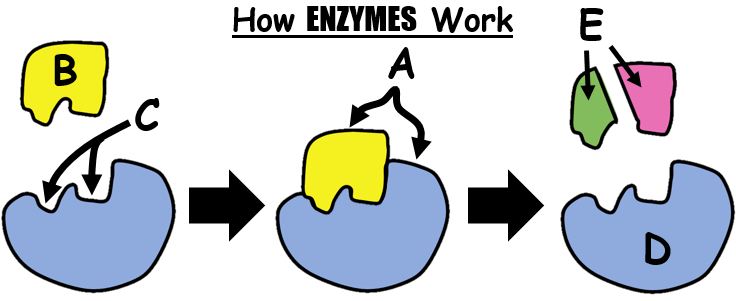
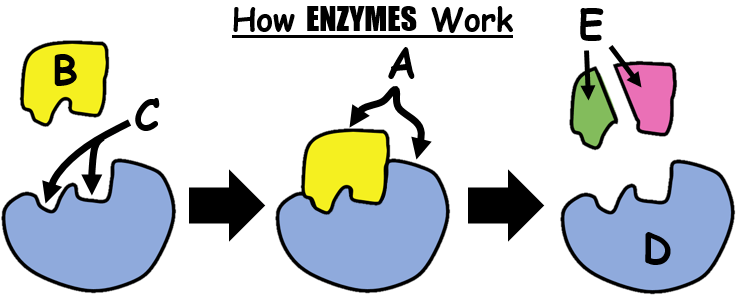
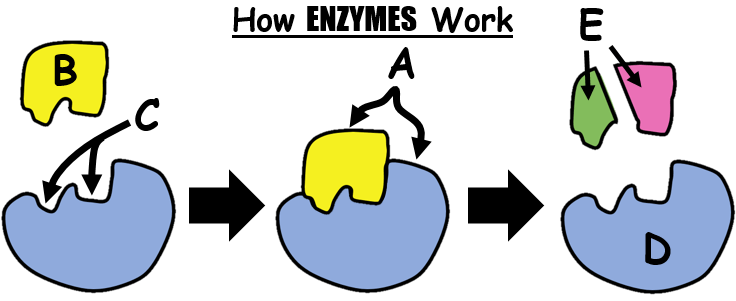
What does letter A represent?
a)
enzyme
b)
substrate
c)
active site
11.

What does the letter B represent?

a)

enzyme

b)

substrate

c)

active site

12.
Each enzyme works best at a certain temperature, and ...
a)
concentration
b)
pH value
c)
active site
d)
activation energy
13.
With what 3 letters do enzymes typically end?
a)
-ose
b)
-ase
c)
-ese
d)
-tic
14.
Which of these is most likely an enzyme?  
a)
Sucrose
b)
Galactose
c)
Fructose
d)
Amylase
15.
Where do substrates bind on an enzyme?
a)
voltage-gated channels
b)
surface receptor
c)
calcium channels
d)
active site
16.
What is a substance called if it speeds up a chemical reaction?
a)
reusable
b)
catalyst
c)
specific
d)
fragile
17.
What is another name for enzymes?
a)
chemical catalysts
b)
microorganisms
c)
biological catalysts
d)
inorganic catalysts
18.
What is indicated by letter A?
a)
enzyme
b)
product
c)
substrate
d)
active site
19.
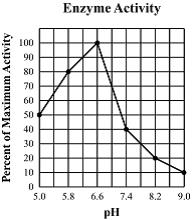
Which of the following conclusions can be drawn from this graph?
a)
The optimum pH of the enzyme is 6.6.
b)
The optimum pH of the enzyme is 5.8
c)
The enzyme’s activity increases as pH increases 5.0 to 9.0
d)
The enzyme’s activity is greater around pH of 8.0 .
20.
What makes an enzyme substrate specific?
a)
Size
b)
Shape
c)
Name
d)
Location it is found in
21.
In the diagram, what is letter A? 
a)
product
b)
substrate
c)
enzyme-substrate complex
d)
active site
22.
Letter D...
a)
active site
b)
enzyme
c)
substrate
d)
products
23.
Letter E...
a)
active site
b)
enzyme
c)
substrate
d)
products
24.

What do enzymes do?

a)

Build things up or break them down

b)

Help filter waste from the body

c)

Create environments where food can be eaten

d)

Add and remove water

25.

Enzymes are specific. This means that an enzyme only works with molecules that are....

a)

the right size and shape

b)

broken down already

c)

present in water

d)

too big for the body to handle

26.

What happens when enzymes are heated to a high temperature?

a)

The enzymes die.

b)

The shapes of the enzyme are altered denature

c)

The enzymes' amino acid sequence changes.

d)

The enzymes remain the same

27.

What happens when an enzyme becomes denatured?

a)

The reaction slows down

b)

The reaction speeds up

28.

Which best describe an enzyme?

a)

it is globular protein

b)

act as biological catalyst

c)

its monomer is amino acid

d)

speed up a chemical reaction

29.
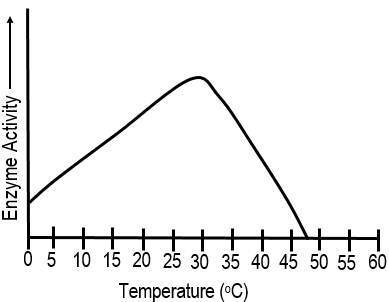
Based on the graph, what temperature does this enzyme work best? 
a)
15 C
b)
40 C
c)
30 C
d)
47 C
30.
Every enzyme has a optimal temperature and pH. True or False?
a)
True 
b)
False
31.

The enzyme that break down the protein into pepton is called ....

a)

pepsin

b)

renin

c)

ptyalin

d)

acid

32.

pepsin and trypsins are____.

a)

digestive enzymes

b)

carbohydrates

c)

lipids

d)

enzymes activators

33.

Majority of enzymes are proteins

a)

True

b)

False

34.

Lock and Key model says that the enzyme active site is flexible

a)

True

b)

False

35.

What does an enzyme need in order to work properly?

a)

The optimal amount of oxygen & CO2

b)

The optimal temperature & amount of water

c)

The optimal temperature & pH

d)

The optimal temperature & pressure

36.

Which enzyme breaks down carbohydrates?

a)

Rennin

b)

Amylase

c)

Pepsin

d)

Lipase

37.

Which enzyme breaks down proteins?

a)

Rennin

b)

Amylase

c)

Pepsin

d)

Lipase

38.

These are types of inhibitors...

a)

poisons & hormones

b)

nerve gas & hormones

c)

poison & antibiotics

39.

make enzymes work harder and faster.

a)

inhibitor

b)

activator

40.

Region of the enzyme where the substrates

binds to (lock & key)

a)

product

b)

substrate

c)

active site

d)

complex

41.

Are enzymes "USED UP" in a chemical reaction?

a)

no

b)

yes

42.

A higher _______ can increase the reaction rate.

a)

Concentration of enzyme

b)

pH

c)

inhibitors

d)

all of the choices are correct

43.

Enzymes change the ______ of a chemical reaction.

a)

type

b)

rate

c)

reactants

d)

product

44.

The new molecules or substances released by the enzyme are called?

a)

substrate

b)

product

c)

activator

d)

active sight

45.

What are inhibitors?

a)

Molecules that make enzymes

b)

Molecules that slow down or stop enzymes

c)

Molecules that speed up enzymes

d)

Molecules that replace enzymes

46.

A higher ______ can increase the reaction rate.

a)

Concentration of enzyme or substrate

b)

pH

c)

All of the Above

d)

None of the Above

47.

Explain the graph

a)

Enzymes are denatured

b)

Enzyme's active site are fully occupied with substrate

c)

Active site of enzyme is no longer complementary with substrate

d)

The rate of reaction increases with increasing substrate concentration

48.

All of the following are example of an enzyme activators EXCEPT ______

a)

Zn2+,

b)

penicillin

c)

Na+

d)

Mn2+

49.

An example of an enzyme inhibitor is _____.

a)

Zn2+,

b)

poisons

c)

Na+

d)

Mn2+

50.
What are the enzymes called when they are at low temperature? 
a)
denatured
b)
Killed
c)
inactive
d)
normal
51.

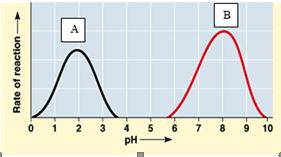
What is the optimal pH of enzyme A?

a)

8

b)

2

c)

5.7-10

d)

10

52.

The enzyme in the picture below is called to be____

a)

created

b)

inhibited

c)

activated

d)

denatured