Wayground logo

Free Printable Worksheets

Font size

S
M
L
XL
Worksheets

Unit 4: Diversity of Species

Total questions: 35

Worksheet time: 1hrs 18mins

Name
Class
Date
1.
Charles Darwin’s observation that finches of different species on the Galápagos Islands have many similar physical characteristics supports the hypothesis that these finches 
 
a)
have the ability to interbreed.
b)
acquired traits through use and disuse.
c)
all eat the same type of food.
d)
descended from a common ancestor.
2.

Based on Darwin's findings, what determines an organism’s ability to survive?

a)

Its ability to have babies

b)

Its ability to adapt to the environment

c)

Its ability to move out of a bad environment

d)

Its ability to win competitions

3.
These cause variations.
a)
mutations
b)
adaptations
c)
a desire to change
d)
injuries
4.
A slight difference in an inherited trait between individual members of the same species.
a)
variations
b)
adapatations
c)
homologous structures
d)
analogous structures
5.

The formation of a new species is called

a)

Natural selection

b)

Struggle for existence

c)

Speciation

d)

Darwinism

6.
Beneficial trait that allows an organism to be better suited for survival or reproduction 
a)
Natural Selection 
b)
Species
c)
Adaptation
d)
Classification 
7.
"Survival of the fittest"
a)
Reproductive Success
b)
Morphological Features 
c)
Biodiversity 
d)
Natural Selection 
8.
The preserved remains of a once living organism
a)
Species
b)
Fossil
c)
Extinct
d)
Gene
9.
The reproductive success of an organism depends in part on the ability of the organism to survive. How does the physical appearance of these organisms help them survive?
a)
Their physical appearance helps them find a habitat
b)
Their physical appearance helps them resist parasites.
c)
Their physical appearance helps them avoid predators.
d)
Their physical appearance helps them defend a territory.
10.
The difference in beak shape and size of the Galapagos Island finches was because...........
a)
birds immigrating from different locations
b)
introduction of non-native bird species to the island
c)
variation within the species which allowed them to adapt to different food sources
d)
cross-breeding of finches with other bird species
11.

When HUMANS select or choose a plant or animal for breeding based on a desired trait

a)

natural selection

b)

artificial selection

12.

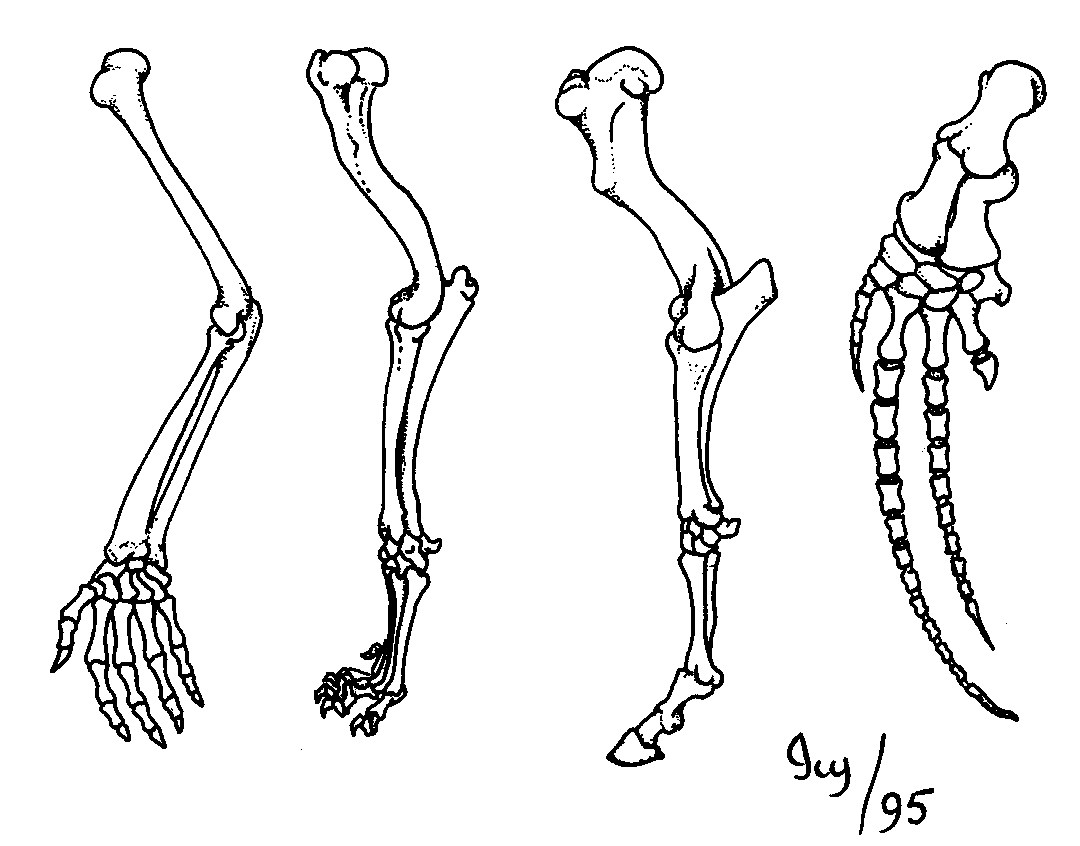
Parts of the body that are similar to other species because they have a common ancestor

a)

fossil record

b)

homologous structures

c)

embryology

13.

Shows how different groups of organisms have changed over time.

a)

fossil record

b)

homologous structures

c)

embryology

14.

Body part you have that use to have a purpose but now has little or no function

a)

vestigial organ

b)

embryology

c)

homologous structures

15.
Structures with the same parts have different functions; suggests that organisms share a common ancestry
a)
vestigial structures
b)
homologous structures
c)
adaptive radiation
d)
fossil
16.
A fossil of an extinct dinosaur is found and the anatomy of the fossil shows similarities to that of a bird. What could this mean?
a)
This is purely by chance and isn't significant
b)
The extinct dinosaur and modern bird share a common ancestor
c)
All dinosaurs evolved into birds and that's why there aren't any dinosaurs alive today
d)
Dinosaurs choose to fly, and evolved into birds to escape predation and capture food
17.
Which of the following are examples of evidence for evolution?
a)

Fossils record

b)

Similarities in Early Development

c)

Structures within organisms

d)

All of the Above

18.
Where is the T.rex and frog's common ancestor?
a)
Point A
b)
Point B
c)
Point C
d)
Point D
19.
Where is the sponge and mouse's most common ancestor?
a)
Point E
b)
Point B
c)
Point C
d)
Point D
20.
According to this evolutionary tree, birds are LEAST related to: 
a)
Amphibians
b)
Sharks
c)
Ray Finned Fish
d)
Crocodiles
21.
Structures that have the same function but different structures are...
a)
homologous structures
b)
analogous structures
c)
vestigial structures
d)
embryology 
22.
Differences between members of the same species are called
a)
predators
b)
traits
c)
selections
d)
variations
23.
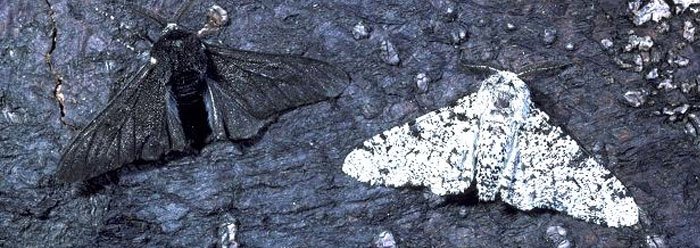
The trees these moths used to live on were white, but have been covered in soot from coal factories. Which moth will be more successful in this environment?
a)
Dark moth
b)
Light moth
c)
Both will be equally successful
d)
Neither will be successful
24.
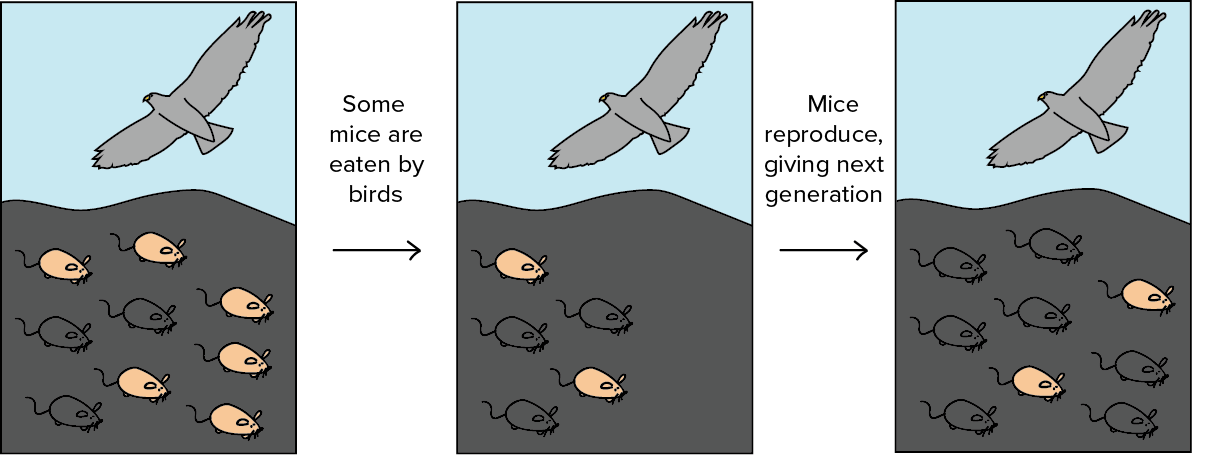
Why is the mouse population changing over time?
a)

The light mice can reproduce more successfully than the dark mice

b)

The owls eat more dark mice than light mice because the dark mice taste better

c)

The owls eat more light mice than dark mice because they can see the light mice more easily

d)

The owls eat more dark mice than light mice because they can see the dark mice more easily
25.
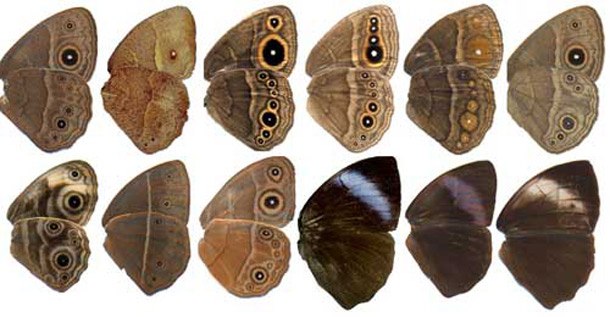
These moths are all the same species. The differences between their wings is an example of ________________
a)
Natural Selection
b)
Variation
c)
Homeostasis
d)
Extinction
26.
Evolution typically happens...
a)
in a few weeks
b)
over millions of years
c)
never
d)
in 100 years
27.

What is a phylogenetic tree?

a)

an idea that is strongly supported by evidence and facts.

b)

an inherited characteristic that increases an organism’s chance of survival and reproduction in an environment

c)

“hand-picking” traits to be bred within a species to create a “race” of desirable organisms

d)

a diagram that represents evolutionary relationships among organisms

28.

The tundra is a vast plain with frigid temperatures and plenty of snow. Which of the following adaptations does not help the polar bear survive in the tundra.

a)

Layers of fat for insulation

b)

webbed toes for swimming

c)

white fur for camouflage

d)

total herbivorous diet

29.
Coloring or another physical characteristic that help an organism blend in with its environment
a)
mimicry
b)
camouflage
c)
hibernation
d)
migration
30.

On the Galapagos Islands, different finches evolved on different islands to fit their environment. When a species develops unique traits because it is trapped in one area this is called:

a)

Geographic isolation

b)

Geologic separation

c)

General relocation

d)

Genetic differentiation

31.
Evolution means...
a)
Change over time in a population.
b)
That everything is the same.
c)
That organisms never change.
d)
Negative traits are acquired in populations.
32.

Which of the following is NOT true in the formation of a new species?

a)

A mutation causes a population to breed with a different species.

b)

Reproductive isolation can occur by the formation of a mountain range.

c)

A population needs to become reproductively isolated.

d)

An isolated population has adapted to new ecological niches eventually result in the inability to reproduce with the original population.

33.

Homologous structures are bones or organs found in different animals which very closely resemble structures in different organisms. What can you conclude about the past of these organisms?

a)

They all have evolved through natural selection but do not use these structures anymore.

b)

They all share a common ancestor but have evolved through natural selection

c)

They all share a common ancestor but did not evolve from natural selection

34.

The evolution of the horse is the most complete fossil record we have of a single organism. Using the picture, what can you conclude happened to the horse over time?

a)

The horse grew larger and lost its toes

b)

The horse shrank and lost its toes

c)

The horse grew larger and gained toes

d)

The horse shrank and gained toes

35.

Fossils are proof of ___________.

a)

Evolution

b)

analogous structures

c)

Physics

d)

artificial selection