wayground logo

Free Printable Worksheets

Font size

S
M
L
XL
Worksheets

IM1 Review For Final !! 2022/23

Total questions: 65

Worksheet time: 4hrs 44mins

Name
Class
Date
1.
 A line has an equation of y = - 3x + 8.  What is the y-intercept of the line?  Please enter your answer as a coordinate (x, y).
a)
(0, -3)
b)
(0, 3)
c)
(0, -8)
d)
(0, 8)
2.
Look at the graph.  Write down the equation for the line.
a)
y = - x + 3
b)
y = 4x + 3
c)
y = 1/x + 3
d)
y = - 4x + 3
3.
Write the equation for this graph? 
a)
y = - 10x + 60
b)
y = - 5x + 60
c)
y = - 1/x + 60
d)
y = - x + 60
4.
Write the equation of the line.
a)
y = 3/x + 1
b)
y = 3/x - 1
c)
y = 5/x + 1
d)
y = 1/x - 1
5.

The total cost (y) at an amusement park can be modeled by y=1.5x+20 where x is the number of rides you ride. What is the entrance fee?

a)

1.5

b)

200

c)

0

d)

20

6.

The total cost (y) at an amusement park can be modeled by y=1.5x+20 where x is the number of rides you ride. What is the price per ride?

a)

1.5

b)

21.5

c)

0

d)

20

7.
A man is climbing down from 100 feet high descending 30 feet per minute.
a)
y = 100 - 30x
b)
y = 100 + 30x
c)
y = 100x + 30
d)
y = 100x - 30
8.
Jenny went to the sale at Kohl's last weekend.  
T-shirts were on sale for $15 each and hoodies were on sale for $20 each.  If she spent $150 total, write an equation to represent this situation.  
a)
20x + 15 = y 
b)
35x = y 
c)
15x + 20y = 150 
d)
150 - 20x = 15y 
9.
In order to join a dancing club, there is a $30 startup fee and a $4 monthly fee. Write an equation in slope-intercept form that models this situation.  After how many months will the total cost be $58?
a)
7 months
b)
6 months
c)
5 months 
d)
4 months
10.

What family of function is this?

a)

Linear

b)

Quadratic

c)

Exponential

d)

Reciprocal

11.

What family of function is this?

a)

Square root

b)

Reciprocal

c)

Exponential

d)

Quadratic

12.

What family of function is this?

a)

Reciprocal

b)

Exponential

c)

Square Root

d)

Cubic

13.

y=2x3y=2^x-3  Identify the function family.

a)

Linear

b)

Exponential

c)

Quadratic

d)

Constant

14.

y=2x3y=2x-3  Identify the function family.

a)

Linear

b)

Exponential

c)

Quadratic

d)

Constant

15.

Which of the following is the common difference of the arithmetic sequence 4, 7, 10, 13, …?

a)

0

b)

1

c)

2

d)

3

16.

What is the common difference in the sequence: -4, 3, 10, 17,, …?

a)

1

b)

-7

c)

7

d)

-1

17.

The first term of an arithmetic sequence is 2 while the 18th term is 87. Find the common difference of the sequence.

a)

7

b)

6

c)

5

d)

3

18.

Identify the common difference.

97, 86, 75, 64, ...

a)

8

b)

-11

c)

11

d)

-8

19.

What is the explicit formula for the sequence?


6, -14, -34, -54, ....

a)

an=6 + 18(n +1)a_n=6\ +\ -18\left(n\ +1\right)

b)

an=6 + 20(n1)a_n=6\ +\ -20\left(n-1\right)

c)

an=6 + 20(n1)a_n=6\ +\ 20\left(n-1\right)

d)

an= 6 + 18(n 1) a_n=\ 6\ +\ 18\left(n\ -1\right)\

20.

What is the explicit formula?


-13, -213, -413, -613, ...

a)

an = 214 + 201(n1)a_n\ =\ -214\ +\ 201\left(n-1\right)

b)

an=13 + 201(n1)a_n=-13\ +\ -201\left(n-1\right)

c)

an=214 + 201(n1)a_n=-214\ +\ -201\left(n-1\right)

d)

an=13 + 200(n1)a_n=-13\ +\ -200\left(n-1\right)

21.
Determine whether the sequence is arithmetic, geometric, or neither.
a)
arithmetic
b)
geometric
c)
neither
22.
Determine whether the sequence is arithmetic, geometric, or neither.
a)
arithmetic
b)
geometric
c)
neither
23.
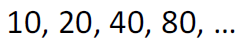
Find the common ratio for the geometric sequence.
a)
10
b)
1/2
c)
2
d)
4
24.
Write the explicit formula for the geometric sequence.
a)
an = 4(3)n-1
b)
an = 3(4)n-1
c)
an = -4(3)n-1
d)
an = 3(-4)n-1
25.

The next term of the geometric sequence

4, 16, 64, ...

is

a)

256

b)

132

c)

120

d)

150

26.

Find the next three terms of the following geometric sequence:

4, 12, 36, 108, ...

a)

324, 972, 2916

b)

972, 2916, 8748

c)

405, 1215, 3645

d)

324, 648, 1296

27.
What type of function is y = 7(5/4)x?
a)
Exponential Growth
b)
Exponential Decay
c)
Linear
d)
None of the above
28.
What is the range of this graph?
a)
y = 6
b)
(0, -4)
c)
y > -6
d)
y < -6
29.
What is the y-intercept of the function?
a)
(0,2)
b)
(0,3)
c)
(0,1)
d)
(0,-2)
30.
Which equation matches the table?
a)
y = x + 5
b)
y = 5x
c)
y = x - 5
d)
x = y - 5
31.
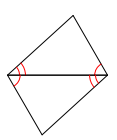
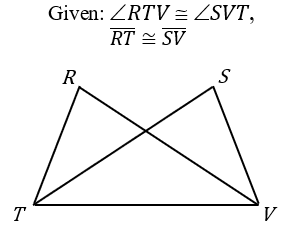
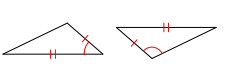
How are the triangles congruent?
a)
AAS
b)
SAS
c)
ASA
d)
SSS
32.
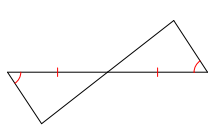
How are the triangles congruent?
a)
HL
b)
SAS
c)
ASA
d)
AAS
33.
a)
A
b)
B
c)
C
d)
D
34.
Are these triangles congruent?
a)
Yes, by ASA
b)
Yes, by SAS
c)
No they are not congruent
d)
Not enough information to know for sure
35.
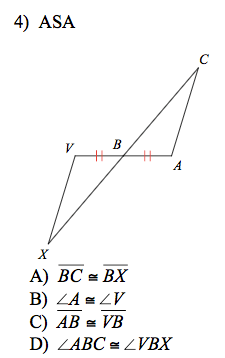
What additional information is required to prove the 2 triangles are congruent by ASA
a)
A)
b)
B)
c)
C)
d)
D)
36.

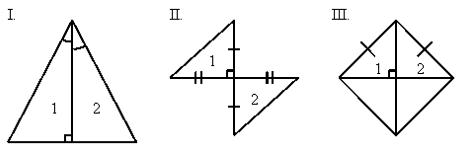
For which situation could you prove

∆1≅ ∆2 using the H-L Theorem?

a)

I only

b)

II only

c)

I & II

d)

I & III

e)

III only

37.

Which of the following are NOT sufficient to prove two triangles are congruent? Choose all that apply.

a)

SSS

b)

AAA

c)

ASA

d)

SSA

e)

AAS

38.
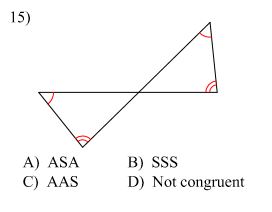
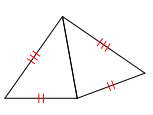
How are the triangles congruent?
a)
SAS
b)
SSS
c)
AAS
d)
HL
39.
How are the triangles congruent?
a)
Not congruent
b)
SSS
c)
ASA
d)
SAS
40.
Solve the following equation for n:
8n = 16
a)
n=24
b)
n=32
c)
n=2
d)
n=8
41.
Solve for x:
8x - 10 = -34
a)
4
b)
3
c)
-3
d)
-24
42.
Simplify:
5(3x+1)
a)
15x+1
b)
15x+5
c)
8x+1
d)
8x+6
43.
Solve for d:
-7(6 + d) = 49
a)
13
b)
1
c)
-1
d)
-13
44.
 Which inequality can be represented by the graph?
a)
x < 5
b)
x > 5
c)
x ≤  5
d)
x ≥ 5
45.
a)

x ≤ -2

b)

x < -2

c)

x > -2

d)

x ≥ -2

46.

Which inequality matches the graph?

a)

x<3

b)

x>3

c)

x<3

d)

x>3

47.

Solve: 10 < |2x + 4|

a)

-7 < x < 3

b)

-3 < x < 3

c)

x < -3 or x > 3

d)

x < -7 or x > 3

48.

Solve the system of inequalities by graphing.

a)
b)
c)
d)
49.
Which point below is NOT part of the solution set?
a)
(0, 0)
b)
(5, 1)
c)
(-1, -3)
d)
(20, -5)
50.
Select the correct graph for each inequality.
a)
A
b)
B
c)
C
d)
D
51.
Which point is a solution?
a)
(0, 6)
b)
(-3, 4)
c)
(1, 0)
d)
(-4, 3)
52.
Solid or dashed line?  Y <
a)
Solid
b)
Dashed
53.
Which system of inequality is shown?
a)
y > -1/5x - 1/2  
 y ≥ -2x - 4
b)
y > -1/5x - 1/2  
 y ≤ -2x - 4
c)
y ≥ -1/5x - 1/2
 y ≤ -2x - 4
d)
y < -1/5x - 1/2  
y ≥ -2x - 4
54.
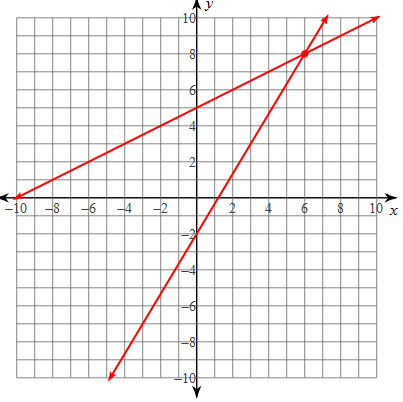
What is the solution to the system?
a)
(6, 8)
b)
(8, 6)
c)
(-6, 8)
d)
No solution
55.

What is the solution to the system?

y = 2x + 1

y = 4x - 1

a)

(1,3)

b)

(-1,-3)

c)

(-1,3)

d)

(3,1)

56.
Will the solution (-3, -7) make the following system of equations a true statement? 
y = 4x + 5
y = x – 4
a)
YES
b)
NO
57.

What is the solution to the system?

a)

Infinitely Many Solutions

b)

No Solution

c)

(0, 0)

d)

(-3, 0)

58.
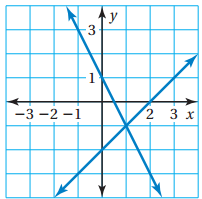
What is the solution? 
a)
1
b)
-2
c)
(1, 2)
d)
(1, -1)
59.

In a two-way frequency table, the order of categories does not matter.

a)

True

b)

False

60.

What percent of female athletes surveyed play basketball?

a)

16%

b)

52%

c)

23%

d)

31%

61.

What percent of basketball players are female?

a)

16%

b)

52%

c)

31%

d)

36%

62.

How many athletes were surveyed in all?

a)

50

b)

150

c)

100

d)

200

63.

This table shows the number of female and male students in each science class. How many students are taking biology?

a)

18

b)

8

c)

80

d)

26

64.

How many female students are taking physics?

a)

14

b)

19

c)

33

d)

24

65.

How many male students were surveyed?

a)

23

b)

47

c)

80

d)

33