
 Worksheets
SHM AND WAVE MOTION
Total questions: 34
Worksheet time: 30mins
A particle oscillates with undamped simple harmonic motion. Which one of the following statements about the acceleration of the oscillating particle is true?
It is least when the speed is greatest.
It is always in the opposite direction to its velocity.
It is proportional to the frequency.
It decreases as the potential energy increases.
The maximum displacement from the equilibrium of a particle is 1 m and its maximum acceleration is 4 ms-2. The period of the particle will be;
0.785 s
1.57 s
6.28 s
3.14 s
Given the equation of SHM, x=0.34 cos 3000t where x in m and t in second. The frequency is ............... Hz;
3000 Hz
3000/2π Hz
0.34/2π Hz
0.34 Hz
The acceleration of a particle in SHM is:
maximum at the equilibrium position
always constant
maximum at the extreme position
zero always
Which one of the following statements is not true for a body vibrating in simple harmonic motion when damping is present?
The damping force is always in the opposite direction to the velocity.
The damping force is always in the opposite direction to the acceleration.
The presence of damping gradually reduces the maximum potential energy of the system.
The presence of damping gradually reduces the maximum kinetic energy of the system.
The frequency of a body moving with simple harmonic motion is doubled. If the amplitude remains the same, which one of the following is also doubled?
the time period
the total energy
the maximum velocity
the maximum acceleration
The period of oscillation of a simple pendulum is T. When the length of the pendulum is decreased to 1/4 th, the new period will be;
2T
4T
T/4
T/2
A particle of mass m oscillates with simple harmonic motion of constant amplitude. The total energy of the particle is E. What is the total energy of another particle of mass 2m, oscillating with simple harmonic motion of the same amplitude but double the angular frequency?
2E
4E
6E
8E
The bob of the pendulum moves faster at the lowest position for a larger amplitude.
TRUE
FALSE
A body executes simple harmonic motion. The potential energy, the kinetic energy and total energy are measured as a function of displacement x. Which of the following statements is true?
Kinetic energy is maximum when x = 0
Total energy is zero, when x = 0
Kinetic energy is maximum when x is maximum
Potential energy is maximum when x = 0
The ratio of frequencies of two pendulums is 2:3 then their lengths are in ratio
32
23
94
49
Simple harmonic motion is defined as the motion of a particle such that
its displacement x from the equilibrium position is always given by the expression x = Asinωt
its displacement x from the equilibrium position is related to its velocity by the expression v=ωx
its acceleration is proportional to, and in the opposite direction to, the displacement from the equilibrium position.
Its acceleration is always ω2A and is directed at right angles to its motion
A mass M suspended from a string having length l undergoes SHM. Which of the following is true about the period of oscillations?
The period increases with increasing amplitude
The period increases with increasing mass
The period increases with decreasing length
The period increases with increasing length
The number of cycles or oscillation made in one second is defined as
time period
angular frequency
frequency
amplitude
Given an expression of x = 10 sin (0.25πt) where x in cm, t in second. Which of these answers are true?
the frequency is 0.125 Hz
the amplitude is 10 m
the angular frequency is 0.125 rad s-1
at t = 0, x = 10 cm
In any system in SHM, the restoring force acting on the mass in the system is proportional to
the spring constant
the velocity
the acceleration
the displacement

The period of a pendulum may be decreased by
decreasing the tension on the string
increasing the tension on the string
decreasing the mass of the bob
decreasing the length of the string
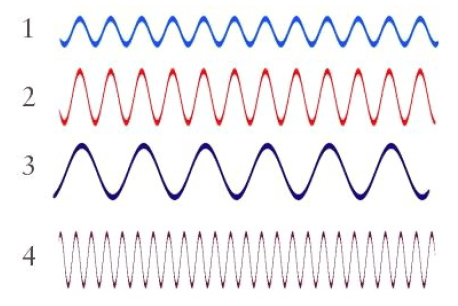
1
2
3
4
solid
liquid
gas
all of the above
The number of wavelengths that pass a point per second is:
angular frequency
period
frequency
phase
light
energy
matter
particles

Longitudinal
Transverse
Light
Electromagnetic
Transverse
Longitudinal
Both
A student measured the length of a rod and wrote it as 3.53 cm. Which instrument did he use to measure it?
A screw gauge having 100 divisions in the circular scale and pitch as 1 mm
A screw gauge having 50 divisions in the circular scale and pitch as 1 mm
A meter scale
A vernier calliper
A wattmeter reads 25.34 W. The absolute error in measurement is - 0.11 W. What is the true value of power?
25.23 W
25.45 W
-25.23 W
-25.45 W
If a zero-centered voltmeter has a scale from – 5V to +5V, then its span is _____.
0 V
5 V
10 V
- 5 V
Which of the following parameters used in statistical analysis?
Standard Deviation
Mode
Median
Mean
All the above
The error in the measurement of radius of a sphere is 1%. Find the error in the measurement of volume.
1%
2%
3%
4%
Find the difference in temperature, with proper error limits, if T1=293±0.1K & T2=273±0.2 K
20±0.1K
20±0.3K
20−0.1K
20+0.1K
The length of one rod is 2.53 cm and that of the other is 1.27 cm. The least count of the measuring instrument is 0.01 cm. If the two rods are put together end to end, find the combined length?
3.80±0.01 cm
3.80±0.02 cm
3.80±0.03 cm
3.80±0.04 cm
The length and breadth of a rectangular field are 4±0.4 m and 2±0.2 m, respectively. Calculate the area of the field with proper error limits.
8±0.6 m2
8±1.6 m2
6±1.6 m2
6±0.6 m2
In an experiment, the percentage of error occurred in the measurement of physical quantities A, B, C and D are 1%, 2%, 3% and 4% respectively. Find the maximum percentage of error in the measurement of X, where X=C31D3A2B21
18%
17%
16%
15%
Find the maximum error in determining the density of a cube if the relative error in measuring the mass and length are 1.5% and 1% respectively.
4.5%
4%
2.5%
0.5%

