
 Worksheets
Physical Geology: Earth Characteristics; Rocks + Minerals
Total questions: 34
Worksheet time: 31mins

Which of the following minerals is felsic?
Quartz
Graphite
Olivine
Diamond
All minerals listed are felsic

Geologists have classified rocks into three major groups of rocks which are:
inorganic, organic and chemical rocks
igneous, sedimentary and metamorphic rocks
metamorphic, chemical and non chemical rocks
sedimentary, inorganic and igneous rocks


Basalt forms _____________ and can be found ______________.
From the solidification of quickly cooled rock; as oceanic crust
From the re-melting of ultramafic rock in the upper mantle; all over the Earth as the ocean floor
From the solidification of mafic minerals; beneath the oceans
All answers are correct

Granite forms:
From the 'remelting' of basalt where only the lighter minerals (felsic) melt out
From subducting oceanic crust
From mostly felsic minerals that are extracted from mafic rock
All answers are correct
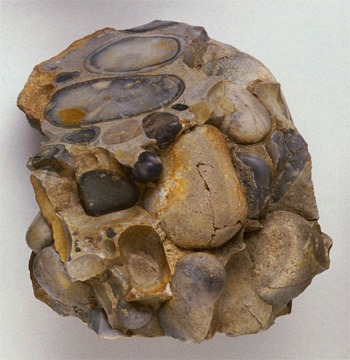


Any rock that forms from another rock as a result of changes in heat or pressure (or both) is a:
chemical rock
igneous rock
sedimentary rock
metamorphic rock

You find a rock in which the grains are arranged in wavy, parallel bands of white and black crystals. What kind of rock have you probably found?
igneous granite
sedimentary sandstone
metamorphic gneiss
extrusive igneous rock basalt

What is the correct sequence from oldest to youngest?
G F H C A B D E
A B D E C H F G
A B C D E F G
A B D E H C G F
No answer shows the correct order

A sample of rock has been radiometric dated to have a Parent:Daughter ratio of 1:3. How many half-lives have passed?
1
2
3
4
A sample of rock has been radiometric dated to have a Parent:Daughter ratio of 1:7. Each half-life is 1 million years. How old is the sample?
1 million years old
2 million years old
3 million years old
4 million years old

When did the Great Ice Age occur? (*Full geologic time explanation)
Phanerozoic eon, Cenozoic era, Quaternary period, Holocene epoch
Precambrian eon, Cenozoic era, Quaternary period, Holocene epoch
Phanerozoic eon, Mesozoic era, Quaternary period, Holocene epoch
Phanerozoic eon, Cenozoic era, Quaternary period, Pleistocene epoch


The geological theory of _______ states that pieces of Earth’s lithosphere are in constant, slow motion.
subduction
plate tectonics
deep-ocean trenches
sea-floor spreading

What is the correct order (starting from the surface) of Earth’s layers?
crust, outer core, inner core, mantle
mantle, outer core, inner core, crust
crust, mantle, outer core, inner core
outer core, inner core, crust, mantle

The mechanism that moves continents is based on heat energy moving by
Radiation in the core
Conduction in the lithosphere
Convection in the Mantle (Earth's interior)
None of these options is true

A Plate Boundary where two plates move toward each other is called
Convergent Boundary
Divergent Boundary
Transform Boundary
Subduction

Where are most divergent boundaries located?
Along the middle of most ocean floors
Along the margins of most continents
Across the middle of many continents
All the above options are correct

Earth's plates meet at ____________.
plate tectonics
plate boundaries
continental drift
oceans
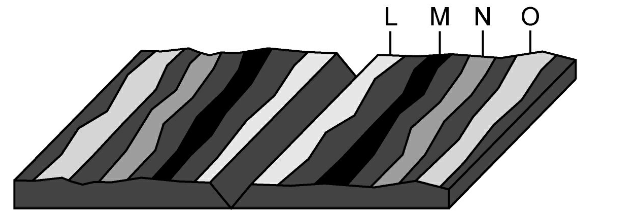
Where would the oldest rock be found?
L
M
N
O

The study of the Earth's magnetic record
ridge push
convection
paleomagnetism
subduction

The formation of the Hawaiian Islands is associated with ____.
A transform boundary drives volcanism in Hawaii
The Pacific Plate moving over a fixed hot spot
Convergent boundaries generate volcanism in Hawaii
Divergent boundaries generate volcanism in Hawaii


What is the fastest moving type of seismic wave?
P-wave
S-wave
Surface waves
All seismic waves travel at the same speed

Which wave has the highest amplitude on a seismograph AND does the most structural damage?
P Wave
S Wave
Surface Wave


Which of the following is TRUE?
A shows the arrival of P-waves
B shows the arrival of S-waves
C shows the arrival of surface waves
The picture is of a seismogram
All answers are true

