wayground logo

Free Printable Worksheets

NEW

Font size

S
M
L
XL
Worksheets

PS #4 Plate Tectonics Pre Test

Total questions: 35

Worksheet time: 22mins

Name
Class
Date
1.

What is the Theory of Continental Drift?

a)

New continents are continually being created

and destroyed.

b)

The layout of the continents is the same today

as it has always been

c)

The continents have always been separate but

may one day drift together to form a single

continent

d)

All the continents were once one continent that

broke up and drifted apart over hundreds of

millions of years

2.

What type of tectonic plate boundary involves a collision of plates?

a)

transform

b)

divergent

c)

convergent

d)

obstructive

3.

What type of boundary exists when 2 plates are pulling apart?

a)

Convergent

b)

Transform

c)

Obtrusive

d)

Divergent

4.

Rift Valley is a feature of what plate boundary?

a)

Obtrusive

b)

Divergent

c)

Transform

d)

Convergent

5.
When two convergent plates come together where the denser one is forced under back into the mantle
a)
reduction
b)
conduction
c)
subduction
d)
convection
6.
What forms when two continental, convergent plates push together?
a)
volcano
b)
mountain
c)
earthquakes
d)
island
7.
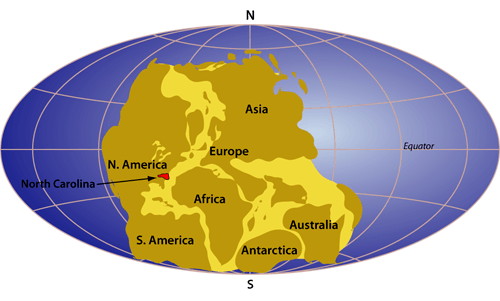
Wegener's evidence supports his theory of a super continent that he named?
a)
Ultima
b)
Pangaea
c)
Plate Tectonics
d)
Continental Drift
8.
Name the boundary
a)
convergent boundary
b)
divergent boundary
c)
transform boundary
d)
sergent boundary
9.
Name the boundary
a)
convergent boundary
b)
divergent boundary
c)
transform boundary
d)
sergent boundary
10.
Name the boundary
a)
convergent boundary
b)
divergent boundary
c)
transform boundary
d)
sergent boundary
11.
Which of the following is evidence that supports continental drift?
a)
the presence of penguins at both the equator and Antarctica
b)
fossils of the same plant have been found on several continents
c)
the presence of glacial features in Antarctica
d)
the presence of volcanic rock in Antarctica
12.
Large pieces of Earth's lithosphere that move around are called?
a)
Sections
b)
Plates
c)
Land Masses
d)
Faults
13.
What process is responsible for moving Earth's plates?
a)
convection currents in the outer core
b)
convection currents in the inner core
c)
convection currents in the mantle
d)
conduction currents in the lithosphere
14.

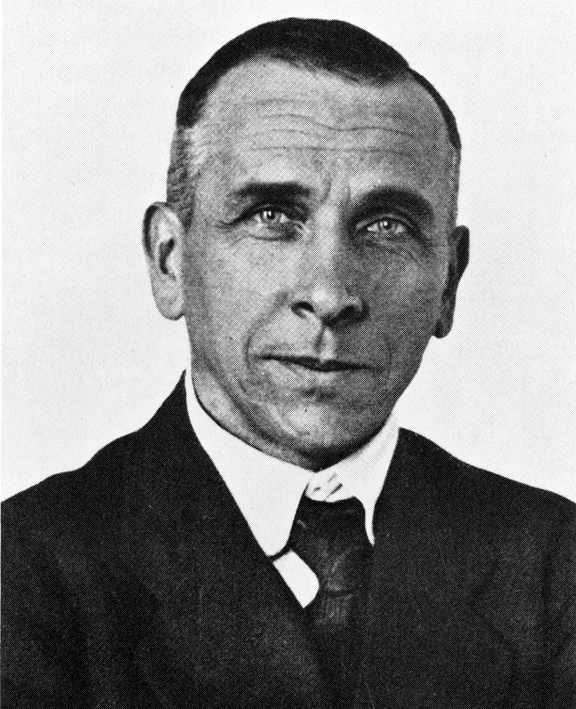
The theory of continental drift states that all the continents were once part of one big landmass called Pangaea. Who was the scientist that came up with this theory?

a)

Harry Hess

b)

Bill Nye

c)

Alfred Wegener

d)

Albert Einstein

15.

Seafloor Spreading occurs at a

a)

convergent boundary

b)

divergent boundary

c)

transform boundary

d)

continental boundary

16.
Who is the person credited with developing the theory of continental drift?
a)
Harry Hess
b)
Galileo
c)
Alfred Wegener
d)
Newton
17.

The supercontinent in the continental drift hypothesis was called ____.

a)

Panthalasa

b)

Pangaea

c)

Mesosaurus

d)

Africa

18.

What hypothesis states that the continents were once joined to form a single supercontinent?

a)

plate tectonics

b)

seafloor spreading

c)

continental drift

19.
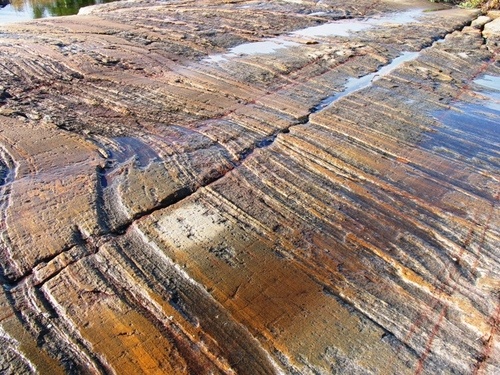
What is this a picture of?
a)
plate tectonics
b)
continental drift
c)
pangea
d)
glacier scaring
20.
This is a picture of glacier scars found in Africa.  What are these evidence for?
a)
Africa has always been near the equator
b)
Africa was once in an area of the Earth that had a very cold climate
c)
The continents have not moved
d)
sea floor spreading
21.
What two specific continents fit together most noticeably?
a)
Africa and North America
b)
South America and Europe
c)
South America and Africa
d)
Antartica and Africa
22.
What is the area where two tectonic plates meet called?
a)
collision
b)
mid-ocean ridge
c)
a boundry
d)
a rift zone
23.
What type of boundary is formed when plates collide?
a)
convergent
b)
horizontal
c)
divergent
d)
transform
24.
What type of boundary is formed when plates separate?
a)
convergent
b)
horizontal
c)
divergent
d)
transform
25.
What type of boundary is formed when plates slide past each other?
a)
convergent
b)
horizontal
c)
divergent
d)
transform
26.
Why did no one believe Wegener's thoery?
a)
He could not explain HOW the continents moved
b)
He didn't have evidence
c)
His data was wrong
d)
He didn't use the right technology to gather data
27.
Which type of plate boundary would cause folded mountains to form? 
a)
transform
b)
convergent
c)
divergent
d)
subduction
28.
The Great Rift Valley in Africa and the Mid-Atlantic Ridge were both created by this type of plate boundary. 
a)
divergent
b)
convergent
c)
transform
d)
subduction
29.
What are the two types of crust?
a)
continental and oceanic
b)
ocean and basin
c)
lower and upper
d)
thick and thin
30.
Earthquakes and volcanoes are most likely found in which locations? 
a)
at plate boundaries
b)
in oceans
c)
in the middle of continents
d)
in the middle of plates
31.
Transform boundaries are most likely to produce what phenomenon?
a)
volcanoes
b)
deep sea trenches
c)
underwater mountain ranges
d)
earthquakes
32.
When an oceanic plate and a continental plate collide, which one will subduct? 
a)
oceanic
b)
continental
c)
neither
d)
both
33.
According to Wegener's hypothesis of continental drift, 
a)
Earth's surface is made up of seven major landmasses
b)
the continents DO NOT move
c)
Earth is slowly cooling and shrinking
d)
the continents were once joined together in a single landmass
34.
A rift valley forms at a 
a)
convergent plate boundary
b)
divergent plate boundary
c)
transform boundary
d)
deep ocean trench
35.
A collision between two pieces of continental crust at a converging boundary produces a 
a)
mid-ocean ridge
b)
deep ocean trench
c)
volcanic mountain range
d)
folded mountain range