
 Worksheets
Identifying Functions in Tables, Graphs & Mapping Diagrams
Total questions: 150
Worksheet time: 3hrs 10mins

Does this represent a function?
Yes
No

Does this represent a function?
Yes
No

A
B
C
D

Does this represent a function?
Yes
No

Does this represent a function?
Yes
No
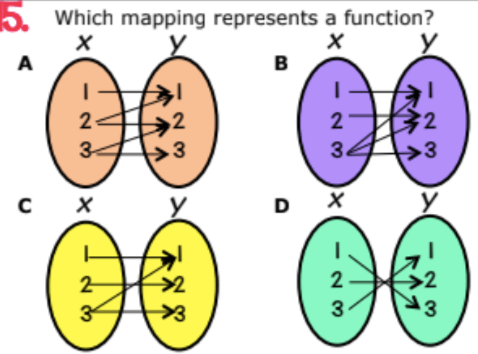
A
B
C
D


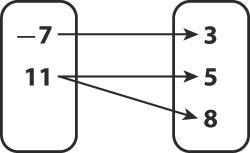
Is the relation a function? Explain.
Yes, the x-value 11 has two y-values paired with it.
Yes, each x-value has only one y-value paired with it.
No, the x-value 11 has two y-values paired with it.
No, each x-value has only one y-value paired with it.
Does the following relation represent a function?
(1,5), (1,6), (1,7), (1,8), (1,9)
Yes, there are no repeated x-values
No, there are repeated x-values
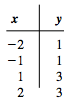
Does the table represent a function?
Yes
No

Does the graph represent a function?
Yes
No
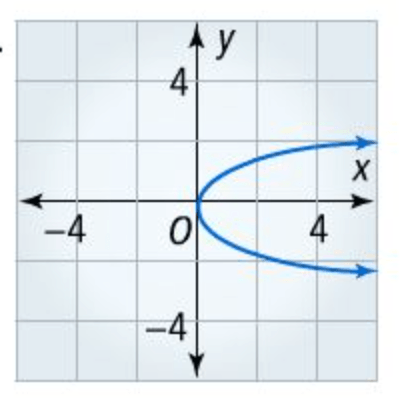
Does the graph represent a function?
Yes
No
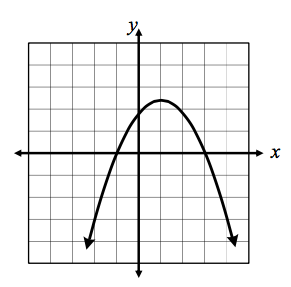
Does the graph represent a function?
Yes
No
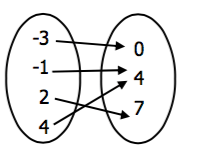
Does the mapping represent a function?
Yes
No


The table represents the equation k = j - 20.
Use the equation to find the missing value.
34
27
41
38
For the function rule, y = -2x + 3: If the input is 4, what is the output?
5
11
-5
-11

Which of the following equations describes the relationship between a and b?
b = a +13
b = a +5
b = a +18
b = a +14
How do you determine if a graph is a function?
look at the y-values, if they repeat, it's not a function
Use the "vertical line" test aka "pencil test"
Look at you x-values, if they repeat it is a function
Use the horizontal line test
How can you determine if a table or ordered pairs represents a function?
for every y-value there is only one x-value
for every x-value there is only one y-value
vertical line test
for every x-value there is more than one y-value


Does this represent Y as a function of X?
Yes
No
oohhh.....Spider Webbs!
Does this represent a function?
Yes
No
A
B
C
D

Does this image represent a Mapping Diagram?
True
False
Does "x" represent the INPUT value?
True
False

Does "y" represent the OUTPUT value in function tables?
YES
NO
When identifying functions using tables, I know that the table represents a FUNCTION when....
the input values repeat
there is only ONE input value for each output value
the output values appear more than once
I know that a set of ordered pairs is NOT A FUNCTION if...
y values repeat
there is no initial value
x values repeat

True or False: This set of ordered pairs represents a FUNCTION
True
False

I know that this set of ordered pairs represents a FUNCTION because...

Which of these tables represents a FUNCTION?
Table A
Table B
None of these tables represents a function

Which of these mapping diagrams represent a FUNCTION?
None of these mapping diagrams represents a function
Mapping Diagram A
Mapping Diagram B

True or False: When creating a mapping diagram there must be two ovals, one representing x- values (input) and one representing y-values (output)
True
False
Select all of the "rules" or steps involved in creating a mapping diagram using a set of ordered pairs.
List the inputs (x-values) in order from least to greatest in the first oval.
List the outputs (y-values) in order from least to greatest in the second oval.
If any x- or y-values repeat, only write them once!
Draw lines to connect each input with the corresponding output.
All of these steps are involved in creating a mapping diagrams.
A function is a relationship in which each (a) has exactly one output.

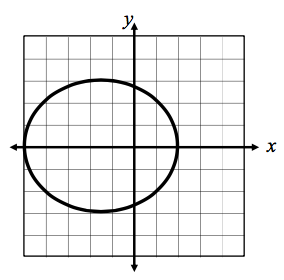


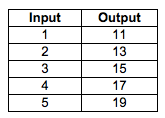
(1,5), (1,6), (1,7), (1,8), (1,9)
f(4)=
f(4)=

Which set of ordered pairs is a function?
{(9,5), (10,5), (9,-5), (10,-5)}
{(3,4), (4,-3), (7,4), (3, 8)}
{(6,-5), (7, -3), (8, -1), (9, 1)}
{(2, -2), (5, 9), (5, -7), (1, 4)}


Does the mapping of these points represent a function? (Note: the left oval represents your x values and the right oval represents your y values)
Function
Not a Function

Which is a function?
A
B
C
D

All of the x values are called what?
Inputs
Range
Relation
Function
All of the y values are called what?
Domain
Outputs
Relation
Function

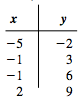
Does this table represent a function?
Yes
No
Which of the following is a function?


What is the missing number?
Level 2 If my function rule is 2x + 1, what is the OUTPUT if the input is 2?
5
4
22
23

Level 1 Find the missing OUTPUT value.
8
-2
2
-8
(1,5), (1,6), (1,7), (1,8), (1,9)
Does this represent a function?
Yes
No

Which of the graphs PASSES the vertical line test?
A
B
C


Is y a function of x?
function
not a function

Is y a function of x?
function
not a function

Is y a function of x?
function
not a function

Is y a function of x?
function
not a function
Which graph represents a function?


Which image is NOT the graph of a function?


Is y a function of x?
function
not a function

Is y a function of x?
function
not a function

Is y a function of x?
function
not a function

Is y a function of x?
function
not a function

Using the vertical line test. Is this a function?
Yes
No

Using the vertical line test. Is this a function?
Yes
No

Using the vertical line test. Is this a function?
Yes
No

Function
Not a function

Function
Not a function

Function
Not a function

Function
Not a function

Function
Not a function

Function or not
function
not a funtion

Is y a function of x?
Yes, because it passes the vertical line test
No, because it does not pass the vertical line test

function
not a function

function
Not a function

Function
Not a function

Function
Not a function
Which of the following is NOT a function?


Which of the following represents a function?
Which of the following does NOT represent a function?


Is the relation a function?
Yes, it is a function.
No, it is not a function.

Is the relation a function?
Yes, it is a function.
No, it is not a function.

Is the relation a function?
Yes, it is a function.
No, it is not a function.

Is the relation a function?
Yes, it is a function.
No, it is not a function.

Is the relation a function?
Yes, it is a function.
No, it is not a function.

Which one IS A function?
A is a function
B is a function
Both are functions
Neither are functions

Is the relation a function?
Yes, it is a function.
No, it is not a function.

Which one IS A function?
E is a function
F is a function
Both are functions
Neither are functions
Which set of ordered pairs is a function?
{(9,5), (10,5), (9,-5), (10,-5)}
{(3,4), (4,-3), (7,4), (3, 8)}
{(6,-5), (7, -3), (8, -1), (9, 1)}
{(2, -2), (5, 9), (5, -7), (1, 4)}

Which of the following is a function?
A
B
C
D
Which is a function?
A
B
C
D

