
 Worksheets
Classification
Total questions: 19
Worksheet time: 57mins
Which of these pairs of organisms are found in the same domain?
plants and archaea
bacteria and protists
protists and fungi
bacteria and archaea
Organisms classified as fungi have unique characteristics. Which of the following
characteristics are found only in organisms classified in the kingdom fungi.
single cells without a nucleus
multicellular with chloroplasts
multicellular and externally absorbs nutrients
colonies of single, photosynthetic cells that reproduce asexually
The list below describes an organism.
- Unicellular
- Prokaryotic
- Lives in very harsh environments
- Lacks peptidoglycan
Based on this list, in which kingdom should the organism be classified?
Eubacteria
Protista
Archaebacteria
Animalia

According to the cladogram, which of the following organisms have fur?
Sun Bear
Giant Panda
Raccoon
Dog
The Florida panther was once considered to be a subspecies of cougars. Current scientists, however, have studied the Florida panther and removed the subspecies classification. Which of the following would explain why the classification of the Florida panther changed?
New genetic evidence suggests a much closer relationship between the Florida panther
and other cougars.
Advanced technologies have shown a large difference in cell structure between the
Florida panther and other cougars
Study of their embryos shows major differences in the development of the Florida panther
fetus when compared to other cougars
Shared physiological features between the Florida panther and other cougars were also
found in newly discovered organisms in the world

Scientists are studying the evolutionary history of a group of plants in the United States, and they developed an evolutionary tree, as shown below.
Which statement can be inferred from the evolutionary tree?
Species 1 is most closely related to Species 8
Species 2 is most closely related to Species 3
Species 3 is most closely related to Species 7
Species 5 is most closely related to Species 6
Which domain would contain organisms that have membrane bound organelles?
Archaea
Bacteria
Eukarya
Protista

The figure below demonstrates the changes to our understanding of the scientific taxonomy for living organisms.
As technology became more advanced, what happened to the classification system?
Advances in DNA sequencing have eliminated the original kingdoms from the Linnaean
system.
Advances in the microscope have allowed us to move from the six kingdom system to a
three kingdom system.
Advances in the microscope have allowed us to modify our classification system, and
create the kingdom animalia.
Advances in DNA sequencing have allowed us to modify our classification systems over
time to include six kingdoms.

The diagram below represents possible evolutionary pathways of certain organisms.
Which species is most closely related to species L?
species F
species G
species I
species E
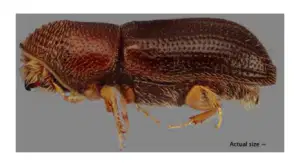
The image shows an insect called a Walnut Twig Beetle. Without a microscope, you
would not be able to see the hair like structures and texture of the beetle's exoskeleton.
Which microscope would have been used to take the image of the beetle?
dissecting microscope
compound microscope
scanning electron microscope
transmission electron microscope

Use the figures to answer the question. Figure 1 represents the percentage similarity in
sequences of nucleotides from a homologous gene. Figure 2 represents a cladogram formed
using evolutionary evidence like the information from Figure 1.
Baboons have a percentage similar to 97.2% to human genes. Where on the cladogram would
you place the baboons?
A
B
C
D

Scientists struggled with classifying lesser pandas and giant pandas because they have
physical similarities to both raccoons and spectacled bears. Lesser pandas were previously thought to be closely related to giant pandas. Nucleotide differences between each organism are found in the chart.
Using data from the table, which statement best describes how the newer nucleotide evidence would change the classification of these organisms?
The similarities in the nucleotide sequences of the giant panda and the lesser panda
demonstrate they are most closely related.
DNA evidence has shown that the lesser panda is most closely related to the raccoon
because it has the most genetic similarities.
The lesser panda and the spectacled bear are most closely related because they share
the same genetic information resulting in many shared traits.
Similarities in nucleotides between the lesser panda and the spectacled bear indicate they
are most closely related and that they should live in similar environments.

The diagram shows the evolutionary relationship between various species.
Which species is most closely related to the sheep?
dog
bats
deer
armadillos

A student identified four organisms in a sample of pond water and was able to identify
characteristics shown in the table.
Based on the observations of the student, which organism demonstrates the characteristics
of the taxonomic group for bacteria?
Organism 1
Organism 2
Organism 3
Organism 4
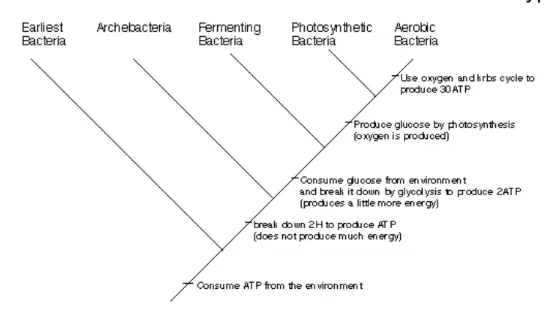
The 3-Domain, 6-Kingdom classification system has only been used for a few decades. The
original scheme did not include the classification level of “Domain”, but this level was added
after Carl Woese proposed it in the 1970s. Archaebacteria were once thought to be in the
Kingdom Bacteria, but it was discovered that there are major differences in their DNA. For this
reason, Archaebacteria was placed in their own Domain and Kingdom. A cladogram of the
current classification of Archaebacteria and three types of Bacteria is shown.
What evidence is most likely to cause scientists to change this current classification system in
the future?
The current classification system is backed up by lots of evidence and cannot change
anymore.
Scientists being able to reach the deepest part of the ocean to find a new species of
bacteria that consume ATP from the environment.
Technological advancements that allow scientists to see 3D images of the organelle that
produces glucose by photosynthesis.
A new organism being discovered that is genetically different from all current bacterial
organisms and does not consume ATP from the environment.

The picture shows a cladogram that scientists have constructed.
Which of the following best explains why scientist constructed the cladogram in this order?
Organisms are placed on the cladogram based on body size.
Organisms are placed on the cladogram based on similar habitats.
Organisms are placed on the cladogram based on mode of nutrition.
Organisms are placed on the cladogram based on derived characteristics.
A student is having a difficult time comparing and contrasting the characteristics of the
Kingdoms Fungi and Plantae. Which question below would lead the student to discovering a
difference between the two kingdoms?
Which organisms are eukaryotic?
Which organisms have a cell wall?
How does each organism obtain energy?
How does each organism store its genetic information?
A research assistant has been asked to take microscopic images of a sample from a study. It was requested that the image must be 3D, but does not require color. It is also important that the image shows the plasmodesmata, which are small openings or pores on the cell wall that allow for exchange of molecules such as water.
dissecting microscope
compound microscope
scanning electron microscope
transmission electron microscope
An organization purchased a transmission electron microscope. Which sample below would the
organization view with this microscope?
a large kidney stone
the surface of a virus
a mitochondrion inside the cell
the movement of a bacterial cell

