
 Worksheets
Pure Substance Review
Total questions: 40
Worksheet time: 20mins

The picture above shows several different compound models. What is true of compounds?
Compounds are made of only one chemical element.
Compounds are made of two or more different chemical elements.
Compounds always contain at least hydrogen.
Compounds must have at least three atoms that are chemically bonded.
Grape juice is an example of a solution in nature. What is the solvent in grape juice?
Grapes
Water
Sugar
Salt
Jasmine is making some macaroni and cheese for dinner. To begin, she places water in a pot on the stove. She adds salt to the water and heats the solution. What is the solute and solvent in this solution?
Salt is the solvent and the water is the solute.
Salt is the solute and the water is the solvent.
Salt is the solute and heat is the solvent.
Salt is the solvent and heat is the solute.
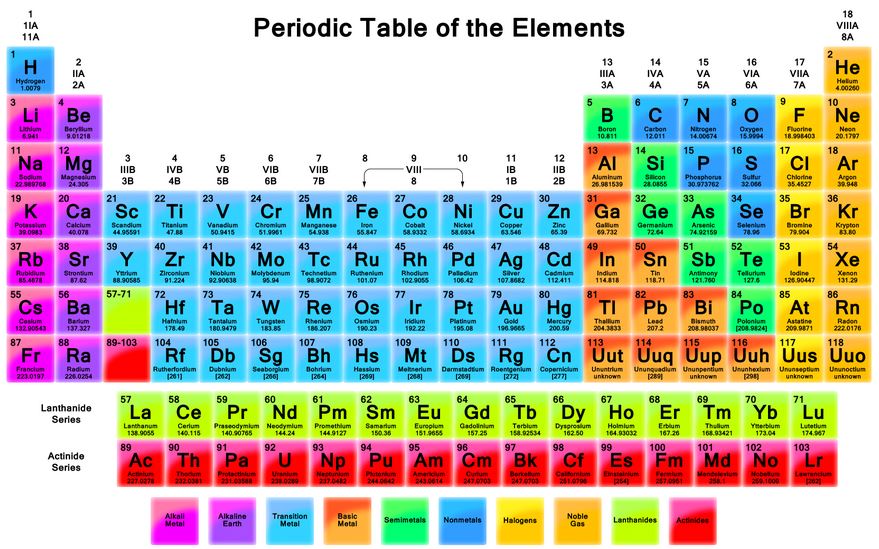
N (Nitrogen) is an example of a(n)
compound
element
mixture
photon
OH is an example of a(n)
compound
element
mixture
photon
Which is an example of a compound
NO
Fe
Mg
C
A substance that is made of only one type of atom is called a(n)
compound
element
mixture
solution
( Ca + Cl2 --> CaCl2 ) The ______________ Calcium combines with the ______________ Chlorine to form the ______________ Calcium Chloride.
compound; compound; element
element; compound; compound
element; compound; element
element; element; compound
A chemical combination of two or more different atoms is called
element
transmutation
mixture
compound
Caffeine is a combination of eight carbon atoms that are bonded with ten hydrogen, four nitrogen and two oxygen. What is the best description of this combination?
solution
mixture
compound
element

Study the liquids listed in the table. How would you best describe each liquid?
Liquid X is an acid and Liquid Y is a base.
Both liquids are bases.
Both liquids are acids.
Liquid X is a base and Liquid Y is an acid.
Which is true about elements in a compound?
The properties of the compound and the properties of the elements are the same.
The compound shares properties with only one element, but the properties of all remaining elements will differ.
The elements all share the same properties but their properties differ from the compound's properties.
The properties of a compound are different that the properties of its elements.

According to the table, which leaves are the most basic alkaline?
Robles
Kakawate
Kalumpit
Trichanthera
Hydrogen (H) is
a pure substance
a mixture
a compound
a solution
A mixture of sand and metal filings needs to be separated. Which of the following would be the best method of separating them?
filtration
evaporation
chromatography
magnetism

What is this?
Atoms of an element
Mixture
Compound
Molecules

What is this?
Atoms of an element
Compounds
Molecules of an element
Mixture

What are these?
Molecules of compounds
Elements
An atom
Mixture

This is a
Pure Substance
Molecule
Compound
Mixture

This is
an atom.
a molecule.
a compound.
a mixture.

This is
a compound.
a mixture.
a molecule.

What is this?
an atom.
a compound.
a molecule.
a mixture.

What is this?
A compound
A mixture
An atom
An element

This is
an atom.
a molecule of a compound.
an element.
a mixture.
Select all the pure substances below (pick 3).
element
compound
molecule
mixture

Which of the following is a covalent bond?
Dihydrogen Monoxide
Magnesium Oxide
Sodium Chloride
Calcium Sulfide
In covalent bonds electrons are ____ and electrons in ionic bonds are ____.
transferred; shared
shared; transferred
lost; gained
balanced; unbalanced

This picture shows a model of hydrazine (N2H4). Based on the model, how many PAIRS of electrons are shared between the 2 nitrogen atoms?
1
2
3
4
Which of the following would have 3 covalent bonds?
H2O
NH3
CH2Cl2
CCl4
The products of a chemical reaction are on the
Left side (Products → Reactants)
Right side (Reactants → Products)
The law of conservation of mass states that
The mass of a system (reaction) increases from beginning to end
The mass of a system (reaction) stays the same from beginning to end
The mass of a system (reaction) decreases from beginning to end
The reactants of a reaction are on the
Left side (Reactants → Products)
Right side (Products → Reactants)

