
 Worksheets
Day 3 Review Unit (7-10)
Total questions: 60
Worksheet time: 1hrs 20mins

Which of the following is true?
1. x-rays travel slower than infrared.
Infrared travels slower than x-rays.
Gamma rays are the slowest moving.
Radio waves have the most energy and shortest wavelength.
What part of a sound wave measures LOUDness?
wavelength
magnitude
amplitude
frequency

The picture shows a light ray hitting the surface of a mirror what is going to happen as it strikes?
It is going to absorb
It will reflect back from where it began.
It is reflected at an angleequal to the angle of incident.
It reflects 30 degrees from the angle of incident.

A light wave travels through the air, passes into this glass and then travels back into the air as seen in the picture. Which best describes what is happening.
The light wave is
refracted
The light wave is diffused
The light is reflected.
The light is diffracted.

The region of the Electromagnetic Spectrum where color can be seen is called visible light. Which of the following is correct?
The lowest frequency is red and the highest is violet
The highest is red and the lowest is violet
green has the highest frequency
Yellow has the highest frequency.
A __________ is a substance through which a wave travels.
Medium
Longitudinal wave
Transverse Wave
Wave speed

Mrs. Yarbrough produced many sound waves while playing the piano. Which diagram shows the sound wave that she produced with the LONGEST wavelength?



Color, texture, hardness, density are examples of
Chemical properties
Biological properties
Physical properties
Properties of matter that cannot be observed just by looking at or touching a substance
Physical Properties
Chemical Properties
Biological Properties
Chemical bond is
A force of attraction between 2 atoms
A force of repulsion between 2 atoms
None of the above
Physical change is
any alteration of the appearance of matter without making it another substance
any alteration of the appearance of matter by making it another substance
None of the above
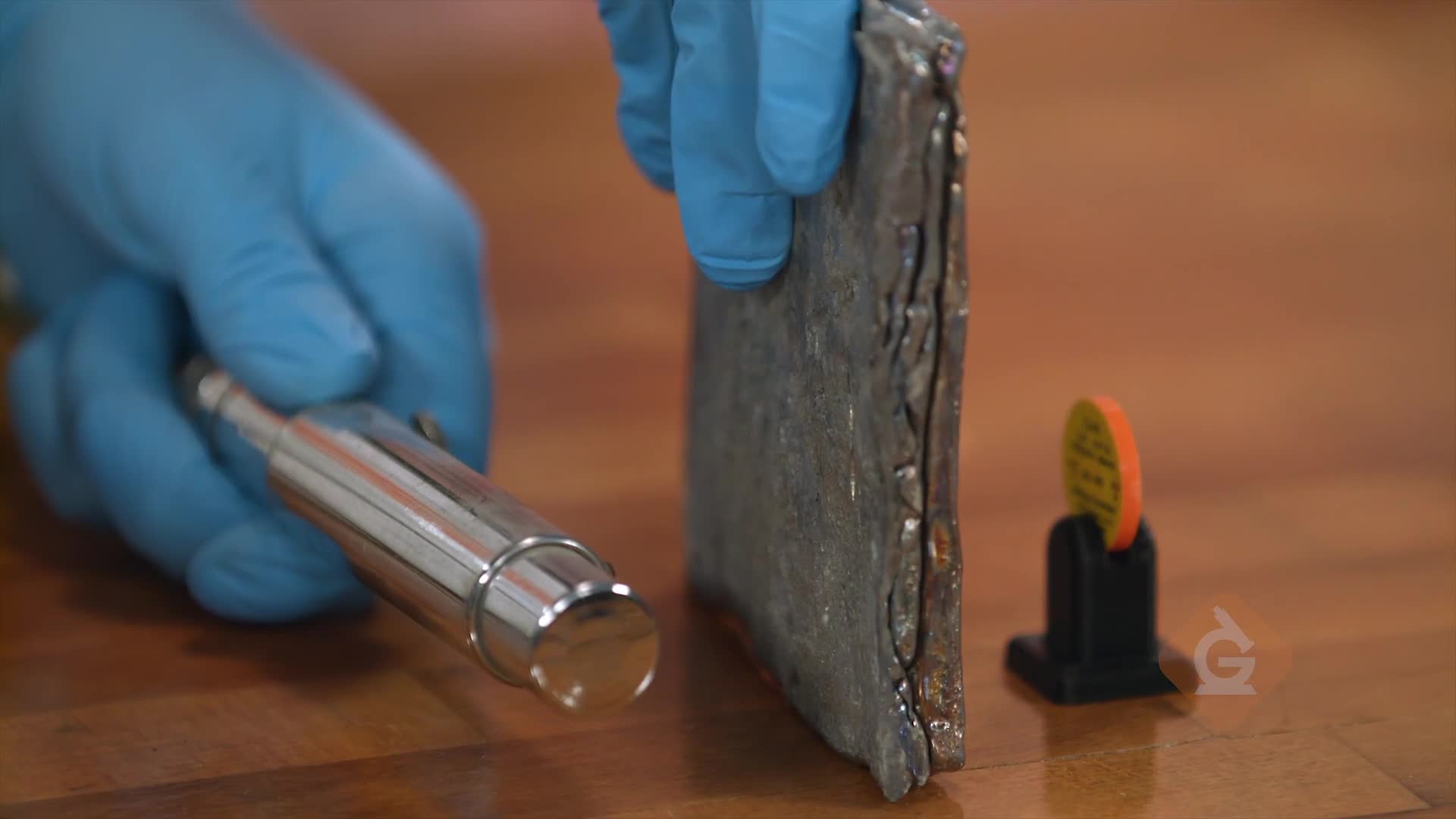
Melting aluminum cans, dissolving sugar in water, tear paper are examples of
Physical change
Chemical change
Biological change

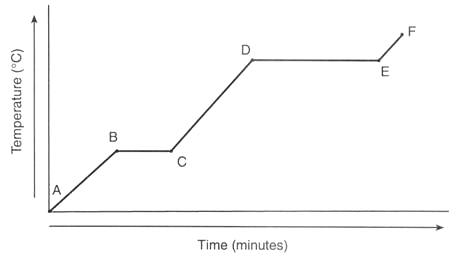
What is happening to the particles in the substance between points D and E?
Melting
Freezing
Vaporizing
Sublimating

Where on the graph are phase changes taking place?
1
2
3
4
5


Isotope
Two or more forms of the same element that contain equal numbers of protons but different numbers of neutrons.
Element on the periodic table.
The center of a cell.
Particle that makes up an atom (protons, electrons, neutrons).

Atomic Number
The number of Atoms in a cell.
The number of protons in the nucleus of an atom, which determines the chemical properties of an element and its place in the periodic table.
The atomic symbol that is on the periodic table.
Electron cloud in an Atom.

Atomic Mass
Average number of different masses
Mass of an atom = to the number of protons and neutrons
1 amu
The SI atomic unit in a cell


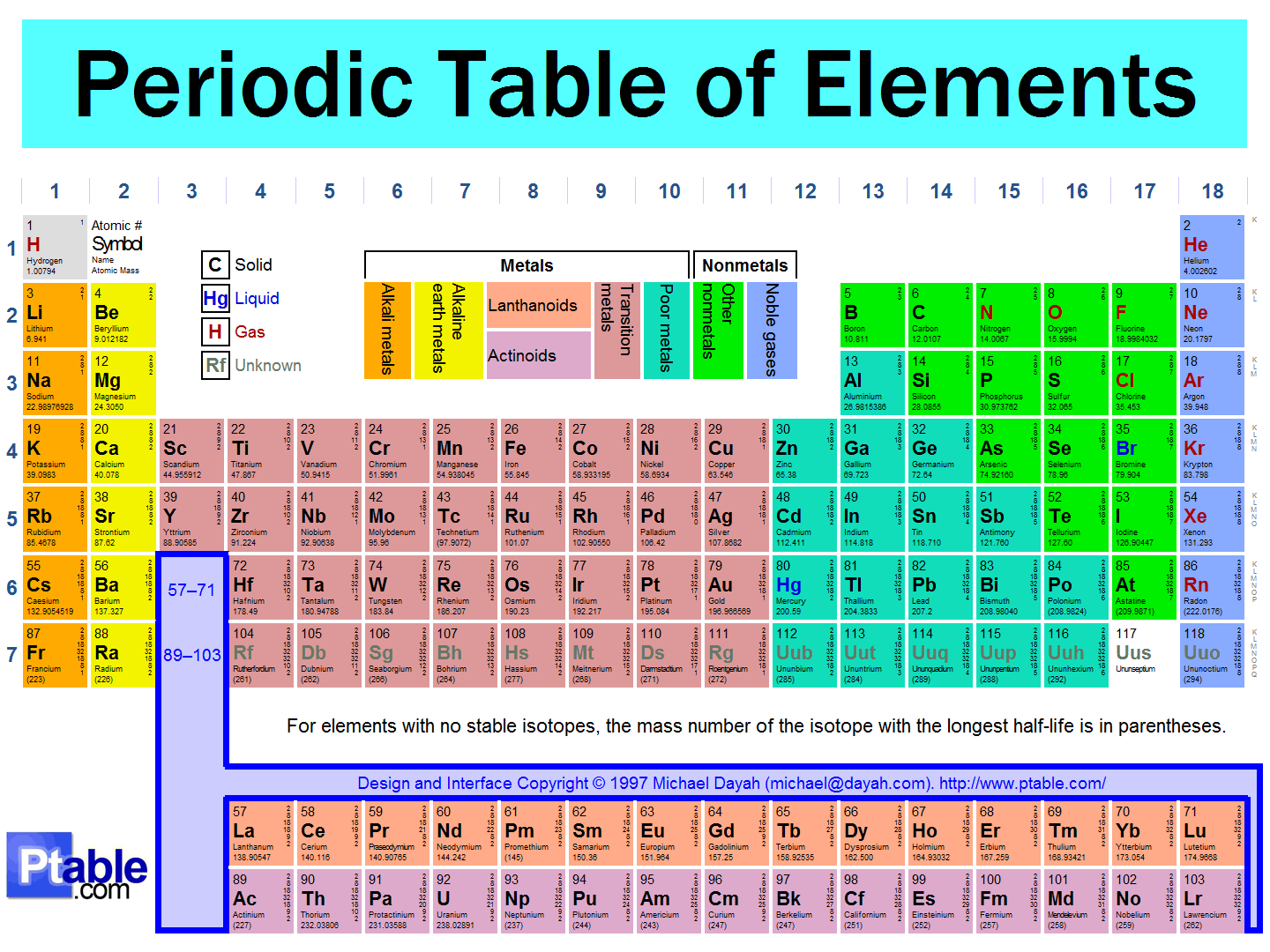
Which element is this?
Nickel
Neon
Sodium
Nitrogen
The innermost energy level has a maximum of how many electrons?
1
2
6
8
What is a valence electron?
Electrons in the first energy shell
Electrons in the second energy shell
Electrons in the outer shell
Total number of electrons


What element is represented in this Bohr Model?
Carbon
Hydrogen
Aluminum
Lithium


How many protons does sulfur have?
32
16
48
12
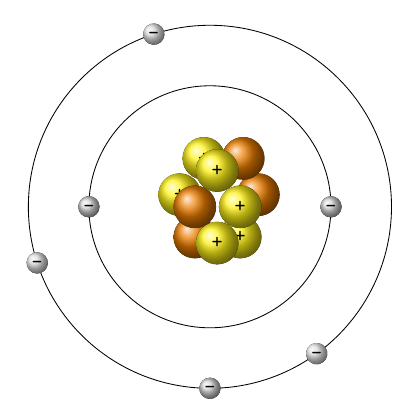
How many electrons does this atom have?
2
4
6
10

Is this a correct dot diagram for fluorine (F)
Yes
No

Is this a correct dot diagram for magnesium (Mg)
Yes
No


The simplest form of matter containing only one type of atom with its own particular set of properties is called a(n)________.
Element
Compound
Mixture
Atom
How many total atoms are in the molecule SO2?
1
2
3
4


Which of the following is an example of a CHEMICAL change?
Shattering a window with a baseball
Ripping paper into 1,000,000,000 tiny pieces
Rusting an iron bar on a humid day
Melting a block of copper metal
Which of the following is an example of a PHYSICAL change?
Neutralizing vinegar with baking soda
Breaking your iPad with a rock due to school stress
Creating a precipitate by mixing Lead Nitrate and Sodium Iodide
Burning popcorn in the microwave

Which of the following describes the basic structure of single replacement reactions?
A + B --> C
A + B --> AB
A + BC --> AC + B
AB + CD --> AD + CB

What are the products of ALL combustion reactions?
Carbon Dioxide and Water
Smoke and Ash
Fire and Carbon Dioxide
Water and Ash

What type of reaction is this?
2NaHCO3 --> Na2CO3 + H2O + CO2
Single Replacement
Combustion
Decomposition
Synthesis

What type of reaction is this?
2Na + 2H2O --> 2NaOH + H2
Single Replacement
Double Replacement
Synthesis
Decomposition
Which coefficient should be placed in front of Lithium to balance this equation?
AlCl3 + Li --> LiCl + Al
1
2
3
0.00000000000001
Which coefficient should be placed in front of NH3 to balance this equation?
NH3 + H2SO4 --> (NH4)2SO4
1
2
3
1,000,000,000

What type of reaction is this?
CH4 + 2O2 --> 2H2O + CO2
Combustion
Synthesis
Double Replacement
Single Replacement

What type of reaction is this?
Pb(NO3)2 + 2KI --> 2KNO3 + PbI2
Double Replacement
Single Replacement
Synthesis
Decomposition
Which law states that Matter cannot be created or destroyed?
Law of Conservation of Matter
Law of Gravity
Law of Equivalent Exchange
Law of Matter ad Infinitum

