
Font size
 Worksheets
1bDNA Structure and Replication Review
Total questions: 92
Worksheet time: 2hrs 35mins


DNA replication occurs during (a) .
Of these four molecules, given the names, which would you think is an enzyme?
Nuclein
Lactase
Glucose
Amino Acid
Polymerase
builds the complimentary DNA strand
Ligase
bonds DNA fragments together
Primase
Indicates whee DNA replication begins
Helicase
"unzips" the DNA
DNA is unzipped
Primase marks region to begin replication
Polymerase builds complimentary DNA strand
Ligase bonds DNA fragments
The fragments on the lagging strand that are made up of repeating segments of DNA and RNA Primers
okazaki fragments
Primase
Polymerase
unused DNA
Which of the following best describes the arrangement of the sides of the DNA molecule
Bonding
Alternating
Anitparallel
Parallel
DNA polymerase moves in the _________ to ____________ direction
3' to 5'
easiest
5" to 3"
9 to 5
Enzyme that connects the DNA to the backbone (glues)
Ligase
Polymerase
Helicase
Primase
DNA strand has the following bases AAGCCA what are the bases on the complementary strand
GGCTTA
TTGGGA
CCAGGT
TTCGGT

The picture below shows the steps of DNA replication beginning with step one and ending with step three.
Because you are reusing the old, or parent, DNA strand DNA replication is said to be
Semi- Conservative
Semi-discontinuous
Continuous
Fully-Conserveative

The picture below shows an enzyme unwinding and unzipping DNA.
What is the name of this enzyme?
DNA Helicase
DNA Ligase
DNA polyermase
RNA Polymerase
Match he nucleotide with its complementary nucleotide. (DNA to DNA).
Adenine -
Thymine
Guanine
Cytosine
Which enzyme is responsible for adding the free nucleotides to the replicating DNA?
DNA Helicase
DNA Ligase
DNA polyermase
RNA Polymerase
Which is the first step?
DNA Helicase unwinds original DNA strand
RNA Primase lays down RNA primer for new nucleotide bases.
DNA polymerase builds new strands by bring in new nucleotide bases.
Ligase knits together fragments on lagging strand
Which is the second step?
DNA Helicase unwinds original DNA strand
RNA Primase lays down RNA primer for new nucleotide bases.
DNA polymerase builds new strands by bring in new nucleotide bases.
Ligase knits together fragments on lagging strand
Which is the third step?
DNA Helicase unwinds original DNA strand
RNA Primase lays down RNA primer for new nucleotide bases.
DNA polymerase builds new strands by bring in new nucleotide bases.
Ligase knits together fragments on lagging strand
Which is the fourth step?
DNA Helicase unwinds original DNA strand
RNA Primase lays down RNA primer for new nucleotide bases.
DNA polymerase builds new strands by bring in new nucleotide bases.
Ligase knits together fragments on lagging strand

Which letter in the picture below depicts the leading strand in DNA replication?
A
C
B
None of the above
Which letter in the picture below depicts the replication fork in DNA replication?
A
C
B
None of the above
If a person suffered from a disorder where their DNA fragments were unable to fill in the missing slots in between the fragments of the lagging strand, they would most likely have a disorder that affected which enzyme?
DNA Helicase
DNA Ligase
DNA polyermase
RNA Polymerase
DNA replication runs from ______' to _____' and is said to be ______________________
5, 3, antiparallel
3, 5, antiparallel
5, 3, parallel
3, 5, parallel
Okazaki fragments appear on which strand of DNA during DNA replication?
lagging
leading
The directionality of DNA is said to be ___________, because it is side by side by goes in opposite directions.
Anti-directional
Parallel
Anti-parallel
Anti-uniform

What gray enzyme in the picture is shown removing the RNA primer?
DNA ligase
DNA Polymerase
Exonuclease
RNA Primase

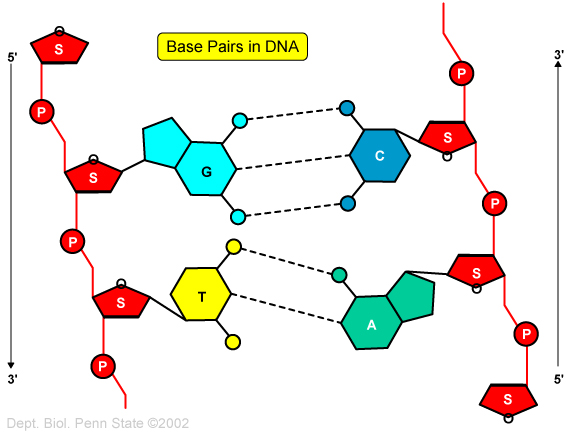
Which of these are nitrogenous bases in DNA that contain a single six carbon ring? Choose all that apply
Thymine
Adenine
Guanine
Cytosine
What major scientific discovery are Watson, Crick, Wilkins, and Rosalind credited for making?
Double helical structure of DNA
RNA structure
In DNA, the amount of adenine in is equal to the amount of thymine and the amount of guanine is equal to the amount of cytosine
Process of semiconservative replication
Which of the following statements about base pairing in DNA is incorrect?
Base pairs are stabilized by hydrogen bonds
Base pairing occurs at the interior of the double helix
Purines always base pair with pyrimidines
Thymine binds to cytosine
Which of these are nitrogenous bases in DNA that contain a double ring structure with a six-carbon ring fused to a five-carbon ring? Choose all that apply:
Thymine
Adenine
Cytosine
Guanine
How is DNA replicated?
Dispersive replication
Conservative replication
Liberal replication
Semiconservative replication
If a DNA strand contains the sequence 5'-TTAGGGACCACCTATA-3', which of the following is the sequence of the complementary strand of DNA?
3'-AATCCCTGGTGGATAT-5'
5'-AATCCCTGGTGGATAT-3'
3'-TTAGGGACCACCTATA-5'
5'-TTAGGGACCACCTATA-3'
What encodes proteins or stable RNA molecules that carries out specific functions in cells?
noncoding DNA
gene
phenotype
genotype
What does Chargaff's rule state?
A pairs with T and C pairs with U
A pairs with G and T pairs with C
A pairs with T and C pairs with G
A pairs with C and G pairs with U

AATCATGGA

What are the three components of a nucleotide?
sugar, hydrogen, nitrogen base
sugar, oxygen, nitrogen base
sugar, phosphate, nitrogen base
sugar, phosphate, protein

When DNA replicates, each strand of the original DNA molecule is used as a template for the synthesis of a second, complementary strand. Which of the following figures most accurately illustrates enzyme-mediated synthesis of new DNA at a replication fork?
A
B
C
D
Which of the following statements about DNA replication is TRUE?
the leading strand is replicated continuously, while the lagging strand is replicated discontinuously
the leading strand is replicated discontinuously, while the lagging strand is replicated continuously
both the leading and lagging strands are replicated continuously
both the leading and lagging strands are replicated discontinuously
each of the leading and lagging strands is replicated both continuously and discontinuously
The point where separation of the DNA occurs is called the replication fork.
True that it is True
True that it is False


Which enzyme proofreads and removes RNA Primase
Ligase
Polymerase
Primase
Helicase


Okazaki Fragment is formed at the
Lagging strand
Leading strand
Linear strand
Leader strand
Below are the enzymes involved in DNA Replication, EXCEPT
DNA helicase
Sucrase
Primase
DNA Polymerase III
What is the function of DNA Ligase?
Forming leading strand
Forming lagging strand
To join Okazaki fragment
To relieve DNA strand
Primase is used to
Form new strand of DNA
Form Okazaki fragment
Produce helicase
Form RNA primer before DNA replication start
Leading strand formed......
Towards replication fork
Away from replication fork
During mitosis
During meiosis
Cytosine makes up 38% of the nucleotides in a sample of DNA from an organism. Approximately, what percentage of the nucleotides in this sample will be thymine?
12
24
31
38
Which of the following statements are TRUE for both DNA and RNA?
I. A primer
II. Contain nitrogenous bases
III. Involve in protein synthesis
I only
I and II only
II and III only
I, II and III
Synthesis of a new DNA strand usually begins with
An RNA primer
A DNA primer
An OKazaki fragment
DNA ligase
What is the basis for the difference in how the leading and lagging strands of DNA molecules are synthesized?
The origin of replication occur only at the 5' end
Helicases and singe strand binding protein work at the 5' end
DNA polymerase can join new nucleotides only to the 3' end of a growing strand
DNA ligase works only in the 3' to 5' direction
Why are single-stranded binding proteins (SSBP) necessary for DNA replication? Select al that apply!
They turn double-stranded DNA into single-stranded DNA
The work done by helicase would be undone
Hydrogen bonds would reform if SSBPs were absent
They ensure the replication bubble stays open
Phosphodiester bonds would reform if the SSBPs were absent
What type of bonds are formed by ligase? Select all that apply!
Hydrogen
Peptide
Ionic
Phosphodiester
Which of the following nitrogenous bases are purines?
A
C
G
T
U
Which of the following depicts the correct order of DNA replication?
Unwind DNA strand, Hold the strand open, Fill in empty spots, Add RNA primers, Replace primers with DNA, Join backbones together
Join backbones together, Fill in empty spots, Replace primers with DNA, Add RNA primers, Hold the strand open, Unwind DNA strand
Join backbones together, Add RNA primers, Fill in empty spots, Replace primers with DNA, Hold the strand open, Unwind the DNA strand
Unwind DNA strand, Hold the strand open, Add RNA primers, DNA synthesis begins, Replace primers with DNA, Fill in empty spots, Join backbones together
Is primer DNA or RNA?
DNA
RNA

Erwin Chargaff investigated the nucleotide composition of DNADNA. He analyzed DNADNA from various organisms and measured the relative amounts of adenine (AA), guanine (GG), cytosine (CC), and thymine (TT) present in the DNADNA of each organism. Table 1 contains a selected data set of his results.
Which of the following statements best explains the data set?
Since the %A and the %G add up to approximately 50 percent in each sample, adenine and guanine molecules must pair up in a double-stranded DNADNA molecule.
Since the %A and the %T are approximately the same in each sample, adenine and thymine molecules must pair up in a double-stranded DNADNA molecule.
Since the %(A+T) is greater than the %(G+C) in each sample, DNADNA molecules must have a poly-AA tail at one end.
Since the %C and the %T add up to approximately 50 percent in each sample, cytosine and thymine molecules must both contain a single ring.

A model of a process involving nucleic acids is shown in Figure 1.
Which of the following best explains what process is represented in Figure 1 ?
New DNA strands are being synthesized in the 3'3′ to 5'5′ direction from their DNA templates.
New DNA strands are being synthesized in the 5'5′ to 3'3′ direction from their DNA templates.
A new RNA strand is being synthesized in the 3'3′ to 5'5′ end from its DNA template.
Two new RNA strands are being synthesized in both directions from their DNA templates.

Figure 1 illustrates a model of the molecules involved in DNA replication and their placement relative to each other.
Which of the following correctly explains where DNA replication will begin on the strand oriented 5'→3', reading from left to right?
DNA replication will be randomly initiated along the unwound portion of the DNA strand since base pairing will occu
DNA replication cannot occur since there is already RNA base pairing with the template strand.
DNA replication will be initiated immediately to the left of the RNA, since DNA polymerase requires an RNA primer.
DNA replication will be initiated at the site of the topoisomerase since that is where DNA begins to uncoil.

A simplified model of a DNA replication fork is represented in Figure 1. The protein labeled Enzyme 1 carries out a specific role in the DNA replication process.
Which of the following statements best explains the role of Enzyme 1 in the DNA replication process?
Enzyme 1 is a DNA ligase that joins together the DNA fragments at a replication fork to form continuous strands.
Enzyme 1 is a DNA primase that catalyzes the synthesis of RNA primers on the lagging strand of a replication fork.
Enzyme 1 is a DNA polymerase that synthesizes new DNA by using the leading and lagging strands of a replication fork as templates.
Enzyme 1 is a topoisomerase that relieves tension in the overwound DNA in front of a replication fork.
Which of the following bases are pyrimidine.
Check all that apply
(a) (b) (c)



