wayground logo

Free Printable Worksheets

NEW

Font size

S
M
L
XL
Worksheets

Unit 3B Review

Total questions: 75

Worksheet time: 1hrs 16mins

Name
Class
Date
1.
A(n) ________ is the single smallest particle of an element that retains the chemical identity of that element.
a)
atom
b)
element
c)
compound
d)
particle
2.
Greek philosophers known for stating that matter is made of tiny particles called atoms. 
a)
Rutherford and Bohr
b)
Aristotle and Brown
c)
Dalton and Lavoisier
d)
Democritus and Leucippus
3.
Matter is classified into two main groups known as_______.
a)
solids and fluids
b)
pure substances and mixtures
c)
homogeneous and heterogeneous
d)
elements and compounds
4.
Mixtures are classified into two groups known as_______________.
a)
elements and mixtures
b)
elements and compounds
c)
heterogeneous and homogeneous
d)
atoms and elements
5.
Atoms are made up of three basic parts, which are -
a)
Protons, neutrons, electrons
b)
neutrinos, protons, neutrons
c)
quarks, protons, electrons
d)
electrons, neutrons, and quarks
6.
The nucleus is made up of -
a)
neutrons and electrons
b)
protons and neutrons
c)
protons and electrons
d)
electrons and quarks
7.
Protons have this charge -
a)
positive
b)
negative
c)
neutral
d)
no charge
8.
Electrons have this charge - 
a)
positive
b)
negative
c)
neutral
d)
no charge
9.
Neutrons have this charge -
a)
positive
b)
negative
c)
neutral
d)
They don't exist
10.
What scientist is best known for his "Plum Pudding" model of the atom?
a)
J.J. Tomson
b)
Ernest Rutherford
c)
John Dalton
d)
Democritus
11.
An atom's overall charge is ________.
a)
positive 
b)
depends
c)
neutral 
d)
negative 
12.
Ernst Rutherford discovered which part of the atom through the use of gold foil?
a)
Proton
b)
Neutron
c)
Electron
d)
Orbitals
13.
The particles that are found in the nucleus of an atom are
a)
neutrons and electrons
b)
electrons only
c)
protons and neutrons
d)
protons and electrons
14.
Fluorine has an atomic number of 9. What can you conclude about an atom of fluorine from this fact?
a)
it has 9 protons
b)
it weighs 9 grams
c)
it has 9 electron shells
d)
it has a boiling point of 9 degree celsius
15.
An atom of fluorine has an atomic mass of 19 u. Keeping in mind that its atomic number is 9, what can you infer about this atom?
a)
it has 9 neutrons
b)
it has 10 electrons
c)
it has 10 neutrons
d)
it has 10 protons
16.
If a hydrogen atom has 1 proton, 1 electron, and 1 neutron, its atomic number is:
a)
1
b)
2
c)
3
d)
4
17.
What do carbon-12 and carbon-14 have in common?
a)
they have same number of protons
b)
they have the same number of neutrons
c)
they have the same atomic mass
d)
they have the same atomic weight
18.
How many neutrons does the isotope of lithium have?
a)
8
b)
3
c)
4
d)
5
19.
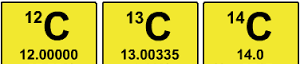
What do these isotopes of carbon all have in common?
a)
neutrons & mass number
b)
atomic number and neutrons
c)
atomic number and electrons
d)
protons, atomic number, and mass number
20.
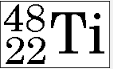
How many protons does this isotope of titanium have?
a)
48
b)
22
c)
26
d)
70
21.
In a correctly written symbol what would be located in the "A" position?
a)
number of neutrons
b)
atomic number
c)
number of electrons 
d)
mass number
22.
How many neutrons in C-14?
a)
6
b)
7
c)
14
d)
8
23.
How many neutrons does the isotope below have?     89 36Kr
a)
53
b)
36
c)
89
d)
125
24.
If X is the symbol for an element, which of the following two symbols represent    isotopes of the same element?     I. 7735X  II. 7733X  III. 8137X  IV. 8135 X
a)
I and II
b)
III and IV
c)
I and IV
d)
I and III
25.
An atom becomes _________ when it gains electrons.
a)
Positive
b)
Negative
c)
Neutral
d)
Invinsible
26.

What is the charge of a sodium ion?

a)

+2

b)

+1

c)

-1

d)

-2

27.
Group 17 always has ions with a charge of 
a)
+1
b)
+2
c)
-1
d)
-2
28.
What charge will an Oxygen ion have? 
a)
+1
b)
-1
c)
+2
d)
-2
29.
Which of the following has a -3 charge?
a)
Boron
b)
Fluorine
c)
Nitrogen
d)
Neon
30.
charge of lithium ion
a)
-2
b)
-1
c)
+1
d)
+2
31.
Elements on the LEFT side of the periodic table will most likely form:
a)
Positive ions
b)
Negative ions
c)
Neutral Ions
d)
None of these
32.
An atom becomes _______ when it loses electrons.
a)
Positive
b)
Negative
c)
Neutral
d)
Invinsible
33.

Which scientist edited the Periodic Table and arranged elements in increased atomic number?

a)

Rutherford

b)

Dalton

c)

Mendeleev

d)

Moseley

34.

Which scientist created the Periodic Table and arranged elements in increasing atomic mass?

a)

Rutherford

b)

Thomson

c)

Mendeleev

d)

Moseley

35.

Elements in the same group or family have _____________.

a)

the same number of valence electrons and different properties.

b)

the same number of valence electrons and similar properties

c)

different number of valence electrons and similar properties.

d)

different number of valence electrons and different properties.

36.

Which class of elements are malleable, ductile, shiny when clean and polished, good conductors of heat and electricity, and reacts with acids to form hydrogen gas?

a)

metals

b)

nonmetals

c)

metalloids

d)

ions

37.

What is the name of Group 1 elements?

a)

Alkali Metals

b)

Alkaline Earth Metals

c)

Transition Metals

d)

Halogens

38.

What is the name of the elements that are unreactive and have a full octet?

a)

Halogens

b)

Noble Gases

c)

Alkali Metals

d)

Transition Metals

39.

Where are metalloids located on the Periodic Table?

a)

In the s block.

b)

In the f block.

c)

In the d block.

d)

The elements that touch the staircase except aluminum.
40.
How do covalent bonds form?
a)
Donating & receiving valence e- between atoms.
b)
Opposite slight charges attract each other between compounds.
c)
Scientists are still not sure how they form.
d)
Sharing valence e- between atoms.
41.
Which of the following is NOT formed by a covalent bond?
a)
K2S
b)
H2O
c)
I2
d)
CO2
42.
Covalent bonds are between...
a)
Metal and Non-metal
b)
Non-metal and Non-metal
c)
Metal and Metal
43.
Ionic bonds are between...
a)
Metal and Non-metal
b)
Non-metal and Non-metal
c)
Metal and Metal
44.
Ionic or covalent?
H2O
a)
Ionic
b)
Covalent
45.
Ionic or covalent?
NaBr
a)
Ionic
b)
Covalent
46.

What kind of element forms covalent bond?

a)

metals

b)

semi -metals

c)

non metals

d)

metal and non metal

47.
Diatomic elements are defined as IDENTICAL elements that bond with each other (i.e. Oxygen with Oxygen).  What type of bond should they form?
a)
Ionic
b)
Polar Covalent
c)
Nonpolar Covalent
d)
Van der Waals force
48.

Conducts electricity well when melted or dissolved in deionized water

a)

Ionic compounds

b)

Covalent compounds

49.

Which of the following solutions would have poor conductivity?

a)

Sugar water

C12H22O11 + H2O

b)

Sodium Hydroxide

NaOH + H2O

c)

Baking Soda

NaHCO3 + H2O

d)

Copper Chloride

CuCl2 + H2O

50.

The correct name for CaBr2 is

a)

calcium dibromide

b)

calcium (II) bromide

c)

calcium bromide

d)

carbon bromide

51.

What is the correct formula for Beryllium fluoride?

a)

BeF

b)

Be2F

c)

BeF2

52.

Which is the correct formula for copper (II) fluoride?

a)

Cu2F

b)

CuF2

c)

CuF

53.

Which is the correct formula for Tin (I) sulfide?

a)

SnS

b)

SnS2

c)

Sn2S

54.

Which is the correct name for CrN?

a)

Chromium (I) nitride

b)

Chromium (III) nitride

c)

Chromium nitride

d)

Chromium (VI) nitride

55.

Identify the formula for this combination Sr2+ and I1-

a)

Sr2I

b)

SrI2

c)

SrI

56.

Identify the formula for this combination Al3+ and O2-

a)

Al3O2

b)

AlO

c)

Al2O3

57.

Identify the formula for this combination Mg2+ and (NO2)1-

a)

Mg2(NO2)

b)

Mg(NO2)

c)

Mg(NO2)2

d)

MgNO4

58.

Which is the correct formula for Magnesium hydroxide (OH)1-?

a)

MgOH

b)

MgOH2

c)

Mg(OH)2

59.
What is a coefficient?
a)
The small number on the right of the chemical symbol.
b)
The large number to the left of a formula.
60.
Which side of a chemical equation is the product side?
a)
Left (before the arrow)
b)
Right (after the arrow)
61.
Which problem is balanced?
a)
PbO2 + 2H2
b)
SO2 + H20 --> H2SO4
c)
2Na + 2H2O --> 2NaOH + H2
62.
Is the equation balanced?: 2H2O + O2 --> 4MgO + 3Fe
a)
Yes
b)
No
63.
Balance this equation
_Zn+_HCl-->_ZnCl+_H2
a)
1,1,2,1
b)
1,1,1,2
c)
1,2,1,1
d)
2,1,1,1
64.
Balance this equation.
_Mg + _Cl--> _MgCl2
a)
1, 2,1
b)
already balanced
c)
2,1,1
d)
1,1,2
65.
KNO3 --> KNO2 + O2
What coefficients are needed to balance the reaction?
a)
2, 2, 1
b)
2, 3, 2
c)
1, 2, 2
d)
1, 3, 1
66.
Balance this equation.
_CH4 + _O--> _CO+ _H2O
a)
1,2,1,1
b)
2,1,2,1
c)
1,2,1,2
d)
0,2,0,2
67.
Balance this equation-
__P+ __O--> __P2O3
a)
it is already balanced
b)
2, 1, 3
c)
1, 2, 3
d)
1, 3, 2
68.
If an atom of Fluorine has an atomic mass of 19 amu, it has a Molar mass of ____
a)
19 lbs.
b)
19 kg
c)
How am I supposed to know?
d)
19 g/mol
69.
What is the molar mass of table salt (NaCl)?
a)
116.886 g/mol
b)
35.453 g/mol
c)
22.990 g/mol
d)
58.443 g/mol
70.
What is the mass of 0.89 mol of CaCl2?
a)
111 grams
b)
0.008 grams
c)
98.9 grams
d)
none of the choices
71.

What is the molar mass of PbSO4?

a)

303.27 g/mol

b)

255.27 g/mol

c)

163.87 g/mol

d)

372.27 g/mol

72.

Determine the mass of 4.20 moles of C6H12

a)

353 g

b)

0.0499 g

c)

337 g

d)

2.53 x 1024 g

73.

How many moles of sodium chloride are in a 321.8 g sample?

a)

18810 moles

b)

3.315 x 1024 moles

c)

5.507 moles

d)

4.767 moles

74.
How many moles are in 16.94g of water?
a)
16.94 mol H2O
b)
0.9401 mol H2O
c)
305.3 mol H2O
d)
1.063 mol H2O
75.

Convert 86.235 g of diphosphorus pentaoxide to moles.

a)

12240 moles

b)

1.8747 moles

c)

.608 moles

d)

.60755 moles