
 Worksheets
Motion & Forces
Total questions: 60
Worksheet time: 54mins


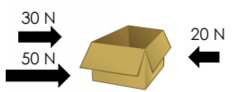
What is the unit for FORCE?
N (Newtons)
lbs (pounds)
g (grams)
m/s (meters per second)

Could this boat be moving? If it is, is it accelerating, decelerating, or moving at a constant speed?
No
Yes, accelerating
Yes, decelerating
Yes, moving at a constant speed

When 2 teams are in a tug of war game, and neither team is winning, what is the net force?
100 N
0 N
50 N
2 N

A car moves along a level road.
The diagram shows all of the horizontal forces acting on the car.
Which statement is correct?
The car is slowing down.
The car is speeding up.
The car is moving at a constant speed.
The car is moving backwards.

The diagram shows a tug-of-war between team X and team Y. The arrows show the forces exerted by the teams on the rope.
What is the size of the resultant force on the rope and in which direction does the resultant force act?
size of resultant force = 75 N; direction of resultant force = to the left
size of resultant force = 75 N; direction of resultant force = to the right.
size of resultant force = 725 N; direction of resultant force = to the left
size of resultant force = 725 N; direction of resultant force = to the right.
When forces are acting in the same direction they should be added together.
True
False
Forces that are acting in opposite directions should be subtracted from each other.
True
False
If the net force (Fnet) is 0, _____
the forces are balanced.
the object just keeps doing what it was doing.
the object maintains its same speed and direction.
the object maintains its velocity.
the object does not speed up, slow down, or turn.
If the net force is not 0, _____
the forces are not balanced.
the object changes what it is doing.
the object changes its velocity.
the object accelerates.

The net force acting on the object is acting _____.
to the right
to the left
up
down

The net force (Fnet) acting on the object is (a) N.

What is the resultant force?
40 N left
0 N Balalnced
400 N right
40 N right


What is the resultant/ net force?
400 N Up
400 N Down
- 400 N Down
800 N Down


If there are two forces going in opposite directions how would you find the net force?
Subtract
Add
Neither
Multiply


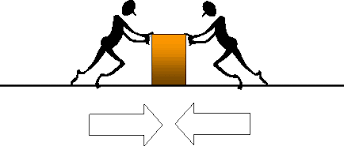

A ____________ is a push or a pull on an object.
friction
force
magnet
gravity
Suppose that an astronaut throws a baseball in outer space at a location far from significant influences of gravity and air resistance. One would expect that the baseball would ____.
eventually stop since all objects ultimately "lose their steam"
eventually stop as its inertia slowly becomes used up
continue in motion with the same speed and direction
either a, b, or c -- depending on whether the astronaut continues to push it
All objects have inertia
True
False
A skateboard rolls down a hill, reaches the level surface and eventually comes to a stop. The fact that the skateboard ultimately stops is best explained by ____.
an unbalanced force would be required to keep the sled moving forward at constant speed
the presence of an unbalanced force (e.g., friction) can cause a moving object to stop
the presence of inertia causes it to stop
the natural tendency of any object is to ultimately stop
the tendency of an object to resist a change in its motion
acceleration
inertia
mass
frame of reference

1st
Law of Motion
2nd
Law of Motion
3rd
Law of Motion
A pulling force exerted along a rope, string, wire, cable...
Friction
Gravity
Normal
Tension
Which of Newton's Laws says that objects tend to maintain a constant velocity unless acted on by an unbalanced force.
1st
2nd
3rd
When a driver slams on the brakes, passengers fly forward. This is an example of Newton's ________ Law.
1st
2nd
3rd
A person is pushed forward into their seatbelt when a car stops. Which of Newton's Laws explains this?
1st
2nd
2 and 3
3rd

Objects at rest resist forces that try to put them into motion.
Which of Newton's Laws of Motion applies?
Newton's 1st Law
Newton's 2nd Law
Newton's 3rd Law
Not a law, it's a generalization.

Objects in motion resist forces that try to make them go faster or go slower.
Which of Newton's Laws of Motion applies?
Newton's 1st Law
Newton's 2nd Law
Newton's 3rd Law
Not a law, its a generalization.
What is the tendency of an object to resist changing its state of motion?
inertia
force
acceleration
velocity
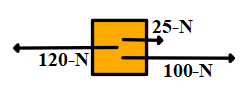
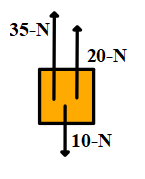
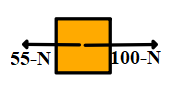
The free body diagram of four boxes are shown below. Which box is in equilibrium?
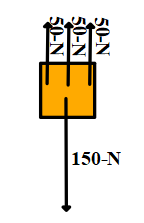


What is the type of force in a rope when the rope is stretch by a weight?
Tension
Gravitational force.
Upthrust.
Thrust.
______ is the force that is transmitted through a string, rope, cable, or wire when it is pulled tight by forces acting from opposite ends.
gravity
friction
applied force
tension
magnetism

The force that is transmitted through a string, rope, cable or wire when it is pulled tight.
Spring Force
Tension Force
Elastic Force

