wayground logo

Free Printable Worksheets

Font size

S
M
L
XL
Worksheets

Geometry Semester 1 Review

Total questions: 139

Worksheet time: 7hrs 8mins

Name
Class
Date
1.
Solve for x
a)
x = 2
b)
x = 4
c)
x = 6
d)
x = 8
2.
What does the word BISECT mean?
a)
To cut something into more than five pieces.
b)
It is a plane with two sets of wings.
c)
A shape that has three sides. 
d)
To cut something into two congruent pieces or in half.
3.

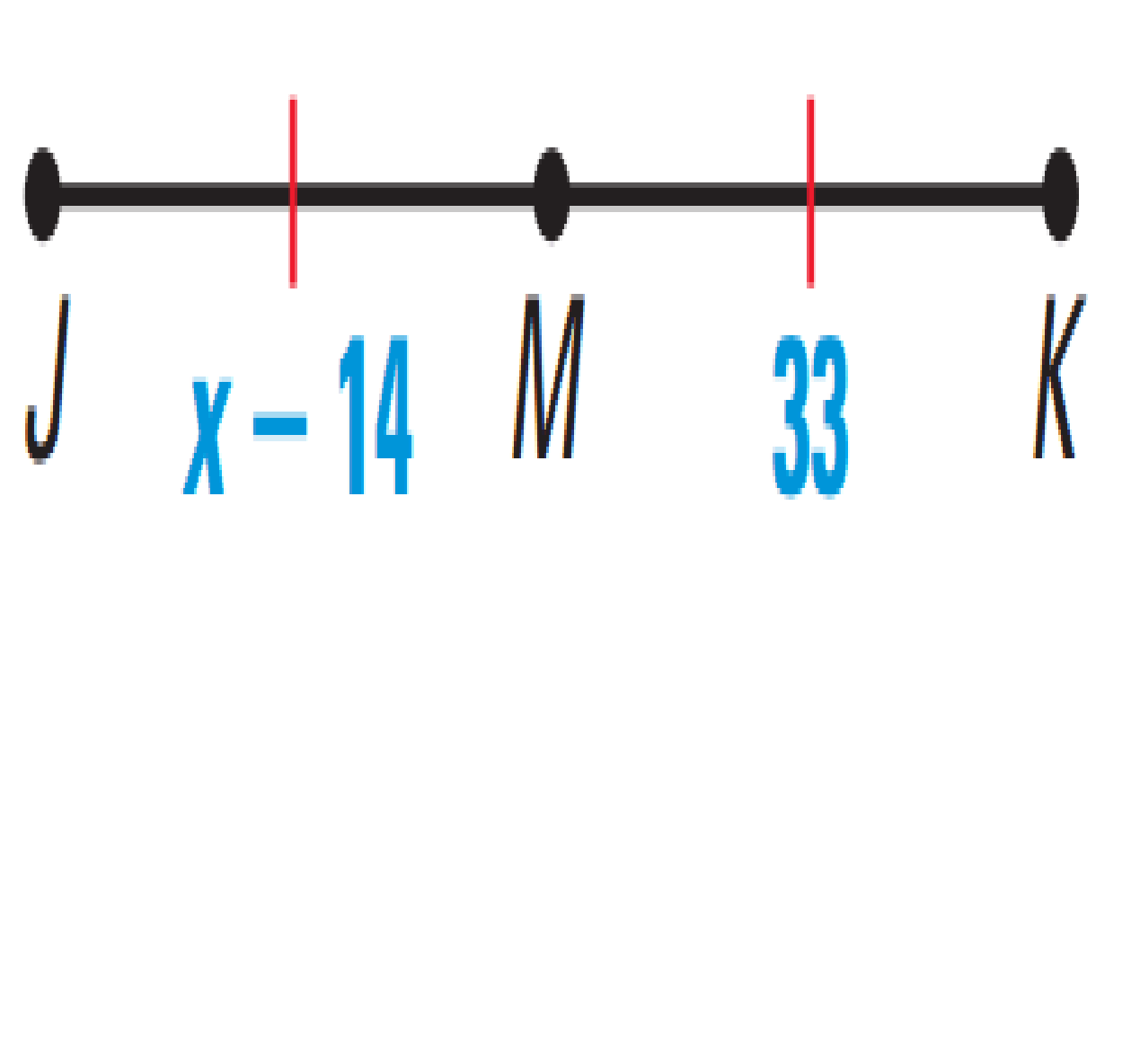
M is the midpoint of the line segment. Find the value of x.

a)

x=47

b)

x=19

c)

x=33

d)

x= -47

4.
a)
-3
b)
0
c)
1
d)
3
5.
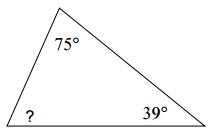
Find the value of ∠A.
a)
25°
b)
30°
c)
35°
d)
90°
6.
a2 + b2 = c2
a = 9 b = 40
a)
c = 41
b)
c = 65
c)
c = 25
d)
c = 5
7.
Find the missing side
a)
9
b)
41
c)
6.4
d)
3
8.
Find the missing side
a)
48
b)
108
c)
83.6
d)
72
9.
Find the measure of each angle indicated. 
a)
139°
b)
66°
c)
138°
d)
116°
10.
Solve for x.
a)
16
b)
11
c)
50
d)
6
11.
1. Find ∠ AOC 
a)
130
b)
50 
c)
40
12.
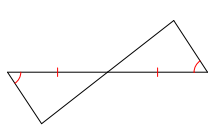
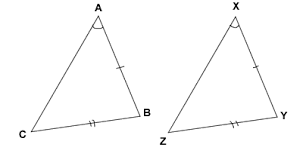
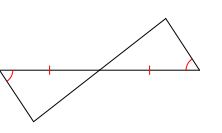
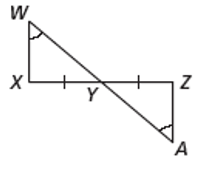
How are the triangles congruent?
a)
HL
b)
SAS
c)
ASA
d)
AAS
13.
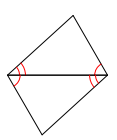
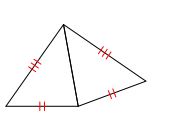
How are the triangles congruent?
a)
AAS
b)
SAS
c)
ASA
d)
SSS
14.
Which is a correct congruence statement.
a)
A
b)
B
c)
C
d)
D
15.
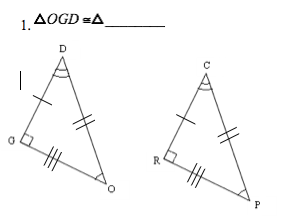
Complete the congruence statement.
a)
CRP
b)
PCR
c)
RPC
d)
PRC
16.

△BAC ≅ △QPR. If ∠B = 2x and ∠Q = 10, find the value of x.

a)

2

b)

4

c)

5

d)

-5

17.
If ∆PIG ≅ ∆COW, WO≅?
a)
GI
b)
PI
c)
PG
18.

Which two sides include angle B (choose both)

a)

Side AC

b)

Side AB

c)

Side BC

19.

ΔPETΔDOG\Delta PET\cong\Delta DOG  

Which of the following are TRUE 

a)

PD\angle P\cong\angle D  

b)

TEGO\overline{TE}\cong\overline{GO}  

c)

TO\angle T\cong\angle O  

d)

TPGD\overline{TP}\cong\overline{GD}  

e)

TEOG\overline{TE}\cong\overline{OG}  

20.

Are the points shown collinear?

a)

Yes

b)

No

21.

Are the points shown collinear?

a)

Yes

b)

No

22.

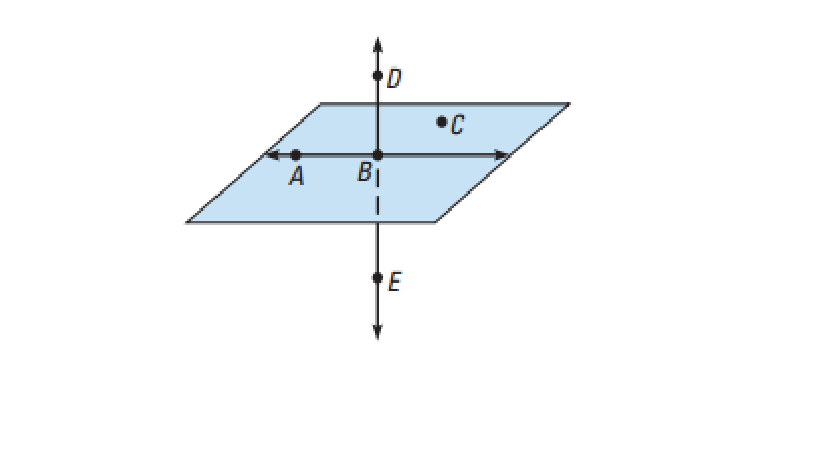
Are the points shown coplanar?

a)

Yes

b)

No

23.

Choose the points that are collinear.

a)

A, B, and C

b)

A, C, and D

c)

A, E, and F

d)

B, C, and D

24.

Are the points D, G, and F coplanar?

a)

Yes

b)

No

25.
Two planes intersect at a...
a)
line
b)
point
c)
plane
d)
letter
26.
a)
No, the three points are not collinear.
b)
Yes, they lie on line MP.
c)
Yes, they lie on line NP.
d)
Yes, they lie on line MO.
27.

ALWAYS, SOMETIMES or NEVER:

Through any three points, there exists exactly one line.

a)

Always

b)

Sometimes

c)

Never

28.

ALWAYS, SOMETIMES or NEVER:

A point is in more than one plane.

a)

Always

b)

Sometimes

c)

Never

29.

ALWAYS, SOMETIMES or NEVER:

Two planes intersect.

a)

Always

b)

Sometimes

c)

Never

30.
State the line of reflection.
a)
Reflection across y-axis
b)
Reflection across x-axis
c)
Reflection across x = 1
d)
Reflection across y = 1
31.
What is the Algebraic Notation for this Reflection?
a)
(x, y) → (y, x)
b)
(x, y) → (-x, y)
c)
(x, y) → (-y, -x)
d)
(x, y) → (x, -y)
32.

Given the point Y at (5, 2), where would the image be after the following translation: (x + 2, y - 7)?

a)

(7, 7)

b)

(3, 9)

c)

(4, -5)

d)

(7, -5)

33.
Identify the transformation from A to D.
a)
90o Clockwise Rotation
b)
180o Rotation
c)
270o Clockwise Rotation
d)
360o Rotation
34.

Reflect Point C over the line x = 1

a)

(-1, 2)

b)

(3, 0)

c)

(0, 2)

d)

(3, -1)

35.

Reflect the shape over the line y = x. Where is A'?

a)

(7, 2)

b)

(-2, 7)

c)

(2, -7)

d)

(-7, -2)

36.

Which would be the correct notation for the composition of transformations from blue to red to green?

a)

<-4,0> then Ry axis

b)

Ry axis then <0, -4>

c)

<0, -4> then Ry axis

d)

Rx axis then Ry axis

37.
Choose the correct scale factor:
a)
2
b)
3
c)
1/3
d)
1/2
38.
If 2x - 5 = 10, then 2x = 15.
a)
Subtraction Property of Equality
b)
Addition Property of Equality
c)
Division Property of Equality
d)
Substitution
39.
x = x
a)
Transitive Property of Equality
b)
Symmetric Property of Equality
c)
Reflexive Property of Equality
d)
Division Property of Equality
40.
If AB = CD and CD = EF, then AB = EF
a)
Symmetric Property of Equality
b)
Reflexive Property of Equality
c)
Transitive Property of Equality
d)
CLT or Simplify
41.
Name the property described:
If PQ = RS then RS = PQ
a)
Reflexive
b)
Symmetric
c)
Transitive
d)
Addition
42.
If a = b, then a may be replaced by b in any expression.
a)
Transitive Property         
b)
Reflexive Property             
c)
Symmetric Property 
d)
Substitution Property
43.
Which property is shown below?
__________________________
If t = 72, then t + 16 = 88 can be rewritten as 72 + 16 = 88
a)
Addition Property
b)
Substitution Property
c)
I Do What I Want Property
d)
Associative Property
44.
Name 3 coplaner points.
a)
ZRW
b)
VZX
c)
VWX
d)
WYZ
45.
Two lines that do not intersect and are not in the same plane are called __________.
a)
parallel
b)
perpendicular
c)
skew
46.

Which of the following cannot be assumed from the diagram?

a)

Points A, B, C and E are coplanar

b)

Points F, B and G are colinear

c)
d)

Line EC intersects plane M at point C

47.
a)

True

b)

False

48.
True or False: Points A, B, and C are coplanar.
a)
True
b)
False
49.
If you were to rotate ABCD 180°  about the origin, what would the coordinate of A' be?
a)
(-5, 5)
b)
(-3, -5)
c)
(-5, 3)
d)
(-3, 3)
50.

How do you get from the red triangle to the orange triangle?

a)

reflection over the y-axis and then the x-axis

b)

rotate 270 degrees and reflect over y = 2

c)

reflection over the y-axis and translate up 7

d)

rotate 180 degrees and reflect over y = 2

e)

translate up 7, translate right 6, and then reflect over the x-axis

51.

Rotation Rules (clockwise):

270o rotation: (x, y)→(-y, x)

What are the coordinates of B' after a 270° clockwise?

a)

(4, 4)

b)

(4, -4)

c)

(-3, 4)

d)

(-4, 4)

52.
Triangle B is rotated 90° counterclockwise with the origin as the center of rotation to create a new figure. Which triangle shows the new location?
a)
A
b)
B
c)
C
d)
D
53.

Rotation Rules (clockwise):

90o rotation: (x, y)→(y, -x)

What are the coordinates for A' after a 90rotation clockwise?

a)

(1, 3)

b)

(3, 1)

c)

(3, -1)

d)

(1, -3)

54.
Find the value of x. 
a)
x = 133
b)
x = 47
55.
Solve for y.
a)
y = 20
b)
y = 120
c)
y = 60
d)
y = 10
56.
Find y.
a)
50
b)
130
57.
Are these lines parallel?  Why?
a)
Yes - the angles add up to 180
b)
Yes - the corresponding angles are congruent
c)
No - there's no tick marks
d)
No - the angles are not equal.
58.
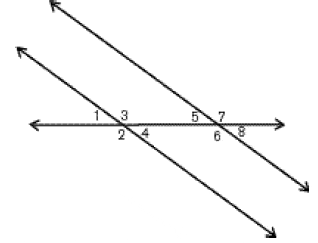
In the diagram, which of the following statements are false?
a)
∠1 and ∠4 are vertical angles
b)
∠4 and ∠5 are alternate interior angles
c)
∠1 and ∠8 are alternate interior angles
d)
∠2 and ∠6 are corresponding angles
59.

If it is a fraction, then it is a number between zero and one.  


What is an appropriate counterexample?

a)

23\frac{2}{3}

b)

45\frac{4}{5}

c)

12\frac{1}{2}

d)

32\frac{3}{2}

60.

Which of the following is a counterexample to the following conjecture? 

If x2 = 4x^2\ =\ 4 , then  x=2x=2  .

a)

x = 4

b)

x = -2

c)

x = 2

d)

x = -4

61.

If an animal is furry, then it is a hamster.

What would be an appropriate counterexample?

a)

goldfish

b)

frog

c)

elephant

d)

cat

62.

The product of two negative numbers is greater than the sum of the two numbers.

What is an appropriate counterexample?

a)

-3 and -3

b)

True. There is no counterexample

c)

-1 and -1

d)

4 and 6

63.

What phrase does a biconditional statement contain?

a)
if, then
b)
if, when
c)
if and only if
d)
then, if
64.

Given the statement;

"If Jose eats fish, then he has an allergic reaction"

Which of the following is the converse?

a)

None of these

b)

If Jose doesn't have an allergic reaction, then he didn't eat fish.

c)

If Jose doesn't eat fish, then he doesn't have an allergic reaction.

d)

If Jose has an allergic reaction, then he ate fish.

65.

What is the converse to this statement?

a)

If it isn't dark outside, then it is not night.

b)

If it is night, then it is dark outside

c)

If it is not night, then it is not dark outside.

d)

It is night.

66.
Name this triangle.
a)
Right, Isosceles
b)
Scalene, acute
c)
Isosceles, acute
d)
Equilateral, obtuse
67.
Find the measure of the indicated angle. 
a)
87 degrees
b)
82 degrees
c)
83 degrees
d)
72 degrees
68.
Find the measure of the indicated angle. 
a)
80
b)
58
c)
42
d)
138
69.
Find the measure of the indicated angle. 
a)
145
b)
113
c)
102
d)
78
70.

Complementary angles are angles that together equal

a)

180 degrees

b)

90 degrees

c)

45 degrees

d)

100 degrees

71.
Name that shape.
a)
quadrilateral, rectangle
b)
quadrilateral, rectangle, square
c)
quadrilateral, parallelogram, rectangle
d)
quadrilateral, parallelogram, rectangle, square
72.
Which quadrilateral cannot be called a parallelogram?
a)
Square
b)
Trapezoid
c)
Rectangle
d)
Rhombus
73.
All squares are rectangles.
a)
True
b)
False
74.

Which line is skew to FG\overline{FG}  ?

a)

EH\overline{EH}  

b)

DC\overline{DC}  

c)

AD\overline{AD}  

d)

FB\overline{FB}  

75.

Which plane is parallel to plane CDG?

a)

Plane ABC

b)

Plane ADE

c)

Plane BEF

d)

Plane BCG

76.
Name a line perpendicular to AD
a)
EH
b)
AB
c)
CG
d)
HG
77.
Name a line parallel to AB
a)
EH
b)
DC
c)
AE
d)
FG
78.
a)
x=67
b)
x=43
c)
x=55
d)
x=12
79.

Find m∠ABD.

(a)  

80.

If KM\overrightarrow{KM}  bisects  LKJ\angle LKJ  and  mJKM=22°m\angle JKM=22\degree  find  mLKMm\angle LKM  .


a)

22

b)

44

c)

11

d)

68

e)

not enough information given

81.

Select every true statement below.

a)

BC = 10 ft.

b)

AD = 36 ft.

c)

BE = 10 ft.

d)

DE = 36 ft.

82.

EJ \overrightarrow{EJ}\  bisects  DEF\angle DEFmDEJ=5x+7m\angle DEJ=5x+7  ,  mJEF=8x8m\angle JEF=8x-8 .
Find x.

a)

5

b)

2

c)

6

d)

13

83.

BD\overrightarrow{BD}  bisects ABC\angle ABCmABD=3x+5m\angle ABD=3x+5  and  mABC=2x+30m\angle ABC=2x+30 . Find  mDBCm\angle DBC  . 

a)

15°15\degree  

b)

35°35\degree  

c)

5°5\degree  

d)

20°20\degree  

84.

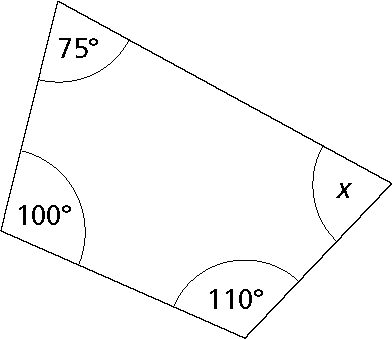
What is the measure of ∠A?

a)

46

b)

134

c)

90

d)

88

85.

Find the missing angle.

a)

75o

b)

85o

c)

100o

d)

45o

86.

Solve for x.

a)

5o

b)

12o

c)

-7o

d)

-6o

87.
Name the angle relationship.
a)
Alternate Interior
b)
Alternate Exterior
c)
Corresponding
d)
Vertical Angles
88.

If lines are parallel with a transversal, then these two angles are...

a)

Supplementary Angles

b)

Corresponding Angles

c)

Alternate Exterior Angles

d)

Parallel Angles

89.
Angle R and C are...
a)
Alternate Interior Angles
b)
Consecutive Interior Angles
c)
Corresponding Angles
d)
Alternate Exterior Angles
90.
Angle Q and B are...
a)
Supplementary
b)
Congruent
91.
Angle C and P are...
a)
Supplementary
b)
Congruent
92.
In the diagram, which of the following statements are false?
a)
∠1 and ∠4 are vertical angles
b)
∠4 and ∠5 are alternate interior angles
c)
∠1 and ∠8 are alternate interior angles
d)
∠2 and ∠6 are corresponding angles
93.
Angles x and y are.....
a)
alternate interior
b)
alternative exterior
c)
corresponding
d)
same-side interior
94.

3 \angle3\  and  2\angle2   are __________________.  

a)

Alternate Interior Angles

b)

Alternate Exterior Angles

c)

Same-side Interior Angles

d)

Corresponding Angles

e)

None of these

95.
Which is NOT a test to prove triangles congruent?
a)
SAA
b)
SSS
c)
SSA
d)
SAS
96.
Are these triangles congruent? If so, state the rule which you used to determine congruence.
a)
Yes by ASA
b)
Yes by AAS
c)
Yes by SSA
d)
Not congruent
97.
Are these triangles congruent? If so, state the rule which you used to determine congruence.
a)
SSA
b)
AAS
c)
ASA
d)
Not necessarily congruent
98.
Congruent by
a)
SSS
b)
SAS
c)
ASA
d)
AAS
99.
Congruent by
a)
SSS
b)
SAS
c)
ASA
d)
AAS
100.
What would be the correct "given" statements for this diagram?
a)
T is the midpoint of segment BG and
∡B≅∡G
b)
∡B≅∡G and ∡A≅∡W
c)
T is the midpoint of segment BG and ∡A≅∡W
d)
T is the midpoint of segment AW and ∡A≅∡W
101.
a)
A
b)
B
c)
C
d)
D
102.
Are these triangles congruent?
a)
Yes, by AAS
b)
Yes, by SAS
c)
Yes, by SSS
d)
No, this is the SSA one!!
103.

The diagonals of a rectangle are

a)

parallel

b)

congruent

c)

perpendicular

d)

not congruent

104.
______ rectangles are parallelograms.
a)
All
b)
Some
c)
No
105.

Which of the following is true about the diagonals of a rectangle? Select all that are true.

a)

Diagonals bisect each other

b)

Diagonals are congruent

c)

Diagonal are perpendicular

d)

Diagonals bisect the angles

106.
a)
90
b)
23
c)
22
d)
180
107.

All sides are congruent. (Select all that apply)

a)

Parallelogram

b)

Rectangle

c)

Rhombus

d)

Square

108.

90 degree angles. (Select all that apply)

a)

Parallelogram

b)

Rectangle

c)

Rhombus

d)

Square

109.

Diagonals bisect each other. (Select all that apply)

a)

Parallelogram

b)

Rectangle

c)

Rhombus

d)

Square

110.

Which of the following statements is false?

a)

a kite has no parallel sides

b)

a kite has one pair of congruent angles

c)

the diagonals of a kite are perpendicular

d)

the diagonals of a kite are congruent

111.
The diagonals in a kite  __________.
a)
are perpendicular
b)
are congruent
c)
bisect each other
112.
Which of the following statements is false?
a)
BD and AC are perpendicular
b)
BD and AC are congruent
c)
∠A and ∠C  are congruent
d)
BD bisects AC
113.
The diagonals of a rhombus 
a)
never intersect
b)
bisect the opposite angles
c)
are congruent
d)
bisect the sides
114.
In a rhombus, opposite angles are __________.
a)
congruent
b)
supplementary
c)
corresponding
d)
parallel
115.
Which of the following are NOT true about diagonals of a rhombus?
a)
they are perpendicular
b)
they bisect each other
c)
they are congruent
116.
A rhombus is a parallelogram with 
a)
four congruent sides
b)
four congruent diagonals
c)
four acute angles
d)
four congruent angles
117.
The diagonals of a rhombus are
a)
parallel
b)
congruent
c)
perpendicular
d)
equal to the side lengths
118.

In a Trapezoid, there is exactly ___ pair(s) of parallel sides.

a)

1

b)

2

c)

3

d)

4

119.

True or false. A trapezoid has 2 bases.

a)

True

b)

False

120.
The legs of an isosceles trapezoid are _____.
a)
parallel
b)
perpendicular
c)
congruent
d)
skew
121.
What is the measure of ∠R?
a)
65 degrees
b)
115 degrees
c)
180 degrees
d)
None of the above
122.
Which of the following properties is true about isosceles trapezoids?
a)
Opposite sides are parallel.
b)
Diagonals are congruent.
c)
Opposite angles are congruent.
123.
Dilate Point B by a scale factor of 1/2
a)
(1.5,-4)
b)
(-1.5,1)
c)
(-1,-1.5)
d)
(-2,-2)
124.
Which of the following is the algebraic representation for a dilation?
a)
(x, y) → (x, 3y)
b)
(x, y) → (3x, 3y)
c)
(x, y) → (x, y - 3)
d)
(x, y) → (.5x, .4y)
125.
Choose the correct scale factor:
a)
2
b)
3
c)
1/3
d)
1/2
126.
Dilate the figure by a scale factor of 3 with the origin as the center of dilation. What are the coordinates of the image?
A(3,3) B(6,6) C(9,3)
a)
A'(9,9) B'(18,18) C'(27,9)
b)
A'(6,6) B'(9,9) C'(12,6)
c)
A'(0,0) B'(3,3) C'(6,0)
d)
A'(1,1) B'(2,2) C'(3,1)
127.
Which rule shows the transformation?
a)
(x, y) ----> (0.5x, 0.5y)
b)
(x, y) ----> ( 2 + x, 2 + y)
c)
(x, y) -----> (2x, 2y)
d)
(x, y) -----> (3x, 3y)
128.
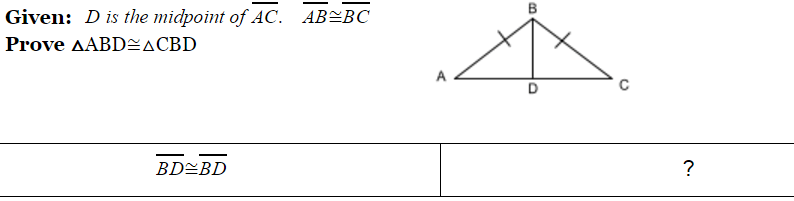
What is the justification (reason)?
a)
reflexive property
b)
definition of segment bisect
c)
definition of a midpoint
d)
substitution property
129.
What is the reason?
a)
Definition of Complementary
b)
Definition of 180 
c)
Definition of supplementary
d)
Angle Addition
130.
Which property justifies the next step?
a)
Segment addition postulate
b)
Definition of an angle bisector
c)
Angle addition postulate
d)
Definition of right angles
131.
Identify the  missing statement or reason
a)
Reflexive Property
b)
Definition of Midpoint
c)
Given
d)
Vertical Angles Theorem
132.
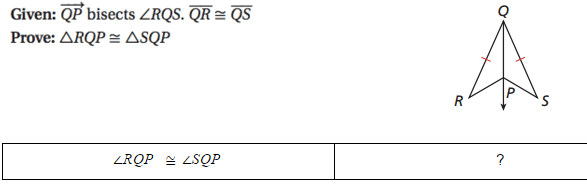
Identify the  missing statement or reason
a)
Given
b)
Vertical Angles Theorem
c)
Definition of Angle Bisector
d)
Alternate Interior Angles Theorem
133.
Fill in the missing proofs.
a)
Transitive Property, SAS(Side-Angle-Side)
b)
Reflexive Property, SAS(Side-Angle-Side)
c)
Reflexive Property, Vertical Angles Thm.
d)
Transitive Property, SSS(Side-Side-Side)
134.
What is the "reason" for step 5 of the proof?
a)
Vertical Angle Theorem
b)
proof
c)
def. of angle bisector
d)
CPCTC 
135.
What is the "statement" for step 3 of the proof?
a)
HA=HA
b)
HA=AH
c)
MA=AM
d)
MA=MA
136.
What is the "reason" for step 4 of the proof?
a)
proof
b)
AAS
≅ Thrm
c)
ASA
≅ Thrm
d)
SAS
≅ Thrm
137.
What is the "statement" for step 2 of the proof?
a)
∆BAC≅∆DAC
b)
BC=DC
c)
∡B≅∡D
d)
∡BAC≅∡DAC
138.
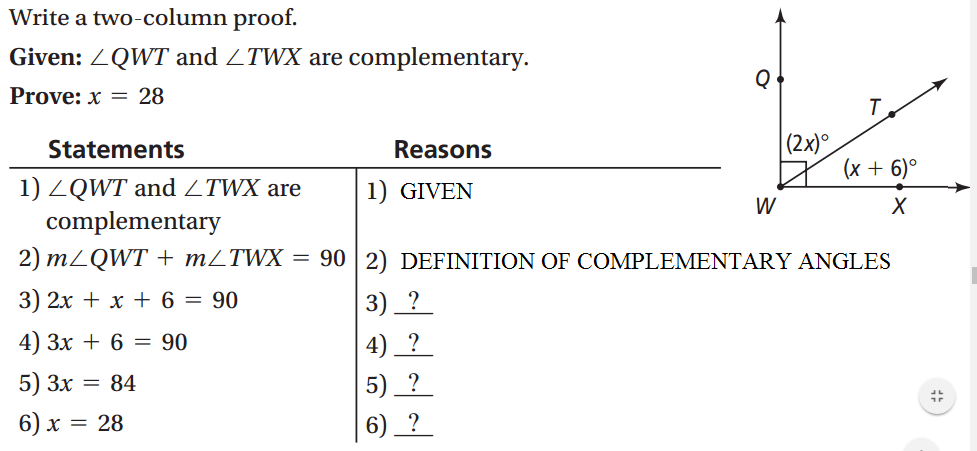
What is the REASON for Statement #3?
a)
Given
b)
Definition of Complementary Angles
c)
Substitution Property
d)
Reflexive Property of Congruence
139.
Which is an example of transitive property?
a)
If a=b and b=m, then a = m.
b)
If a=b then b=a.
c)
Given a number a, a=a
d)
If a=5, then 3a-5 = 3(5)-5