wayground logo

Free Printable Worksheets

Font size

S
M
L
XL
Worksheets

FGCL ss1 (Kinematic 1)

Total questions: 90

Worksheet time: 1hrs 24mins

Name
Class
Date
1.
What is velocity?
a)
the quickness of an object
b)
the location of an object
c)
acceleration
d)
speed in a specific direction
2.
What is the formula to calculate speed?
a)
S = t/d
b)
S = d/t
c)
S = d x t
d)
S = t x d
3.
What is speed?
a)
how far you go
b)
how much distance is covered over a period of time
c)
how fast you accelerate
d)
the change in the location of a object
4.
A change in velocity over time is known as:
a)
acceleration
b)
constant speed
c)
average speed
d)
displacement
5.
Velocity is both ____ and _____. 
a)
speed , direction 
b)
direction, mass
c)
volume, density 
d)
direction, magnitude 
6.
The unit we use to measure acceleration is ___. 
a)
meters / second 
b)
meters 
c)
seconds 
d)
meters / second / second 
7.
The speedometer on your car tells you
a)
average velocity
b)
instantaneous velocity
c)
average speed
d)
instantaneous speed
8.
What is this graph representing?
a)
Constant Speed
b)
Acceleration (speeding up)
c)
Deceleration (slowing down)
d)
No motion
9.
What two measurements are necessary for calculating speed?
a)
Mass and time
b)
Temperature and mass
c)
Mass and distance
d)
Distance and time
10.
At 60 seconds, how far had this object traveled? 
a)
0 m
b)
10 m
c)
20 m
d)
40 m
11.
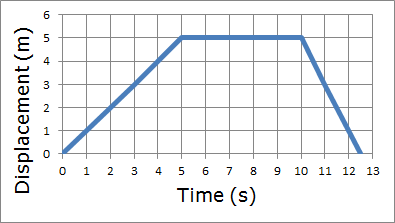
What is the person doing from 5 seconds to 10 seconds?
a)
Walking 
b)
Running
c)
Standing Still 
d)
Walking Fast
12.
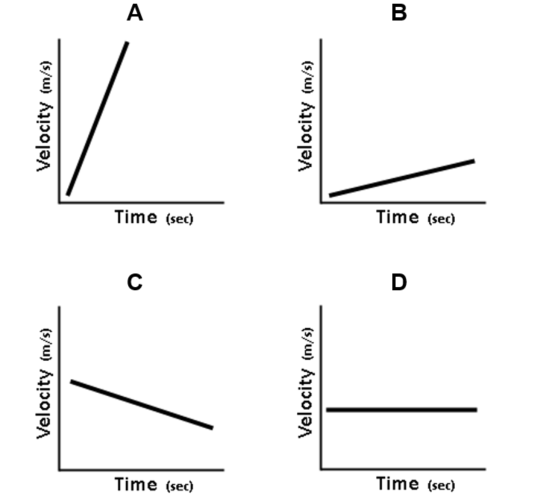
Which graph represents zero acceleration (constant velocity)?
a)
A
b)
B
c)
C
d)
D
13.
You run from your house to a friend's house that is 3 km away. You then walk home. The distance you traveled is 6 km. What is your displacement? 
a)
6  km
b)
0 km
14.
The fastest trains are magnetically levitated above the rails to avoid friction (and are therefore called
MagLev trains...cool, huh?). The fastest trains travel about 250 km in a half an hour. What is their
average speed in km/hour?
a)

250 km/hr

b)

500 km/hr

c)

125 km/hr

d)

1000km/hr

15.
A hummingbird averages a speed of about 45 km/hour (Cool facts: They visit up to 1000 flowers per day, and reach maximum speed, while diving, up to 160 km/hour!). Ruby-throated hummingbirds take a non-stop trip across Gulf of Mexico in which they fly for 18 hours straight! How far is the trip across the Gulf of Mexico at their average speed?
a)
810 km
b)
2.5 km
c)
3.6 km
d)
360 km
16.
A car slows down from +32 m/s to +8 m/s in 4 s. The acceleration is 
a)
6 m/s/s opposite the motion
b)
2m/s/s in the direction of motion
c)
8 m/s/s opposite the motion
17.
A cheetah travels 75 m in 3 s. What is her velocity over the interval?
a)

225 m/s

b)

25 m/s 

c)

0.04 m/s

d)

72m/s

18.

Which of the following terms describes a Vector and it's proper units?

a)

position in seconds

b)

distance in meters

c)

speed in hours

d)

velocity in m/s

19.

A car is traveling south for 250 meters over the course of 100 seconds. What was the car's average velocity?

a)

0.4 m/s south

b)

0.4 m/s

c)

2.5 m/s

d)

2.5 m/s south

20.

Horse A is running East at a speed of 6 m/s. Horse B is running at a speed of 8 m/s East as it passes Horse A. What is Horse B's velocity relative to Horse A?

a)

14 m/s

b)

-2 m/s

c)

2 m/s

d)

48 m/s

21.
How long will it take a running horse to travel 260 m and attain a speed of 12 m/s from rest?
a)
1200 seconds
b)
1.2 hours
c)
43 Hours
d)
43 minutes
22.
A quantity that is ignorant of direction is referred to as a
a)
vector quantity
b)
scalar quantity
23.
A quantity that is has magnitude and  direction is referred to as a
a)
vector quantity
b)
scalar quantity
24.
An object can be moving for 10 seconds and still have zero displacement.
a)
True
b)
False
25.
You run from your house to a friend's house that is 3 km away. You then walk home. The distance you traveled is 6 km. What is your displacement? 
a)
6  km
b)
0 km
26.
A _________ quantity is completely described by magnitude alone. A _________ quantity is
completely described by a magnitude with a direction.
a)
vector, scalar
b)
scalar, vector
27.
Speed is a __________ quantity and velocity is a __________ quantity.
a)
scalar, vector
b)
vector, scalar
28.
An object is NOT accelerating if it is moving
a)
in a circle
b)
at constant velocity 
c)
at increasing speed
d)
only as influenced by gravity
29.
A car slows down from +32 m/s to +8 m/s in 4 s. The acceleration is 
a)
6 m/s/s opposite the motion
b)
2m/s/s in the direction of motion
c)
8 m/s/s opposite the motion
30.
An airplane accelerates down a runway at 3.20 m/s/s
for 8 s until it finally lifts off the ground.
Determine the velocity at take-off.
a)
0.4 m/s
b)
25.6 m/s
c)
2.5 m/s
31.
A cheetah travels 75 m in 3 s. What is her velocity over the interval?
a)
225 m/s
b)
25 m/s 
c)
0.04 m/s
32.
A cheetah travels 75 m in 3 s. Her velocity of 25 m/s over the interval is
a)
instantaneous
b)
average
33.
What is the basic unit for velocity?
a)
m/s2
b)
m
c)
N
d)
m/s
34.
Person X moves from A to B in 5 seconds. Person Y does it in 10 seconds. Person Y is moving with twice the speed as person X.
a)
True
b)
False
35.
Accelerating objects MUST be changing their speed.
a)
True
b)
False
36.
Which of the following does NOT explain acceleration?
a)
Speeding up
b)
Changing directions
c)
Slowing down
d)
Constant speed
37.
An object which is moving at constant speed in a circle has an acceleration.
a)
True
b)
False
38.
An object moving to the right AND speeding up has a rightward acceleration.
a)
True
b)
False
39.
Which of the following is NOT a unit for acceleration?
a)
m/s2
b)
cm/s2
c)
km/hr
d)
km/hr2
40.
What is the basic unit for force?
a)
m/s2
b)
m
c)
N
d)
m/s
41.
An object moving to the right AND slowing down has a rightward acceleration.
a)
True - it has rightward acceleration
b)
False - it has leftward acceleration
42.
A falling skydiver which has reached terminal velocity is considered to be in a state of free fall.
a)
True
b)
False
43.
n object that is free-falling is acted upon by the force of gravity alone.
a)
True
b)
False
44.
An object in free fall experiences an acceleration which is independent of the mass of the object.
a)
True
b)
False
45.
The acceleration due to gravity on Earth is...
a)
6.67 m/s2
b)
9.8 m/s2
c)
6.67 m/s
d)
9.8 m/s
46.
What is the basic unit for distance?
a)
m/s2
b)
m
c)
N
d)
m/s
47.
What is the basic unit for work?
a)
N
b)
m/s
c)
J
d)
s
48.

Velocity is...

a)

The rate of change of acceleration

b)

The rate of change of displacement

c)

The rate of change of distance

d)

The rate of change of speed

49.

What is the difference between a vector quantity and a scalar quantity?

a)

A scalar has a magnitude and direction and a vector has only a magnitude

b)

A vector has a magnitude and direction and a scalar has only a magnitude

c)

A scalar has a direction and a vector has a magnitude

d)

None of the above

50.

An unladen swallow flies 5 m/s. How far has the bird traveled after 1 min?

a)

5 m

b)

12 m

c)

120 m

d)

300 m

51.

Which of the following is a vector quantity?

a)

Velocity

b)

Acceleration

c)

Displacement

d)

All of the above

52.
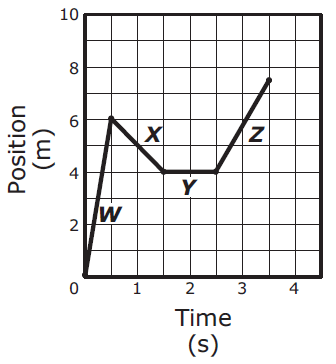
Motion sensors recorded the following data about a runner during a cross-country race. During which segment of the race did the runner have the greatest speed?
a)
W
b)
X
c)
Y
d)
Z
53.

What is the acceleration of an object moving at constant velocity?

a)

2 m/s2

b)

1 m/s2

c)

0 m/s2

d)

0.8 m/s2

54.

When velocity is negative and acceleration is negative, what happens to the object’s motion?

a)

The object slows down

b)

The object speeds up

c)

Nothing happens to the objects motion

d)

The object remains at rest

55.

A dolphin swims 1.85 km/hr. How far has the dolphin travelled after 0.6hr?

a)

1.1 km

b)

2.5 km

c)

0.63 km

d)

3.7 km

56.

A coin released from rest from the top of a tower hits the ground after 1.5 seconds. What is the speed of the coin as it hits the ground?

a)

15 m/s

b)

21 m/s

c)

31 m/s

d)

39 m/s

57.

The graph shows the position of a truck vs. time. According to the graph, the velocity of the truck is...

a)

increasing

b)

remaining constant

c)

decreasing

58.
The graph respresents
a)
no motion
b)
constant velocity
c)
increasing velocity
d)
decreasing velocity
59.

What is the person doing from 5 seconds to 10 seconds?

a)

Walking

b)

Running

c)

Standing Still

d)

Walking Fast

60.
According to the graph how far does the person travel in the first 5 seconds?
a)
2 m
b)
10 m
c)
0 m
d)
5 m
61.

What quantity is equal to the slope of this graph?

a)

Distance

b)

Displacement

c)

Acceleration

d)

Velocity

62.

An object is thrown into the air at 60 m/s, straight up. What is its velocity at the highest point?

a)

0 m/s

b)

-9.8 m/s

c)

60 m/s

d)

-60 m/s

63.
Scott travels north 5 miles and then goes west 3 miles before coming straight back south 2 miles. What is his distance?
a)
10
b)
7
c)
8
d)
6
64.

A race car starting from rest accelerates uniformly at a rate of 4.90 m/s2. What is the car's speed after it has traveled 200 meters?

a)

1960 m/s

b)

62.6 m/s

c)

44.3 m/s

d)

31.3 m/a

65.
A car is traveling at 21.0 m/s. It slows to a stop at a constant rate over 5.00 s. How far does the car travel during those 5.00 seconds before it stops? 
a)
4.20 m
b)
52.5 m
c)
105 m
d)
158 m
66.
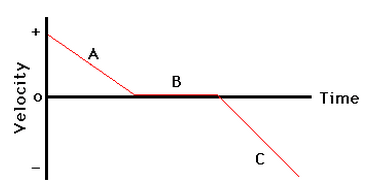
Describe the motion in segment C
a)
Slowing down;  Positive direction
b)
Slowing down;  Negative direction
c)
Speeding up;  Negative direction
d)
Constant velocity;  Negative direction
67.

A person already walking at 1 m/s takes 2 seconds to reach a top speed of 5 m/s. What is their acceleration?

a)

1 m/s^2

b)

2 m/s^2

c)

4 m/s^2

d)

6 m/s^2

68.

What is this distance vs time graph representing?

a)

Constant Speed

b)

Acceleration

c)

Deceleration (negative acceleration)

d)

No motion

69.

In the velocity time graph shown, what does the section of the graph below the time axis refer to?

a)

Object travelling downward

b)

Object traveling in the opposite direction to initial motion

c)

Object traveling upward

70.

What motion is represented by the speed-time graph?

a)

Travelling at constant speed, then decelerating.

b)

Accelerating, then decelerating.

c)

Accelerating, then travelling at constant speed.

d)

Traveling at constant speed, then stopping

71.

The height of an individual step on a staircase is closest to

a)

2.0 m

b)

2.0 cm

c)

20 cm

d)

20 mm

72.

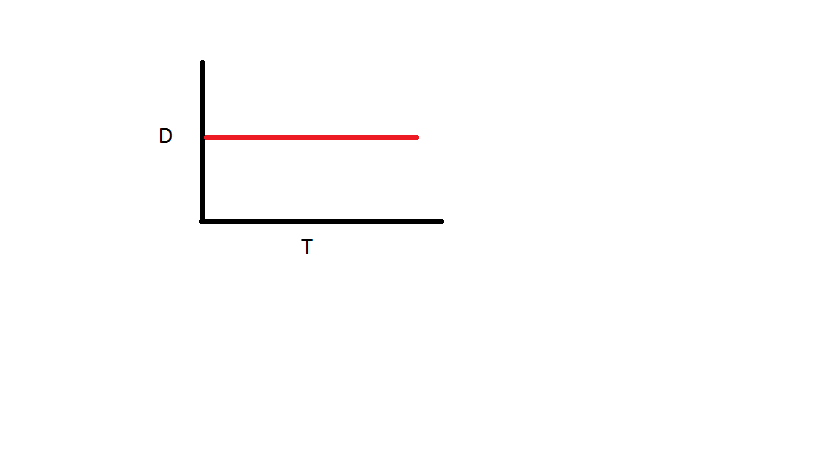
In this distance vs time graph what is happening at D?
a)
Stationary
b)
Accelerating
c)
Fast steady speed; moving away from the starting position
d)
Slower steady speed; moving away from the starting position
73.

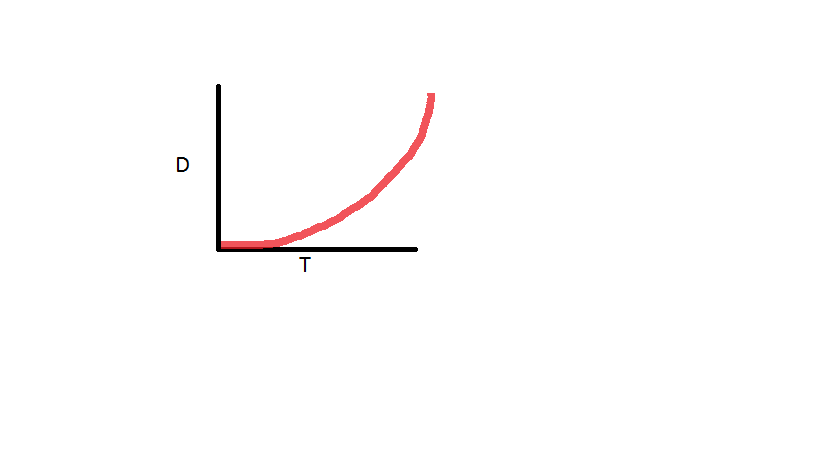
This distance vs time graph shows an object that is

a)

Moving at a constant speed

b)

Slowing down (decelerating)

c)

Speeding up (accelerating)

d)

Standing still

74.

This distance vs time graph shows an object that is:

a)

Moving at a constant speed

b)

Slowing down (decelerating)

c)

Speeding up (accelerating)

d)

Standing still (no motion)

75.

What is this distance vs time graph representing?

a)

Constant Speed

b)

Acceleration

c)

Deceleration (negative acceleration)

d)

No motion

76.

In the velocity time graph shown, what does the section of the graph below the time axis refer to?

a)

Object travelling downward

b)

Object traveling in the opposite direction to initial motion

c)

Object traveling upward

77.

In this distance vs time graph what is happening at D?
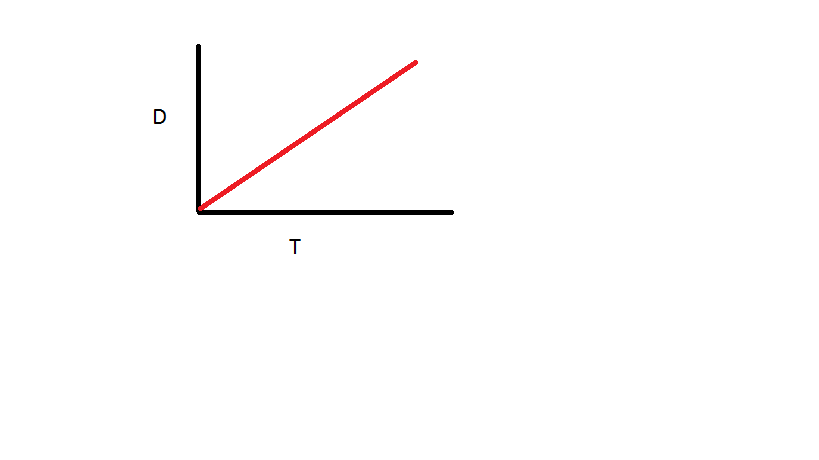
a)
Stationary
b)
Accelerating
c)
Fast steady speed; moving away from the starting position
d)
Slower steady speed; moving away from the starting position
78.
Which of the following is a unit for acceleration?
a)
km/s
b)
m/s2
c)
mi/hr
d)
ft
79.
Calculate the speed of a sprinter who ran 200 meters in 20 seconds.
a)
10m/s
b)
10km/s
c)
10m/hr
d)
10km/hr
80.

This distance vs time graph shows an object that is:

a)

Moving at a constant speed

b)

Slowing down (decelerating)

c)

Speeding up (accelerating)

d)

Standing still (no motion)

81.

Choose the correct equation to use for the following problem:

"Baba Ajasco accelerates from rest at a rate of 3.6 m/s2. How long did he run if his final speed is 16 m/s?"

a)

v=u+atv=u+at  

b)

  s=ut+12at2s=ut+\frac{1}{2}at^2

c)

  v2=u2+2asv^2=u^2+2as

d)

none of the above

82.


Choose the correct equation to use for the following problem:

"Miss Kpekpeye is jogging at 5 m/s. Suddenly, a bulldog! she speeds up to 9 m/s in 0.85 seconds. What was her acceleration?"

a)

v=u+atv=u+at  

b)

s=ut+12at2s=ut+\frac{1}{2}at^2

c)

v2=u2 +2asv^2=u^{2\ }+2as

d)

none of the above s=12(v+u)×ts=\frac{1}{2}\left(v+u\right)\times t

83.

Choose the correct equation to use for the following problem:

"Garuba jogs at an average pace of 8.5 m/s. How far can he run in 120 s?"

a)

v=u+atv=u+at  

b)

  s=ut+12at2s=ut+\frac{1}{2}at^2

c)

  v2=u2+2asv^2=u^2+2as

d)

s=12(v+u)×ts=\frac{\text{1}}{\text{2}}\left(v+u\right)\times t

84.
A quantity that is ignorant of direction is referred to as a
a)
vector quantity
b)
scalar quantity
85.
What is the formula to calculate speed?
a)

v=tsv=\frac{t}{s}

b)

v=stv=\frac{s}{t}

c)

v=s×tv=s\times t

d)

v=s×t2v=s\times t^2

86.
A change in velocity over time is known as:
a)
acceleration
b)
constant speed
c)
average speed
d)
displacement
87.

It's the change of position, from the starting point to the ending point, it always has direction.

a)

Distance

b)

Displacement

c)

Speed

d)

Velocity

88.
An object  accelerates at 2  m/s^2. Assuming the object starts from rest, how much time does it need to accelerate to a speed of 16  m/s?
a)
4 s
b)
8 s
c)
16 s
d)
1/16 s
89.
A golf ball starts with a speed of 2 m/s and slows at a constant rate of 0.5 m/s2, what is its velocity after 2 s?
a)
0 m/s
b)
0.5 m/s
c)
1 m/s
d)
1.5 m/s
90.
How much time would it take for an object to fall 4.7 meters?
a)
0.959 s
b)
4.79 s
c)
0.979 s