
 Worksheets
Unit 3A Review-IMF and Ideal Gas
Total questions: 65
Worksheet time: 56mins
Determine the number of moles in a container of gas at 1 atm with a volume of 99.2 L and a temperature of 100K.
12 mol
120 mol
10 mol
100 mol
6.85 mol
0.007 mol
6.9 mol
0.0069 mol
0 K
107 K
207 K
310. K
PV=nRT
14 atm
16.53 atm
14.19 atm
22.54 atm
If pressure is held constant and "n" increases what happens to T?
Increases
Decreases
Unchanged
"n" and T have a(an) _________ relationship.
Inverse
Direct
P and V have a(an) ________ relationship.
Inverse
Direct
"n" and V have a(an) ________ relationship.
Inverse
Direct
A direct relationship means as one increases the other _________.
Increases
Decreases
An inverse relationship states that as one variable decreases the other __________.
Increases
Decreases
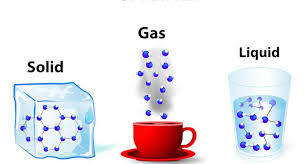
Adding heat to a solid makes the particles move...
Particles in a solid are not moving
Slower
At the same rate as before the heat was applied
Faster
The particles in a gas are ______ away from each other than the particles in a solid
farther
closer
the same distance

This one is tricky!
The temperature of each flask is given in Kelvin (K). Think about how temperature affects the motion of gas particles. Now think about what causes gas pressure....
Which of the following statements is correct?
Flask 1 has the lowest pressure
Flask 3 has the lowest pressure
Flask 2 has the lowest pressure
Flask 4 has the lowest pressure
Which among the following is NOT true regarding the Kinetic Molecular Theory of gases?
Gases particles move in straight lines.
Gas particles are closely packed and their motion is orderly.
Gas particles are in constant motion.
Gas particles do not attract or repel each other.

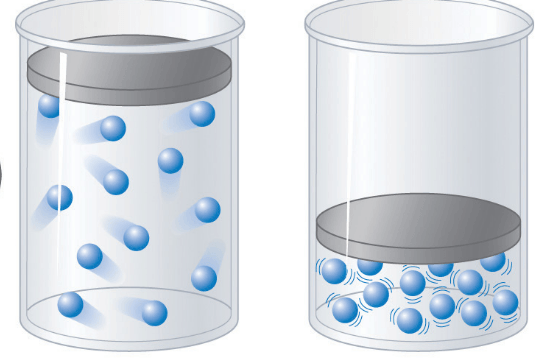
Which type of motion in the figure best represents the movement of gas particles?
Motion 1
Motion 2
Motion 3
Motion 4

Which of the following statements is true?
Gases do not move in straight line
Gas particles are spaced so far apart that most of the volume of gas is empty space
Gas particles are not in constant motion
Gas particles attract each other

The pressure of each flask is given in atmospheres (atm). Flask 1 has the lowest pressure, and Flask 4 has the highest. Knowing what causes gas pressure, which of the following statements is true?
Flask 1 contain the most molecules
Flask 2 contain the most molecules
Flask 3 contain the most molecules
Flask 4 contain the most molecules
The energy of motion is known as ___.
potential energy
kinetic energy
mechanical energy
Gas pressure is caused by ______.
gravity.
gas molecules colliding with each other.
gas molecules colliding with surfaces of the container.
gas molecules reacting with each other.
What happens to matter as its temperature increases?
The average kinetic energy of its particles decreases
The average thermal energy of its particles decreases
The particles gain kinetic energy
The particles lose potential energy
Which substance would have the weakest intermolecular forces of attraction?
CH4
NaCl
H2O
MgF2

Intermolecular forces for: NH3
Dispersion Force
Dipole dipole
Hydrogen bonding
The weaker the intermolecular forces of a substance the _____________ the boiling point
higher
lower

Intermolecular forces for: CO2
Dispersion Force
Dipole dipole
Hydrogen bonding

Intermolecular Forces are the forces that exist
Between two or more molecules
Within a single molecule
Only in molecules containing carbon
In all molecules
Examples of an intermolecular force include
london disperson
hydrogen bonding
dipole dipole
all of the above
For hydrogen bonding to occur, a molecule must have a hydrogen bonded to
carbon
another hydrogen
Fluorine, Chlorine or Oxygen
Fluorine, Nitrogen or Oxygen
Type of intermolecular force present in I2, Br2, and Cl2.
dipole dipole
H-bond
London dispersion
metallic
Does NH3 or PH3 have a higher boiling point?
(Hint: identify the types of IMF's present for each)
NH3 because it has the strongest IMF's
PH3 because it has the strongest IMF's
NH3 because it has the weakest IMF's
PH3 because it has the weakest IMF's
In general, substances with stronger intermolecular forces have ________ boiling points than those with weaker forces
Higher
Lower
The same
Which substance has the weakest intermolecular forces?
Substance A, boiling point of 75 °C
Substance B, boiling point of 105 °C
Substance C, boiling point of 25 °C
Substance d, boiling point of 45 °C
The intermolecular force present in all matter is
Hydrogen Bonding
Ionic Bonding
Dipole-Dipole
London or Dispersion
The strongest IMF is
London/Dispersion
Dipole-Dipole
Hydrogen Bonding
The weakest IMF is
Dipole-Dipole
Dispersion
Hydrogen Bonding
To form a hydrogen bonding, Hydrogen needs to attract to the highly electronegative elements such us _____, _____, and ____
chlorine, fluorine, and oxygen
fluorine, oxygen, and sulfur
fluorine, bromine, and oxygen
fluorine, oxygen, and nitrogen
Dipole-Dipole forces are stronger than _______ and weaker than _________ interactions.
london dispersion, ion-dipole
hydrogen bonding, london dispersion
ion-dipole, london dispersion
Hydrogen bonding is a special case of __________.
london dispersion
ion-dipole
dipole-dipole
Which of the following has the lowest boiling point?
PH3
H2O
SiH4
NH3
Which of these has ONLY London forces?
I2 (nonpolar)
NH3 (polar)
OCl2 (polar)
HCl (polar)

What intermolecular forces will be found between two of the molecules shown?
dispersion forces only
dispersion forces, dipole-dipole forces and hydrogen bonding
dispersion forces and dipole-dipole forces
dispersion forces and hydrogen bonding

What intermolecular forces will be found between two of the molecules shown?
dispersion forces only
dispersion forces and dipole-dipole forces
dispersion forces, dipole-dipole forces, and hydrogen bonding
hydrogen bonding only

What types of intermolecular forces will be present between two molecules of acetone?
Dispersion forces only
dipole-dipole forces & dispersion forces
dispersion forces, dipole-dipole forces, and hydrogen bonding
dispersion forces and hydrogen bonding
Intermolecular force resulting from the attraction of partial positive and negative charges on polar molecules.
dispersion force
dipole-dipole force
hydrogen bonding

