wayground logo

Free Printable Worksheets

Font size

S
M
L
XL
Worksheets

Geometry Final Study

Total questions: 100

Worksheet time: 5hrs 9mins

Name
Class
Date
1.

How many squares are in Figure 4?

a)

10

b)

11

c)

12

d)

13

e)

14

2.
What is the rule for this pattern?
32,36,40,44
a)
add 4
b)
multiply 2
c)
subtract 4
d)
divide by 2
3.
What number belongs in the blank?
18,24,___,36,42
a)
28
b)
31
c)
30
d)
35
4.

Which number is a counterexample to the following statement?
For all numbers a, 2a + 7 17\le17  

a)

a = 6

b)

a = 0

c)

a = 5

d)

a = 1

5.

Use the table to figure out the sum of the first 50 positive even integers.

2 = 2 = 1 * 2

2 + 4 = 6 = 2 * 3

2 + 4 + 6 = 12 = 3 * 4

2 + 4 + 6 + 8 = 20 = 4 * 5

2 + 4 + 6 + 8 + 10 = 30 = 5 * 6

(a)  

6.
Which figure will this net make?
a)
Rectangular Prism 
b)
Triangular Prism
c)
Triangular Pyramid 
d)
Cube
7.
Is this an orthographic or isometric drawing?
a)
Orthographic
b)
Isometric
8.

How many cubes would you need to make this figure?

(a)  

9.

Another name for line k

a)

DB\overleftarrow{D}\overrightarrow{B}

b)

DE\overleftarrow{D}\overrightarrow{E}  

c)

EC\overleftarrow{E}\overrightarrow{C}  

d)

ED\overleftarrow{E}\overrightarrow{D}  

e)

plane MM  

10.

A plane containing \cdot A

a)

plane DFA

b)

plane DEF

c)

plane j

d)

plane M

e)

plane BEC

11.

intersection of l and m

a)

\cdot H

b)

\cdot E

c)

plane Q

d)

FE\overleftarrow{F}\overrightarrow{E}

e)

\cdot D

12.

another name for plane Q

a)

FGI

b)

m

c)

FG

d)

plane P

e)

FEG

13.

Fill in the blank


Skew lines ___________ intersect.

a)

sometimes

b)

never

c)

always

d)

what?!

14.

.

.

.

What is the name of this ray?

a)

Ray AB

b)

Ray BA

c)

Ray ABC

d)

Ray AC

15.
Find measurement for PR.
a)
9
b)
1
c)
-1
d)
3
16.
Find measurement for QT.
a)
10
b)
6
c)
-10
d)
2
17.
If GH = 31 and HI = 11, then GI =?
a)
20
b)
11
c)
42
d)
16
18.
GH = 7y + 3, HI = 3y - 5, and GI = 9y +7. What is the value of y?
a)
9
b)
10
c)
-1
d)
2
19.
What is this tool called and what is it used for?
a)
A ruler used to measure lines.
b)
A protractor used to measure lines.
c)
A ruler used to measure angles.
d)
A protractor used to measure angles.
20.
What is the measure of the angle shown in the picture?
a)
30 degrees
b)
35 degrees
c)
140 degrees
d)
145 degrees
21.
Tell whether the angles are complementary or supplementary. Then find the value of x.
a)
Complementary; x=25
b)
Complementary; x=5
c)
Supplementary; x=25
d)
Supplementary; x=5
22.

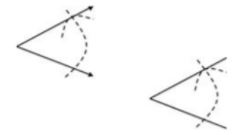
The given diagram is what kind of construction?

a)

Perpendicular bisector

b)

Congruent angles

c)

Angle bisector

d)

Congruent line segments

23.

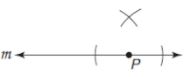
What is being constructed in the figure?

a)

the perpendicular bisector of line m

b)

the line perpendicular to line m through a point on the line

c)

the line parallel to line m through a point NOT on the line

d)

an angle that has line m as its bisector

24.

What does the word BISECT mean?

a)

To cut something into more than five pieces.

b)

It is a plane with two sets of wings.

c)

A shape that has three sides.

d)

To cut something into two congruent pieces or in half.
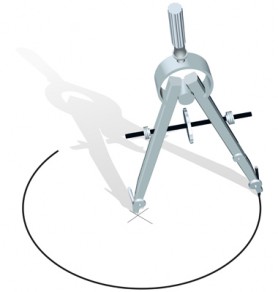
25.
What is this?
a)
Compass
b)
Circle creator
c)
Pencil swingy-thing
d)
Arc maker
26.
What is the midpoint between (3, -1) and (7, -5)
a)
(5, -2)
b)
(10, -6)
c)
(5, -3)
d)
(2, -2)
27.

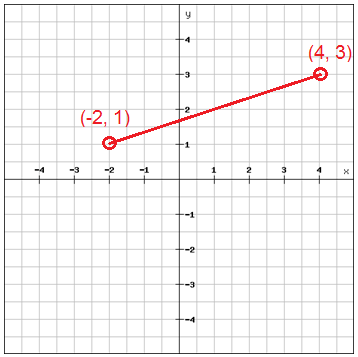
Find the midpoint:

a)


(3,1)\left(3,-1\right)

b)

(1,3)\left(-1,3\right)

c)

(3,4)\left(3,4\right)

d)

(4,3)\left(4,3\right)

28.

Find the other endpoint of the line segment with the given endpoint and midpoint. Endpoint: (-9, -5) Midpoint: (-9, 0)

a)

(-7.5, -8)

b)

(-7, -4.5)

c)

(0, -2.5)

d)

(-9, 5)

29.

Find the y-coordinate of the midpoint of the line

(a)  

30.
Find the distance between (-5, -8) and (-1, -16).
a)
8.9
b)
9.8
c)
10.3
d)
11
31.
Find the distance between (3, 24) and (7, 56).
a)
32.1
b)
32.2
c)
32.3
d)
32.4
32.
Find the distance between (-4, 5) and (7, 18).
a)
15.96
b)
16.08
c)
16.23
d)
17.03
33.

What is the distance between (2,9) and (1,5)?

(a)  

34.

Find the perimeter of the shape.

a)

27 ft.

b)

40 ft.

c)

27 ft.

d)

54 ft.

35.
What is the diameter?
a)
5 in
b)
10 in
c)
3.14 in
d)
15.84 in
36.
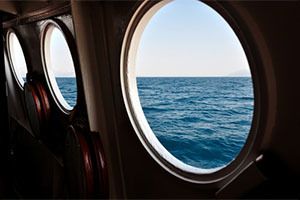
A cruise ship has a large, circular window. It has a diameter of 6 meters. What is the window's area?
a)
31.25 m2
b)
29.55 m2
c)
30.36 m2
d)
28.26 m2
37.

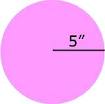
Find the circumference. Round to the nearest tenth.

(a)  

38.
Name the angle relationship.
a)
Alternate Interior
b)
Alternate Exterior
c)
Corresponding
d)
Vertical Angles
39.
Name the angle relationship.
a)
Alternate Interior
b)
Alternate Exterior
c)
Corresponding
d)
Vertical Angles
40.
Name the angle relationship.
a)
Same Side Interior
b)
Alternate Interior
c)
Vertical Angles
d)
Linear Pairs
41.
Name the angle relationship.
a)
Same Side Interior
b)
Corresponding
c)
Alternate Interiors
d)
Linear Pairs
42.
What is the value of x?
a)
22
b)
26
c)
24
d)
23
43.
What is the measure of ∠ABC?
a)
25°
b)
75°
c)
108°
d)
150°
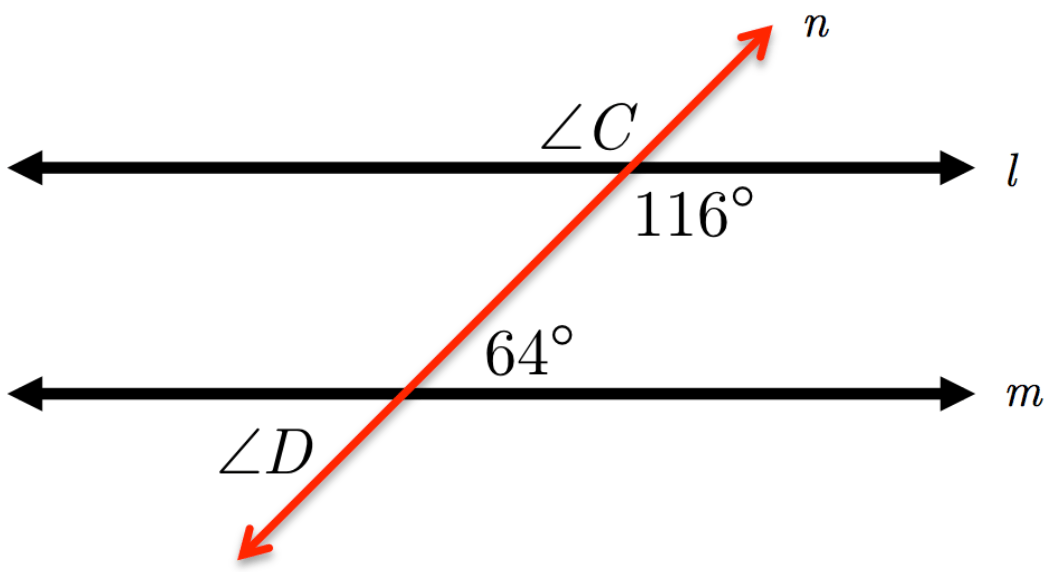
44.
Find D
a)
∠D=116°
b)
∠D=64°
c)
∠D=180°
d)
∠D=26°
45.
Solve for x.
a)
41
b)
-41
c)
-9
d)
-21
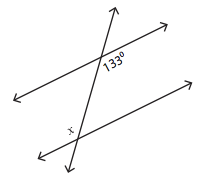
46.

Find the value of x.

a)

x = 133

b)

x = 47

c)

x = 180

d)

x = 90

47.
What is the third angle of a triangle whose 1st angle is 34 and 2nd angle is 101?
a)
32
b)
39
c)
45
d)
54
48.
What is the measure of angle b?
a)
36o
b)
56o
c)
63o
d)
117o
49.
Solve for x.
a)
7
b)
9
c)
-11
d)
-8
50.
Find the slope of the line that passes through:
(5, -10) and (5, -4)
a)
undefined
b)
0
c)
- 14/10
d)
10/14
51.
Find the slope of the line that passes through:
(-4, 7) and (-6, -4)
a)
2/11
b)
13/2
c)
3/10
d)
11/2
52.
Find the slope
a)
-5/3
b)
-3/5
c)
5/3
d)
3/5
53.
Which equation represents the following graph?
a)
y = 3x + 2
b)
y = -2x + 3
c)
y = 2x + 3
d)
y = -3x + 2
54.
Write an equation  
m = -1/2 through (-2, 4)
a)
y = -3/2x + 3
b)
y = 3/2x + 3
c)
y = -1/2x + 3
d)
y = 3x - 3/2
55.

What is the equation of the red graph pictured?

a)

y = -1

b)

x = -1

c)

y = 1

d)

x = 1

56.

If a line has a slope of -5/6 a line that is parallel has a slope of what?

a)

-5/6

b)

6/5

c)

5/6

d)

-6/5

57.

If a line has a slope of 2/3 a line that is perpendicular has a slope of what?

a)

-3/2

b)

3/2

c)

2/3

d)

-2/3

58.

Which of the following lines is PARALLEL to the graph of 5x + 2y = 8?

a)

2x + 5y = 8

b)

5x - 2y = 6

c)

-10x - 4y = 7

d)

-10x + 4y = 9

59.

Which of the following represents the equation of the line passing through (-4, 5) PERPENDICULAR to the line y = -1/2x + 5/2?

a)

y = 2x + 13

b)

y = 2x + 5

c)

y = -1/2x + 3

d)

y = -1/4x + 11/2

60.

Which drawing is a construction of the perpendicular line to  QR\overline{QR}   from S?

a)
b)
c)
d)
61.
A transformation in which a graph or geometric figure is picked up and moved to another  location without any change in size or orientation.
a)
Translation
b)
Rotation
c)
Reflection
d)
Dilation
62.
Determine where X' would be if you translated X 3 units to the left and 9 units down.
a)
(-4, 4)
b)
(-10, 2)
c)
(-4, -5)
d)
(-1, 5)
63.
What does a translation do to a figure on the coordinate plane?
a)
Rotates it
b)
Flips it
c)
Shrinks it
d)
Slides it
64.
How is trapezoid ABCD translated to trapezoid A'B'C'D'?
a)
Translated 5 units to the right and 5 units down
b)
Translated 8 units to the right and 5 units down
c)
Translated  5 units to the right and 8 units down
d)
Translated 4 units to the right and 5 units down 
65.

Translate the blue shape to the green shape...

a)

3 Left

3 Down

b)

3 Right

3 Up

c)

2 Right

3 Up

d)

2 Left

3 Down

66.
How would you translate point P to P'?
a)
Translate 2 units to the right and  8 units down
b)
Translate 3 units down and 2 units to the right
c)
Translate 4 units down and 4 units to the left
d)
Translate 8 units to the right and 2 units down
67.
How is triangle ABC being translated to triangle A'B'C'?
a)
up 3, left 8
b)
up 9, left 4
c)
down 3, right 8
d)
down 9, right 4
68.
How many degrees was the figure rotated?
a)
90 degrees counterclockwise 
b)
180 degrees
c)
90 degrees clockwise
69.
If you were to rotate ABCD 180°  about the origin, what would the coordinate of A' be?
a)
(-5, 5)
b)
(-3, -5)
c)
(-5, 3)
d)
(-3, 3)
70.
If you were to rotate ABCD 90° counterclockwise about the origin, what would the coordinate of A' be?
a)
(-5, 5)
b)
(-3, 5)
c)
(-5, 3)
d)
(-3, 3)
71.
If you were to rotate ABCD 180° about the origin, what would the coordinates of B' be?
a)
(0, 0)
b)
(-6, -5)
c)
(-1, 3)
d)
(-6, 2)
72.
What is the angle of rotation for this counterclockwise rotation about the origin?
a)
90°
b)
180°
c)
270°
d)
360°
73.
Rotate the point (-3,-4) around the origin 180 degrees. State the image of the point.
a)
(-4,-3)
b)
(-4,3)
c)
(4,-3)
d)
(3,4)
74.
The image A'B'C' is a rotation of ABC.
a)
True
b)
False
75.
How many degrees was the figure rotated?
a)
90 degrees counterclockwise 
b)
180 degrees
c)
90 degrees clockwise
76.

Triangle A is rotated 90° clockwise with the origin as the center of rotation to create a new figure. Which triangle shows the new location?

a)

A

b)

B

c)

C

d)

D

77.
Rotate the point (7,8) around the origin 90 degrees counterclockwise.
State the image of the point.
a)
(-7,-8)
b)
(8,-7)
c)
(-8,7)
d)
(8,7)
78.
Rotate the point (-5,8) around the origin 270 degrees counterclockwise. State the image of the point.
a)
(-8,5)
b)
(8,-5)
c)
(8,5)
d)
(5,-8)
79.
Rotate the point (5,5) around the origin 180 degrees counterclockwise. State the image of the point.
a)
(5,-5)
b)
(5,5)
c)
(-5,5)
d)
(-5,-5)
80.
How many degrees was the figure rotated?
a)
90 degrees counterclockwise 
b)
180 degrees
c)
270 counterclockwise 
d)
90 degrees clockwise
81.
Rotate the point (-3,-4) around the origin 180 degrees clockwise. State the image of the point.
a)
(-4,-3)
b)
(-4,3)
c)
(4,-3)
d)
(3,4)
82.
Reflect (6, -3) over the line x-axis.
a)
(6, 3)
b)
(-6, -3)
c)
(-3, 6)
d)
(3, -6)
83.

Which diagram shows a reflection across the x-axis?

a)

D

b)

C

c)

B

d)

A

84.

What is a reflection?

a)

When you turn an object around a point.

b)

When you slide an object form one place to another.

c)

When you flip or mirror an object across a line.

d)

When you resize an object.

85.

True or False: When a point is reflected across a line of symmetry, it remains the same distance from that line.

a)

True

b)

False

86.

What changes when an ordered pair is reflected across the y-axis?

a)

Neither the x-value nor the y-value

b)

y-value only

c)

x-value only

d)

Both the x-value and the y-value

87.
Which of the following is NOT preserved with a reflection?
a)
Angle measurement
b)
Distance between points
c)
Orientation
d)
Shape
88.
∆QRS contains the points: Q(4, 2) R(5, 1) S(3,7). If the triangle is reflected across the y-axis, what will S' be?
a)
S'(3, 7)
b)
S'(-3, 7)
c)
S'(-3, -7)
d)
S'(3, 7)
89.
Reflect Point C over the y-axis:
a)
(-3, 2)
b)
(3,2)
c)
(-2,3)
d)
(3,0)
90.
What is the rule for the following reflection? 
a)
Reflection across       y = −2
b)
Reflection across        y = 2
c)
Reflection across            x = 2
d)
Reflection across          x =  −2
91.
What is the rule for the following reflection? 
a)
Reflection across      x-axis
b)
Reflection across        y-axis
c)
Reflection across            y = x
d)
Reflection across          y = −x
92.
What scale factor was used to produce the image?
a)
2
b)
3
c)
1/3
d)
1/2
93.
What scale factor was used to produce the image?
a)
2
b)
-2
c)
1/2
d)
1
94.
State the coordinate of the image of the given point B (-10,-6) under a dilation with center at the origin with the given scale factor k = 1/2.
a)
(5,3)
b)
(20,12)
c)
(-20,-12)
d)
(-5,-3)
95.
State the coordinate of the image of the given point B (4,9) under a dilation with center at the origin with the given scale factor r = 2.
a)
(2,4.5)
b)
(-8,-18)
c)
(8,18)
d)
(9,4)
96.
The point (8, 12) was dilated to become point (2, 3). What was the scale factor?
a)
½
b)
¼
c)
4
d)
2
97.
When a dilation has a scale factor greater than one, the dilation is an enlargement.
a)
True
b)
False
98.
When the scale factor of a dilation is less than one, the dilation is a reduction.
a)
True
b)
False
99.

Dilation changes a shape's __________?

a)

Size

b)

Position

c)

Form

d)

Orientation

100.

Where is the Center of Dilation?

a)

(0, 0)

b)

(4.5, 5.5)

c)

(3, 2)

d)

(6.5, 4)