wayground logo

Free Printable Worksheets

NEW

Font size

S
M
L
XL
Worksheets

Classification and Taxonomy Digital Worksheet

Total questions: 52

Worksheet time: 49mins

Name
Class
Date
1.
Which domain is capable of living in extreme environments like hot springs, geysers, or very salty waters?
a)
Bacteria
b)
Archaea
c)
Eukarya
2.
Which domain includes all animals and plants?
a)
Archaea
b)
Eukarya
c)
Bacteria
3.

bacteria belong to which domain?

a)

Eukarya

b)

Prokarya

c)

Archaea

d)

Bacteria

4.
Which kingdoms have some organisms that can make their own food (autotrophic)?
a)
Plantae and Animalia
b)
Fungi and Plantae
c)
Protista and Plantae
5.

What is binomial nomenclature (naming)?

a)

A two headed turtle

b)

A two name naming system

c)

A two grouped system to classify

d)

A microscope with two lenses.

6.
What taxa are in a scientific name?
a)
Genus and Kingdom
b)
Species and Family 
c)
Species and Class
d)
Genus and Species
7.

What is the science of organizing, classifying and naming living things?

a)

taxification

b)

taxadermy

c)

taxonomy

d)

toxicology

8.

In a properly written scientific name, which part is written entirely in lowercase?

a)

species

b)

genus

c)

phylum

d)

family

9.
In the 8 levels of classification which level is the broadest category? 
a)
Kingdom
b)
Family
c)
Species
d)
Domain
10.
Things that are classified together ___________.
a)
are not related to each other.
b)
share a similar evolutionary history.
c)
are larger organisms.
d)
have a different evolutionary history
11.
Who organized living things based on shared characteristics and created a system for assigning scientific names?
a)
Carolus Linnaeus
b)
Robert Hooke
c)
Anton van Leeuwenhoek
d)
James Watson
12.
What are the 8 levels of classification of living things from most general to most specific?
a)
domain, kingdom, phylum, class, order, family, genus, species
b)
domain, kingdom, class, phylum, order, family, genius, species
c)
domain, kingdom, family, class, order, family, genus, species
d)
domain, king, phillip, class, order, family, genus, species
13.
Organisms that belong to the same _________ share the MOST DNA.
a)
family
b)
kingdom
c)
genus
d)
species
14.

Which organism is most closely related to Quercus rubrum?

a)

Acer rubrum

b)

Quercus macrophylla

15.

Which of the following taxa contain the fewest members?

a)

phyllum

b)

family

c)

genus

d)

class

16.

What is the subdivision of a kingdom called?

a)

phylum

b)

class

c)

order

d)

family

17.

The smallest, most specific classification category is called...

a)

genus

b)

species

c)

taxonomy

d)

kingdom

18.

What is the science of grouping and naming organisms?

a)

binomial nomenclature

b)

taxonomy

c)

dichotomous key

19.

What is the two-name system of classification called?

a)

species

b)

phylum

c)

taxonomy

d)

binomial nomenclature

20.

What are the eight major classification groups from most broad to most specific?

a)

class, kingdom, order, family, species, genus, domain

b)

domain, kingdom, class, phylum, family, order, genus, species

c)

kingdom, phylum, class, order, domain, family, species, genus

d)

domain, kingdom, phylum, class, order, family, genus, species

21.

The current method to classify organisms by means of binomial nomenclature was developed by...

a)

Aristotle

b)

Linnaeus

22.

Which choice shows the correct way to write the scientific name for a tiger?

a)

Panthera Tigris

b)

panthers tigris

c)

Panthero leo

d)

Panthera tigris

23.

Which of the following is the most specific level of classification?

a)

Order

b)

Kingdom

c)

Genus

d)

Species

24.

Which of the following is the broadest level of classification?

a)

Kingdom

b)

Domain

c)

Class

d)

Family

25.
Scientific names are written using which two levels of classification?
a)
Kingdom phylum
b)
Kingdom class
c)
Species genus
d)
Genus species
26.
Which of the following levels of classification would have organisms that had the most in common?
a)
Phylum
b)
Family
c)
Order 
d)
Kingdom
27.
Which of the following is the least closely related animal:
Gray Wolf: Canis lupus
Aardwolf: Proteles cristatus
Coyote: Canis latrans
a)
Coyote
b)
Aardwolf
c)
Gray Wolf
d)
Need more information on body characteristics
28.
Organisms that are unicellular, plant-like or animal-like or fungus-like, live in damp or wet places like ponds, rivers, or streams.
a)
Kingdom Fungi
b)
Kingdom Plantae
c)
Kingdom Animalia
d)
Kingdom Protista
29.
Organisms that are multicellular, photosynthetic autotrophs, reproduce sexually or asexually belong to this Kingdom:
a)
Animalia
b)
Fungi
c)
Monera
d)
Plantae
30.
Organisms that are eukaryotic, unicellular OR multicellular, decomposers or parasites belong to this Kingdom:
a)
Protista
b)
Fungi
c)
Plantae
d)
Archaebacteria
31.
A group of organisms that look alike and can reproduce among themselves is known as a:
a)
Genus
b)
Phylum
c)
Species
d)
Animal Family
32.
As you move down the classification pyramid, the variety of organisms:
a)
Increases
b)
Stays the same
c)
Decreases
d)
Doubles
33.
Several different classes make up a
a)
Kingdom
b)
Phylum
c)
Family
d)
Genus
34.
Which are the two highest level taxa in the Linnaean system?
a)
kingdom and order
b)
domain and phylum
c)
phylum and kingdom
d)
genus and kingdom
35.
Which of the six kingdoms correspond to the domain Eukarya?
a)
the kingdoms Eubacteria and Archaebacteria only
b)
the kingdoms Eubacteria, Archaebacteria, Protista, and Fungi only
c)
the kingdoms Plantae and Animalia only
d)
the kingdoms Protista, Fungi, Plantae, and Animalia only
36.
Fungi are different from plants primarily because they
a)
are nonmotile.
b)
contain chlorophyll.
c)
are heterotrophic.
d)
have cell walls.
37.
The image shows a multicellular organism. This organism lives in water and can best be viewed using a microscope. It often reproduces asexually by budding, has no cell walls, and obtains energy by eating other organisms. Into what kingdom would you classify this organism?
a)
Animalia
b)
Fungi
c)
Plantae
d)
Protista
38.
Marine sponges are multicellular organisms that can live on coral reefs. Their cells do not have cell walls. They eat by filtering organic particles and plankton out of water. Sponges belong to which kingdom?
a)
Animalia
b)
Fungi
c)
Plantae
d)
Archeabacteria
39.

The scientific name of the sugar maple is Acer saccharum. What does the second part of the name, saccharum, designate?

a)

Genus

b)

Species

c)

Family

d)

Kingdom

40.
The table shows characteristics of several organisms. Based on the information given in the table, which two organisms would you think have the most recent common ancestor?
a)
Turtle and jawed fish
b)
Lamprey and jawed fish
c)
Turtle and frog
d)
Lamprey and frog
41.
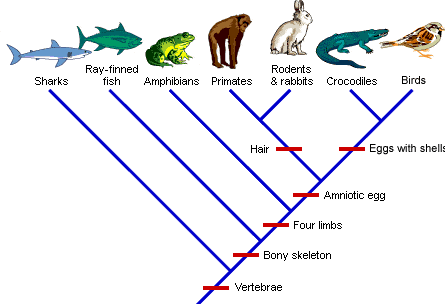
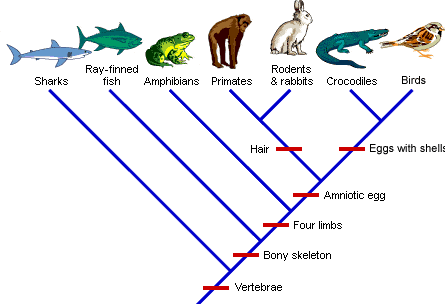
According to this cladogram, sharks are MOST closely related to which organism? 
a)
Amphibians
b)
Ray finned fish
c)
Crocodiles
d)
Birds
42.
According to this cladogram, birds are LEAST related to: 
a)
Amphibians
b)
Sharks
c)
Ray Finned Fish
d)
Crocodiles
43.
What trait separates sharks from ray-finned fish?
a)
Vertebrae
b)
Bony skeleton
c)
Four limbs
d)
None
44.
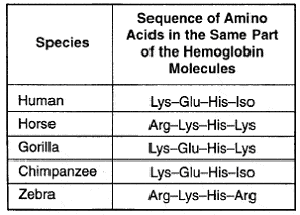
You look at two species and see very similar amino acid sequences. What does this likely tell you?
a)
These are the same animal.
b)
These animals have a common ancestor.
c)
These animals are not likely related.
d)
These animals are likely becoming one species.
45.

Which letter represents the most recent common ancestor of sponges and mushrooms?

a)

A

b)

B

c)

C

d)

D

e)

E

46.

This cladogram shows the evolutionary relationships among some mammals based on homologous structures. Which statement is supported by this cladogram?

a)

Hippopotamuses are more closely related to cows than javelinas

b)

Toothed whales are more closely related to mouse deer than to hippopotamuses

c)

Javelinas and pigs are more closely related than baleen whales and toothed whales

d)

Cows and mouse deer are more closely related than javelinas and pigs

47.

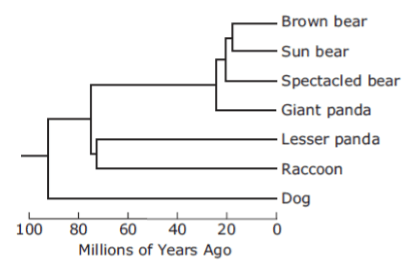
An analysis of DNA and RNA sequences can be used to classify organisms. A dendrogram, such as the one shown below, is based on molecular data. It can be used to represent evolutionary relationships within a group of organisms that are hypothesized to have descended from a common ancestor. Which statement is best supported by the information in this dendrogram?

a)

Lesser pandas are more genetically similar to giant pandas than they are to raccoons

b)

Brown bears are more genetically similar to giant pandas than they are to sun bears

c)

Lesser pandas are more genetically similar to racoons than they are to giant pandas

d)

The bear species are all more genetically similar to dogs than they are to giant pandas

48.

According to this image, which two domains of life are most related?

a)

Bacteria & Archaea

b)

Archaea & Eukarya

c)

Eukarya & Bacteria

49.

What number is the common ancestor of C and D

a)

1

b)

2

c)

3

d)

4

50.

Phylogeny is usually represented by a tree diagram called a _________ - _____

a)

Genetic Line

b)

Phylogenetic Tree

c)

Photographic Queue

d)

Future Babies

51.

Who is the closest relative to the brown bear?

a)

Giant panda

b)

Dog

c)

Lesser panda

d)

Sun bear

52.

Which organism is the most distantly related to all the others?

a)

Raccoon

b)

Dog

c)

Giant Panda

d)

Sun Bear